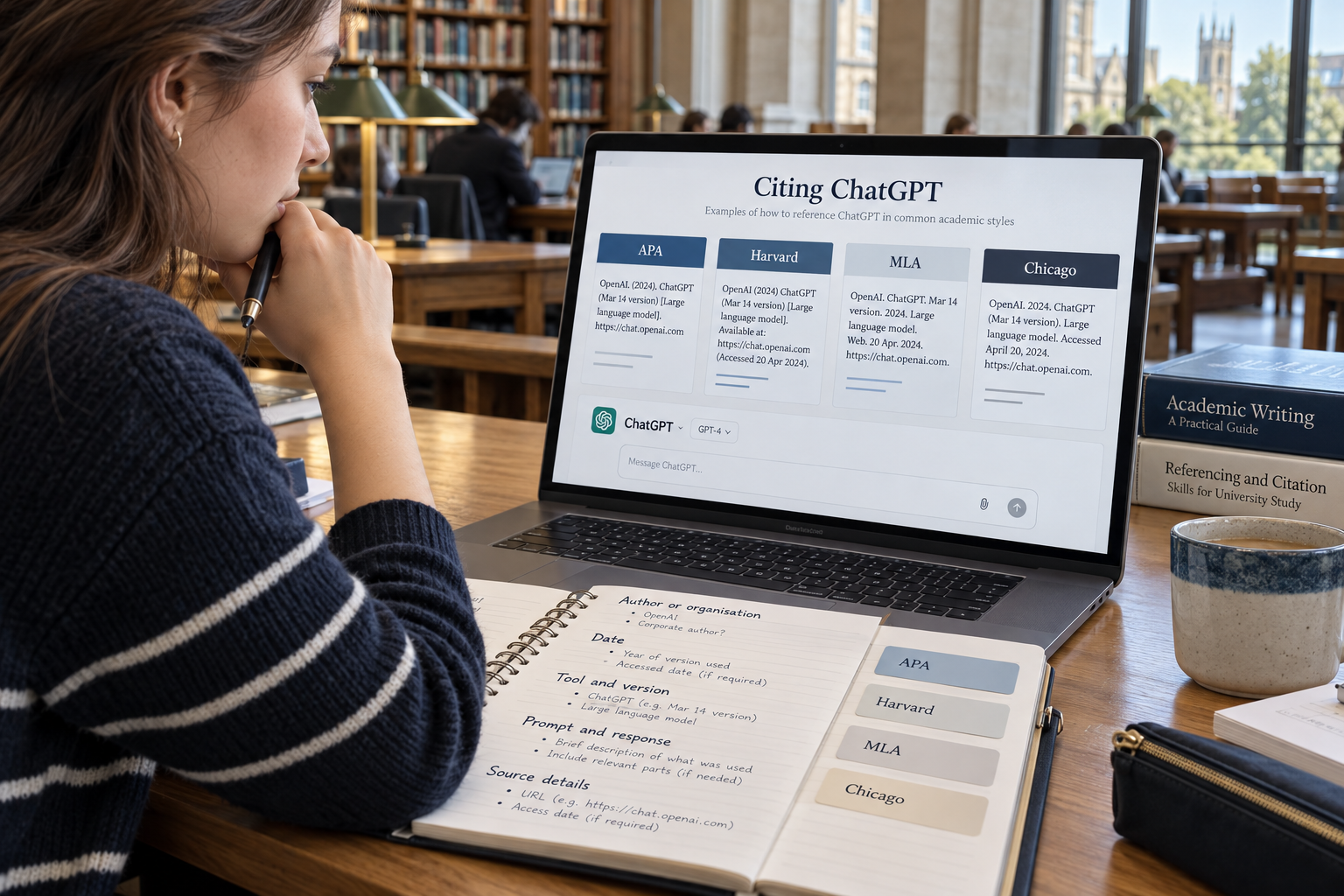
Generative artificial intelligence has become part of the academic workflow for many students. Tools such as ChatGPT, Claude, Gemini, Copilot, and Perplexity may be used to brainstorm questions, explain concepts, summarise material, edit language, generate images, assist with coding, or produce text. Once AI-generated material enters an assignment, however, a new question arises: how should that contribution be acknowledged?
Learning how to cite ChatGPT and AI tools in APA, Harvard, MLA, and Chicago is complicated because the major referencing systems do not treat generative AI in exactly the same way. Guidance has also changed as AI platforms have introduced identifiable models and stable share links to individual conversations. Older citation examples circulating online may therefore no longer reflect current recommendations.
Citation is only one part of responsible AI use. A correctly formatted ChatGPT reference does not make prohibited AI use acceptable, and a citation does not remove the student's responsibility to verify claims, check sources, and follow the assessment's academic-integrity rules. This guide explains the current citation logic, provides practical examples, and distinguishes citation from the broader requirement to disclose how AI contributed to academic work.
Do You Need to Cite ChatGPT and Other AI Tools?
You should consider citation when material generated by an AI tool becomes part of the academic work you submit. This may include quoted AI-generated wording, paraphrased output, a generated image, code, a substantive interpretation, or another output that contributes directly to the assignment. The exact method depends on the required referencing system and your university's AI policy.
AI use that affects the research or writing process may also require acknowledgement even when there is nothing appropriate to cite as a conventional source. For example, a student might use an AI tool to brainstorm search terms, reorganise an outline, or provide language feedback. Some institutions ask students to disclose these uses separately in an acknowledgement, methodology statement, appendix, or AI-use declaration.
This distinction reflects the wider purpose of academic referencing. Epic Essay's guide to academic referencing and source use explains that referencing allows readers to distinguish the writer's contribution from material derived from elsewhere. Generative AI adds another layer because the tool may generate new wording without being a conventional scholarly author.
Citation answers "Where did this material come from?" An AI-use disclosure answers "How did artificial intelligence contribute to the work?" Depending on the assignment, you may need both.
Citing AI Does Not Automatically Make Its Use Permissible
Before worrying about punctuation and reference formats, students should establish whether generative AI is allowed for the particular assessment. Universities can permit AI for one task while restricting it for another, and individual lecturers may specify acceptable uses such as brainstorming, proofreading, coding assistance, or idea generation. Assessment-specific instructions therefore take priority over a generic citation guide.
This point matters because referencing rules and academic-integrity rules perform different functions. A student cannot make prohibited AI-generated writing acceptable simply by adding a citation to ChatGPT. If the assessment prohibits generative AI from drafting text, citing that prohibited text does not remove the underlying breach of the assessment conditions.
Students should also keep an accurate record of their use where required. Saving prompts, outputs, dates, share links, or screenshots may help document what the AI contributed. The level of documentation needed depends on institutional policy, so students should check the module handbook, assessment brief, or university guidance before submission.
A correct AI citation is not permission to use AI. Always check the assessment's AI policy before generating material for submitted academic work.
What Information Should You Record When Using ChatGPT?
AI citation becomes much easier when the necessary information is recorded at the time the tool is used. Unlike a journal article with stable bibliographic metadata, an AI interaction may depend on a specific conversation, model, prompt, generation date, and account interface. If these details are lost, recreating an accurate citation later can be difficult.
The exact elements vary by citation style, but several pieces of information are commonly useful. Students should preserve only what is appropriate to share, because chat histories can contain personal, confidential, unpublished, or sensitive information.
| Information | Why It Matters | Example |
|---|---|---|
| AI company | Identifies the organisation responsible for the tool | OpenAI |
| Tool name | Identifies the application used | ChatGPT |
| Model, if known and required | Some citation systems request the model or version | The model shown in the interface |
| Date generated | Identifies when the particular output was produced | 7 October 2026 |
| Prompt or chat title | Helps readers understand what generated the cited output | Prompt about formative assessment |
| Shareable conversation link | Can allow readers to retrieve the cited interaction | A stable link created by the platform's sharing function |
| Nature of use | May be required for an AI acknowledgement | Brainstorming, editing, summarising, coding, or image generation |
Recording these details does not mean every element belongs in every citation. APA, MLA, Harvard variants, and Chicago organise AI information differently. The benefit of recording it early is that you can later apply the specific rules required by your institution without reconstructing the conversation from memory.
How to Cite ChatGPT in APA 7
APA revised its generative-AI guidance in 2025. Its current approach distinguishes between citing a specific AI chat and referring generally to an AI tool. When generated content from a particular conversation contributes to the work, a specific chat reference provides greater traceability because it can identify the date, chat, tool, and shareable URL.
The current APA Style guidance on citing generative AI uses the AI company as the author and treats an individual shareable conversation as a retrievable source. This is different from many early ChatGPT citation examples, which cited a general version of ChatGPT rather than the individual conversation being used.
A practical APA structure for a specific AI conversation is:
AI Company. (Year, Month Day). Title of chat [Generative AI chat]. Tool or model. Shareable URL
For example, a student using a hypothetical ChatGPT conversation generated on 7 October 2026 could structure the reference as follows: OpenAI. (2026, October 7). Comparing formative and summative assessment [Generative AI chat]. ChatGPT. [Shareable chat URL]. The corresponding parenthetical citation would normally use the corporate author and year: (OpenAI, 2026).
APA In-Text Citation for ChatGPT
APA's author-date logic still applies. A parenthetical citation can identify the AI company and year, while a narrative citation can integrate the company into the sentence. If several AI chats from the same company and year need to be distinguished, students should follow APA's normal rules for differentiating works with identical author-date combinations.
Students already working in APA can review the broader author-date principles in Epic Essay's APA referencing guide. The important AI-specific point is that current guidance gives a specific conversation greater bibliographic value when that conversation itself supplies material used in the paper.
How to Cite ChatGPT in Harvard Referencing
There is no single global Harvard manual. Universities develop their own Harvard variants, so punctuation, access-date requirements, treatment of models, and even the preferred AI reference structure can differ. Students should therefore avoid treating any one online "Harvard ChatGPT citation" as universally correct.
For example, the University of Leeds Harvard guidance for generative AI instructs students to acknowledge AI assistance and to cite and reference AI output when it is incorporated into academic work. It gives a general reference pattern based on the company, year, AI name, version if known, resource type, access date, and URL, preferably using a specific output link when one is available.
A Leeds-style structure can therefore be represented as:
Company. Year. Name of generative AI (version if known). [Generative AI]. [Accessed Day Month Year]. Available from: URL of specific output if available.
An illustrative ChatGPT entry might therefore begin: OpenAI. 2026. ChatGPT. [Generative AI]. [Accessed 7 October 2026]. Available from: [specific share URL]. However, this should be treated as a Harvard example rather than a universal Harvard rule. If your university uses another Harvard variant, follow that institution's prescribed format.
Harvard In-Text Citation for AI
Where the university treats the AI company as a corporate author, the in-text citation follows the institution's normal author-date convention. An illustrative form would therefore be (OpenAI, 2026). The reference-list entry then provides the additional information required by the local Harvard system.
Epic Essay's Harvard referencing examples explain why institutional variation matters across the style generally. AI referencing makes that variation even more important, because universities have adopted different conventions while generative-AI citation practices continue to develop.
How to Cite ChatGPT in MLA 9
MLA updated its generative-AI guidance in August 2025. The MLA Style Center's current AI citation guidance explicitly advises against treating the AI tool as the author. Instead, the entry begins by describing the generated material or the prompt that produced it.
MLA then uses its normal core-elements logic. ChatGPT functions as the container, the model or version is identified as specifically as possible, OpenAI is named as the publisher, the generation date is provided, and a stable shareable conversation URL is preferred. If a stable conversation URL is unavailable, MLA allows a general link to the tool.
A practical MLA pattern is:
"Description of prompt" prompt. ChatGPT, model [model used], OpenAI, Day Month Year, shareable conversation URL.
For example: "Explain the difference between formative and summative assessment" prompt. ChatGPT, model [model used], OpenAI, 7 Oct. 2026, [shareable chat URL]. The corresponding in-text citation is normally derived from the shortened title or description that begins the Works Cited entry rather than from "OpenAI" as though it were a conventional personal author.
Why MLA Does Not Treat ChatGPT as the Author
MLA's approach reflects an important distinction between generating output and accepting scholarly authorship. The citation documents the tool that produced the material without assigning it human-like authorship. The person submitting the academic work remains responsible for evaluating and accurately representing the material.
Students using MLA should also ensure that AI citations fit the structure of the wider Works Cited page. Epic Essay's MLA Works Cited guide explains the core-elements system and the relationship between MLA in-text citations and Works Cited entries.
How to Cite ChatGPT in Chicago Style
Chicago's current guidance is comparatively flexible. The Chicago Manual of Style guidance on AI-generated content states that ChatGPT and similar tools should be credited when their generated text is used. For many contexts, naming the tool clearly in the prose may be sufficient.
When a formal citation is appropriate, Chicago provides a numbered footnote or endnote model. If the prompt is already explained in the surrounding text, the note can identify the generated text, ChatGPT, OpenAI, date, and share URL. If the prompt has not been stated in the text, the note can include the prompt itself.
An illustrative formal Chicago note would be:
1. ChatGPT, response to "Explain the difference between formative and summative assessment," OpenAI, October 7, 2026, [shareable chat URL].
Chicago also advises authors to state when AI-generated material has been edited substantively. Because Chicago offers both Notes and Bibliography and Author-Date systems, students should confirm which system the assignment requires and whether their instructor expects AI material to appear beyond the note itself.
APA vs Harvard vs MLA vs Chicago AI Citations
The four systems share an underlying goal of transparency, but they organise the bibliographic information differently. The comparison below focuses on the current practical distinction students are most likely to encounter when citing generative AI output.
| Style | How AI Is Identified | Typical Citation Location | Important Current Feature |
|---|---|---|---|
| APA 7 | AI company as corporate author | In-text citation plus reference entry | Specific shareable AI chat can be cited as the source |
| Harvard | Depends on institutional variant; often company or organisation | Author-date citation plus reference entry | University-specific guidance takes priority |
| MLA 9 | AI tool is not treated as author | In-text citation plus Works Cited entry | Describe the prompt/output and identify the model when possible |
| Chicago | Tool named directly | Prose acknowledgement or formal note | Formal footnote/endnote can include prompt, company, date, and share URL |
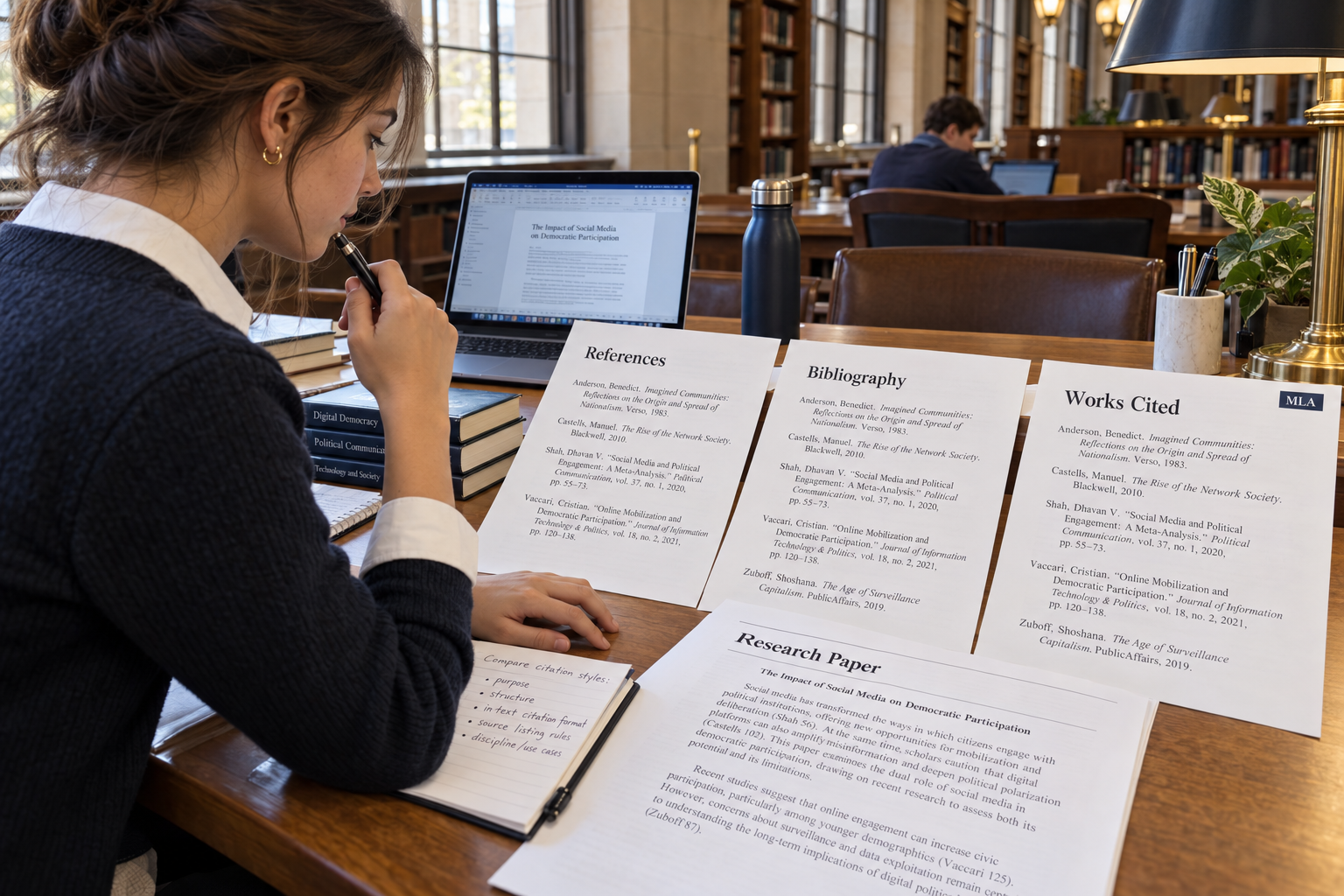
The table demonstrates why copying one ChatGPT citation and simply changing punctuation for another style is unreliable. APA, MLA, and Chicago conceptualise the source differently, while Harvard depends substantially on institutional convention. Students should construct the citation from the rules of the required style rather than from an automated citation generator alone.
How to Cite AI Tools Other Than ChatGPT
The same underlying principles can be applied to tools such as Claude, Gemini, Copilot, and Perplexity, but the company, model, platform, and share-link structure will differ. Students should identify the organisation responsible for the tool and follow the source elements required by their referencing style. They should not automatically replace "ChatGPT" with another product name without checking how the official guidance applies.
MLA, for example, asks writers to identify the AI tool and model as specifically as possible, while current APA guidance can identify both the organisation and the particular tool or model associated with a specific chat. A Harvard institution may prescribe its own format, and Chicago's flexible note structure can name the relevant AI system directly.
Different forms of AI output can also require different treatment. A generated image may need a figure caption and source acknowledgement, while generated code might require explanation in a methodology or appendix in addition to whatever citation the institution requires. The format should reflect both the citation style and the nature of the material being incorporated.
The safest principle is transparency. Record the exact tool used, identify the contribution accurately, and avoid wording that makes AI-generated material appear to have been created independently by the student.
Should You Cite ChatGPT When It Helps You Find Sources?
Using an AI tool to discover a journal article does not normally make the AI response the best source for the academic claim. If ChatGPT, Perplexity, Copilot, or another system points you to an article, open the article, verify that it exists, read the relevant material, and cite the article itself if it actually supports your statement.
This is particularly important because generative AI can produce incorrect bibliographic information, inaccurate summaries, or references that do not exist. Current MLA guidance specifically advises writers to consult sources linked or mentioned by AI directly rather than relying on the AI-generated representation of those sources. The same practice is sensible across referencing systems.
Suppose an AI tool tells you that a 2024 journal article found a statistically significant relationship between two variables. You should not cite the AI response as evidence of that empirical finding when the actual paper can be accessed. Read the study, check the sample, method, analysis, and finding, and then cite the researchers who produced the evidence.
Use AI to help locate evidence if your assessment permits it, but cite the evidence itself after you have read and verified it.
What If ChatGPT Gives You References?
Never transfer AI-generated references directly into an assignment without verification. A citation can look perfectly formatted while containing an invented article, incorrect DOI, wrong page range, false journal title, or inaccurate author information. Correct APA or Harvard punctuation does not make a nonexistent source academically valid.
Each reference should be checked against the original publication, publisher page, DOI record, academic database, library catalogue, or another authoritative source. You should then read the relevant source before relying on it in your argument. This protects the assignment from both fabricated references and inaccurate representations of genuine publications.
The principle applies even when an AI tool provides direct links. A real webpage does not guarantee that the AI's summary of it is accurate. Source evaluation remains the student's responsibility regardless of how the source was discovered.
Never cite an academic article solely because an AI tool supplied its title or DOI. Verify that the publication exists, read it yourself, and confirm that it actually supports the claim you intend to make.
Citation vs AI Acknowledgement: What Is the Difference?
A citation identifies particular material being used as a source. An acknowledgement or declaration describes how an AI system contributed to the process of producing the assignment. These functions can overlap, but one should not automatically be assumed to replace the other.
For example, a student may quote an AI-generated passage and therefore need a citation. The same student may also need to declare that ChatGPT was used to generate and refine that material. Conversely, a student who used an approved AI tool only to suggest alternative keywords for database searches might have no AI-generated statement to cite, yet the university could still require the use to be declared.
A useful AI acknowledgement identifies the tool and explains its function accurately. It might state that a generative AI system was used to brainstorm initial search terms, provide feedback on clarity, or assist with code debugging, followed by confirmation that the student reviewed and verified the final work where appropriate. The precise wording should follow institutional requirements.
| Use of AI | Likely Academic Action | Why |
|---|---|---|
| Directly quoting AI-generated text | Cite the AI and disclose use where required | The generated wording enters the submission |
| Paraphrasing substantive AI output | Cite or acknowledge according to style and university rules | The generated intellectual contribution is being used |
| AI suggests a journal article | Read and cite the original article | The article, not the AI, is the scholarly evidence |
| AI helps brainstorm keywords | Disclosure may be required | The tool influenced the research process without necessarily serving as a source |
| AI proofreads permitted student-written text | Acknowledgement may be required | The use concerns process rather than a conventional cited claim |
| AI generates an image or table | Credit or cite according to the relevant style and policy | The submitted visual was produced using AI |
Because institutional policies differ, the table should be treated as a decision framework rather than permission to use AI. Assessment instructions remain the controlling requirement.
Should You Put Your AI Prompt in an Appendix?
Some universities ask students to preserve or submit the prompts used with generative AI. An appendix can be useful when full prompts and outputs would interrupt the main argument but transparency about the interaction is academically necessary. Other institutions use dedicated AI declaration forms rather than dissertation appendices.
A shareable conversation URL may reduce the need to reproduce every exchange, particularly in citation styles that now recognise stable chat links. However, share links can expose everything contained in the shared conversation. Students should check carefully for confidential, personal, commercially sensitive, or unpublished material before creating a public link.
Where the institution requests full evidence of AI use, students should follow that requirement even if the citation style itself needs only a short reference. Citation rules determine bibliographic presentation; university policy determines what evidence of AI use must accompany the assessment.
If no appendix or disclosure mechanism is specified, ask whether the AI interaction is important enough for readers to understand the research or writing process. For substantial methodological use, transparent explanation is usually more informative than a citation alone.
Common Mistakes When Citing ChatGPT and Generative AI
One common mistake is using obsolete examples. Early ChatGPT citation guides often relied on generic product URLs and dated software-version descriptions because stable chat links and later citation guidance did not yet exist. Students should check the publication or update date of any AI citation advice they use.
A second mistake is assuming that all four major citation styles work identically. MLA does not recommend treating the AI system as the author, whereas current APA examples use the AI company as the corporate author. Harvard depends on institutional rules, and Chicago's current formal example is designed as a note.
A third mistake is citing ChatGPT instead of the original scholarly evidence. If an AI response summarises a published article, policy document, statistical dataset, or theory that you can access directly, the stronger academic practice is to consult and cite that source. The AI should not become an unnecessary intermediary between your argument and verifiable evidence.
Finally, students sometimes assume that acknowledgement removes the need for verification. It does not. You remain responsible for the accuracy of claims, calculations, citations, quotations, and references included in your submission, regardless of whether they originated from an AI tool.
A Step-by-Step Checklist for Citing AI in Academic Work
A reliable workflow begins before the assignment is written. By checking permissions and recording AI interactions as they occur, students can avoid reconstructing citations immediately before submission and can distinguish more clearly between AI output and genuine scholarly evidence.
Use the following process:
- Check whether generative AI is permitted for the assessment.
- Identify which uses are allowed and which are prohibited.
- Record the AI company, tool, model if known, date, prompt, and relevant output.
- Create a stable share link where appropriate and safe.
- Determine whether the AI output itself appears in the submitted work.
- Check whether your university requires a separate AI-use declaration.
- Apply the current rules for APA, Harvard, MLA, Chicago, or the required style.
- If the AI provides academic sources, locate and read those sources directly.
- Verify every factual claim, quotation, calculation, DOI, and reference generated by AI.
- Keep citations and AI acknowledgements consistent with the actual use of the tool.
- Remove confidential information before sharing any AI conversation.
- Perform a final check against the official style guide and assessment instructions.
This process treats AI citation as part of source evaluation rather than as a last-minute formatting exercise. It also creates a clearer evidence trail if a lecturer asks how artificial intelligence contributed to the submitted work.
How to Cite ChatGPT and AI Tools Responsibly
Knowing how to cite ChatGPT and AI tools in APA, Harvard, MLA, and Chicago requires understanding both the citation style and the nature of the AI interaction. APA's current approach can cite a specific shareable chat using the company as corporate author, MLA begins with a description of the generated content rather than treating AI as an author, Chicago provides a flexible note-based approach, and Harvard formatting depends on the university's local system.
The more important academic principle is transparency. Students should distinguish AI-generated material from original academic evidence, disclose AI assistance when required, preserve enough information to document substantial use, and verify any scholarly sources suggested by AI before citing them. A polished citation cannot compensate for fabricated evidence or prohibited use.
When in doubt, begin with the assessment instructions, then consult the current official citation guidance rather than an old online example. Use AI citations only where they accurately describe the material incorporated into the work, cite original research whenever it is available, and make the student's own intellectual responsibility unmistakable. That combination of correct formatting, verification, and transparent disclosure provides the strongest foundation for responsible AI use in university writing.


Comments