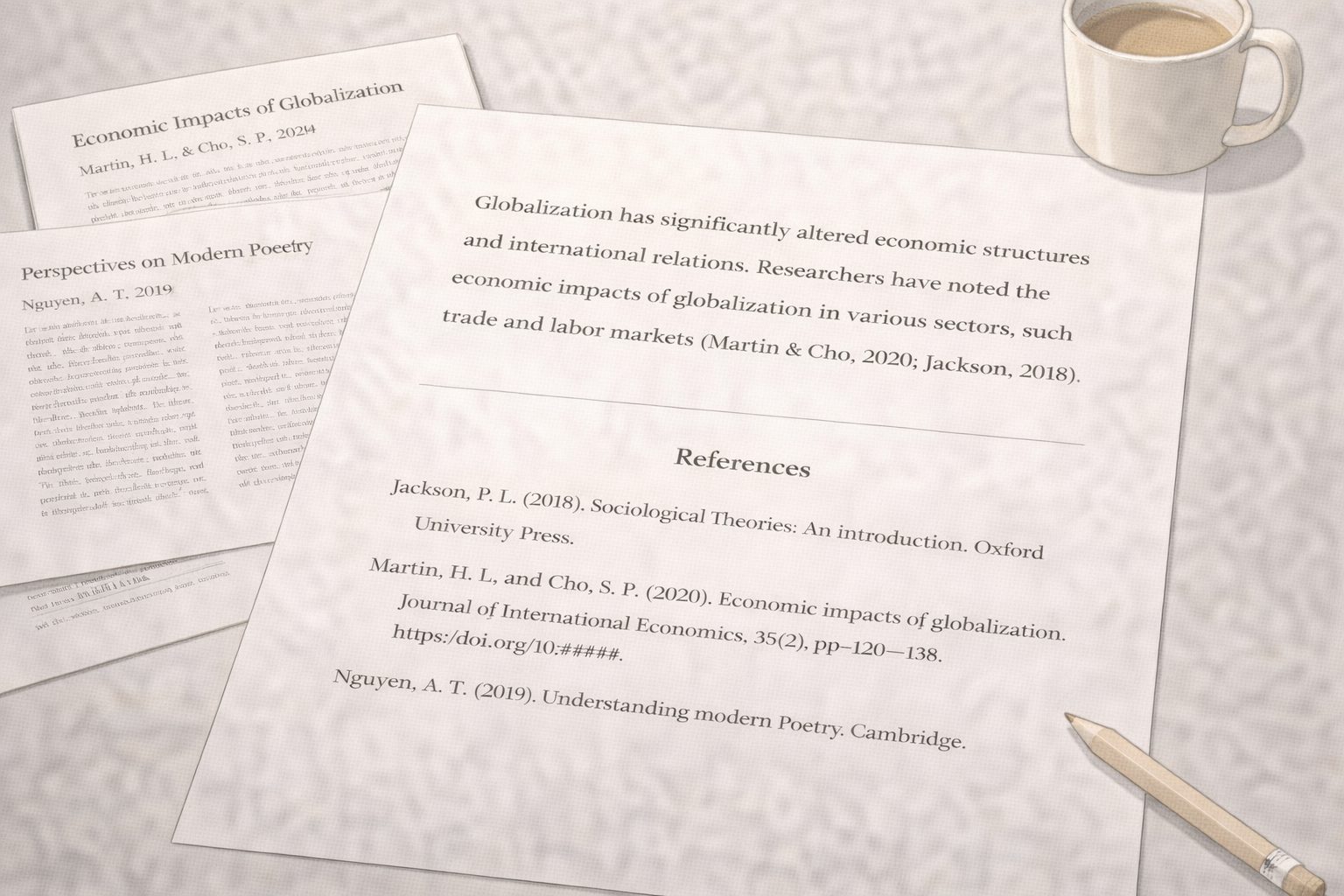
APA referencing is a core academic skill for students in disciplines such as psychology, education, business, health sciences, and parts of the social sciences. While it is often treated as a technical formatting exercise, APA referencing reflects deeper academic expectations about evidence use, research credibility, and scholarly integrity.
Many students lose marks not because their ideas are weak, but because APA conventions are applied inconsistently or incorrectly. This guide explains APA referencing from first principles, clarifying how it works, why it matters, and how to apply it accurately in real university assignments.
What APA Referencing Is and Why Universities Use It
APA referencing is a citation system developed by the American Psychological Association to standardise how academic sources are acknowledged. Its emphasis on author names and publication dates reflects the importance of recent research and evidence-based knowledge in scientific and applied disciplines.
Universities adopt APA referencing to ensure consistency, transparency, and academic accountability. When used correctly, it allows readers to identify the source, assess its credibility, and locate it efficiently.
APA is not simply a formatting preference. It is a disciplinary convention that signals how knowledge is evaluated and communicated.
Key academic principle: In APA referencing, the publication year is central because currency of research matters.
The Two Core Components of APA Referencing
APA referencing always consists of two connected elements: in-text citations and a reference list. Both must be present and must correspond exactly.
In-text citations appear within the body of the assignment and show where external sources are used. The reference list appears at the end and provides full publication details.
Missing or mismatched citations are among the most common reasons for lost marks.
APA In-Text Citations Explained
APA in-text citations follow the author–date system. This allows readers to identify the source quickly and link it to the reference list.
The basic format includes the author’s surname and the year of publication. Page numbers are required for direct quotations but optional for paraphrasing.
Basic APA In-Text Citation Formats
- Paraphrase: (Smith, 2021)
- Direct quote: (Smith, 2021, p. 45)
- Narrative citation: Smith (2021) argues that…
Consistency in punctuation and spacing is essential, as even minor deviations are noticeable to markers.
How Many Authors to Include in APA Citations
APA rules change depending on the number of authors. These distinctions are frequently misunderstood by students.
For works with one or two authors, both names appear every time the source is cited. For works with three or more authors, “et al.” is used from the first citation.
| Number of Authors | In-Text Citation Format |
|---|---|
| One author | (Taylor, 2020) |
| Two authors | (Taylor & Brown, 2020) |
| Three or more authors | (Taylor et al., 2020) |
Applying the wrong author format is a common APA error.
The APA Reference List: Structure and Ordering
The reference list provides full details of every source cited in the text. It appears on a new page at the end of the assignment and is titled “References.”
Entries are arranged alphabetically by the surname of the first author. All sources cited in the text must appear in the reference list, and no uncited sources should be included.
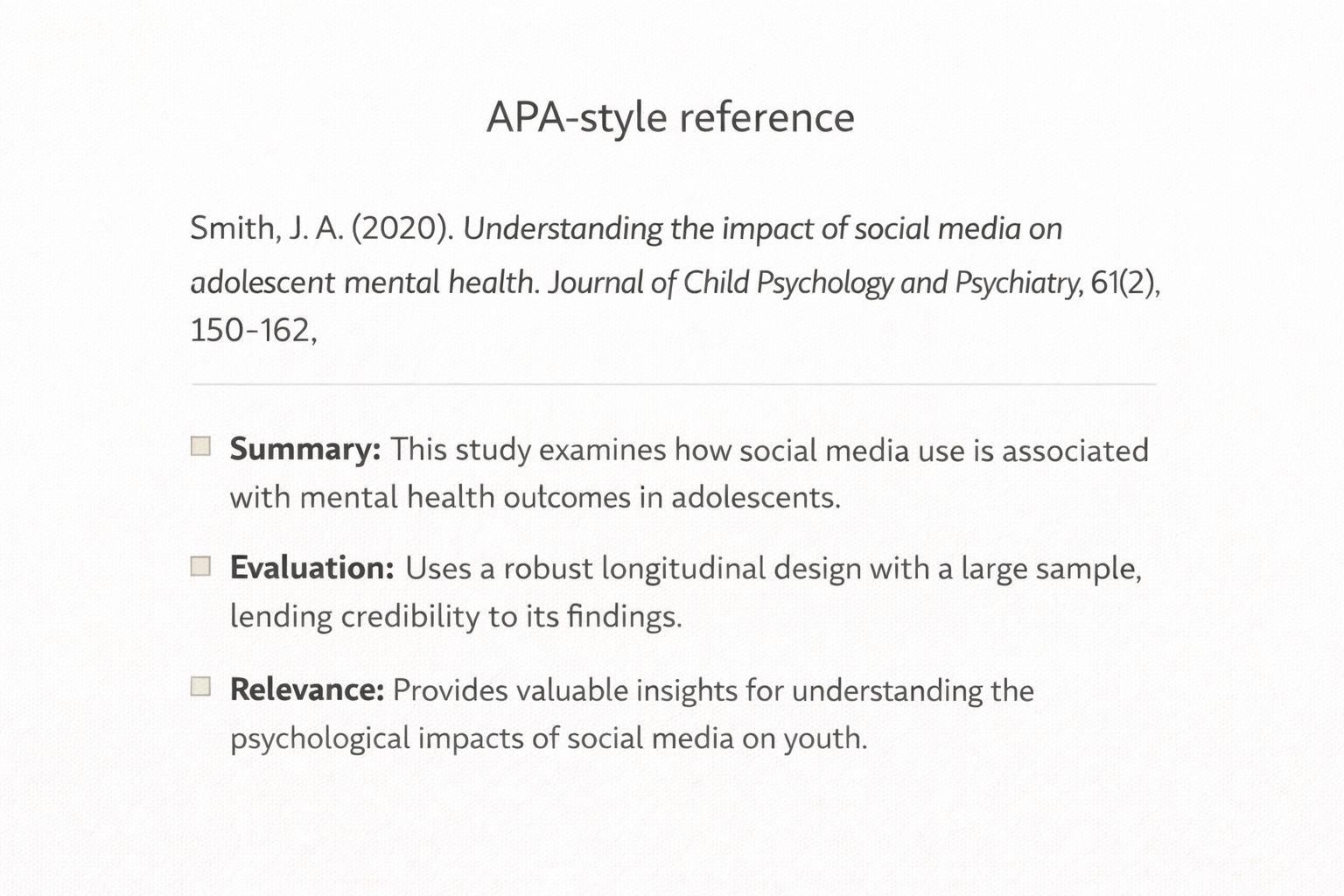
APA reference entries follow a strict order: author, year, title, and source information.
Formatting Books in APA Referencing
Books are common academic sources, especially for theoretical frameworks and foundational concepts.
In APA style, book titles appear in italics and sentence case. Only the first word and proper nouns are capitalised.
Place of publication is no longer required in recent APA editions, a change that still confuses many students.
Formatting Journal Articles in APA Referencing
Journal articles are central to APA-referenced disciplines because they represent peer-reviewed research.
APA requires the journal title and volume number to be italicised, while the article title remains in sentence case.
Digital Object Identifiers (DOIs) should be included where available.
Using DOIs and URLs Correctly in APA
DOIs provide permanent links to academic articles and are preferred over URLs.
If a DOI is available, it should be presented as a clickable link. URLs should only be used when a DOI does not exist.
Long or unstable URLs should be avoided where possible.
APA Referencing for Websites and Online Reports
Web-based sources must be treated carefully to ensure credibility.
APA references for websites require the author (or organisation), year, page title, and URL. Retrieval dates are generally unnecessary unless content is designed to change over time.
Students should prioritise institutional and academic websites over blogs or commercial sources.
Paraphrasing and APA Referencing
Paraphrasing does not eliminate the need for citation. In APA style, paraphrased material must still include an author–date reference.
Effective paraphrasing involves restructuring ideas rather than simply replacing words.
Overly close paraphrasing can still be considered plagiarism.
Critical warning: Changing wording without citing the source is plagiarism under APA standards.
Direct Quotations in APA Style
Direct quotations should be used sparingly and purposefully.
Short quotations are enclosed in quotation marks, while longer quotations (40 words or more) are presented as block quotes.
Page numbers are mandatory for all direct quotations.
Common APA Referencing Mistakes Made by Students
APA errors often stem from inattention to detail rather than misunderstanding.
- Incorrect use of italics
- Missing DOIs
- Inconsistent capitalisation
- Mismatched in-text citations and references
- Using outdated APA rules
Careful proofreading significantly reduces these issues.
APA Formatting Beyond Referencing
APA style also governs document formatting, including headings, margins, line spacing, and font choices.
Although this guide focuses on referencing, students should remember that APA is a comprehensive style system.
Ignoring formatting rules can affect presentation marks.
Using APA Style Guides and Official Resources
The APA Publication Manual is the authoritative source for APA rules.
University libraries often provide summarised APA guides tailored to student assignments.
Relying on unofficial online examples can lead to errors.
Reference Management Tools and APA
Reference management software can support APA referencing, but it is not foolproof.
Automatically generated references often contain formatting errors that must be corrected manually.
Students remain responsible for accuracy.
APA Referencing and Academic Assessment
Referencing accuracy is frequently embedded within marking criteria.
Strong APA referencing signals careful research and academic professionalism.
Poor referencing can undermine otherwise strong analytical work.
Developing Confidence with APA Referencing
APA referencing becomes easier with consistent practice and feedback.
Students who understand the logic behind APA rules are better equipped to apply them accurately.
Confidence grows when referencing is treated as part of academic thinking, not a last-minute technical task.
Applying APA Referencing Consistently Across Assignments
Consistency is more important than perfection. Minor errors are less damaging than inconsistent application of rules.
Establishing a systematic approach to referencing saves time and reduces stress.
Over time, APA conventions become familiar rather than intimidating.
APA Referencing as an Academic Skill, Not a Barrier
APA referencing supports clarity, transparency, and scholarly dialogue.
When mastered, it strengthens academic writing rather than complicating it.
Students who invest time in learning APA referencing gain a transferable academic skill that supports long-term success.
Comments