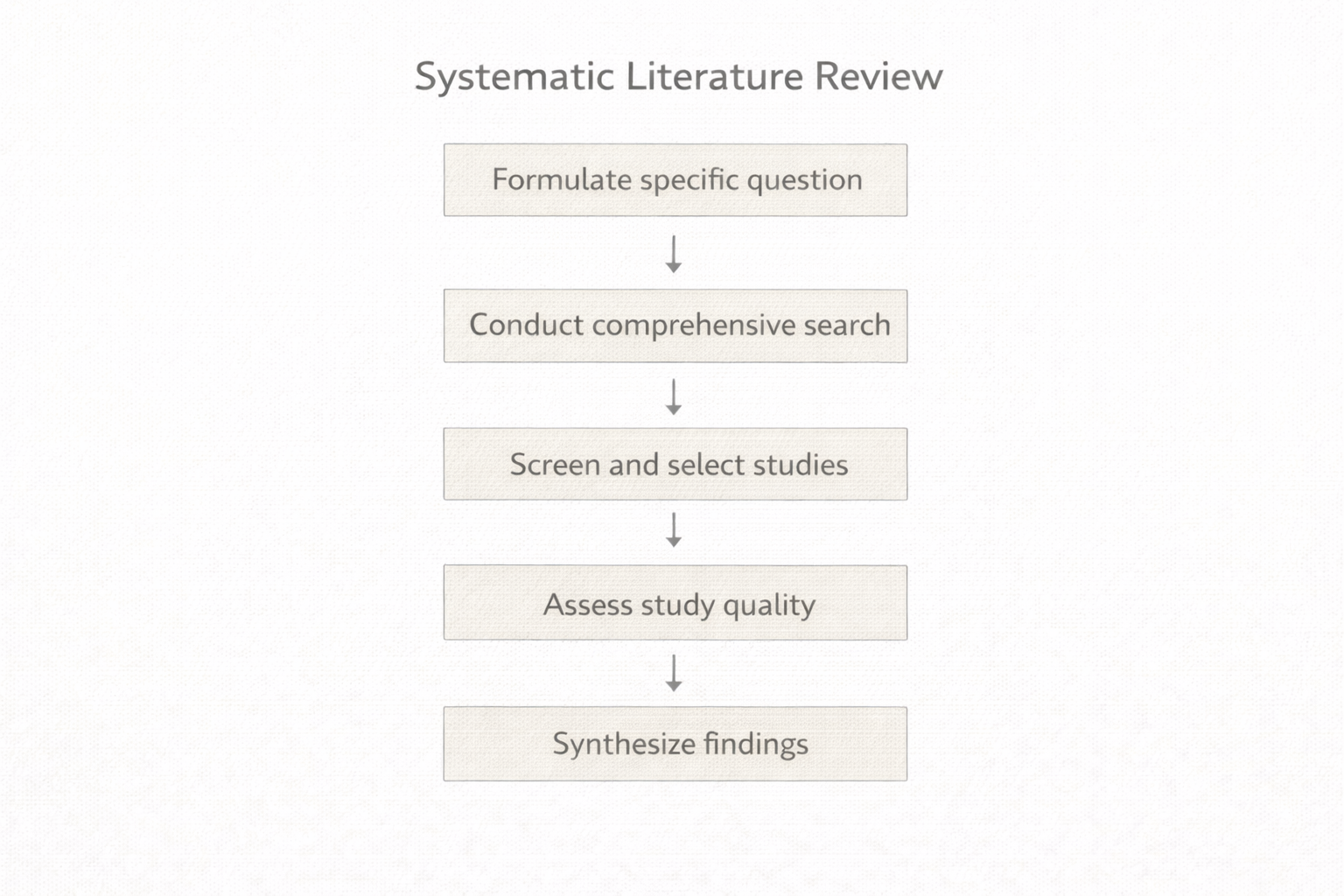
A systematic literature review is one of the most rigorous forms of academic evidence synthesis. Unlike narrative or traditional literature reviews, it follows a clearly defined, replicable process designed to identify, evaluate, and synthesise all relevant studies on a specific research question. Because of this methodological precision, systematic reviews are widely used in dissertations, theses, and postgraduate research.
Despite their growing importance, many students struggle with systematic literature reviews because they are process-driven rather than purely analytical. Common challenges include defining an appropriate research question, managing large volumes of sources, and documenting decisions transparently. These difficulties often lead to confusion between systematic and traditional review approaches.
This article explains the systematic literature review steps in detail. It provides a clear, sequential framework that students can follow confidently, ensuring methodological rigour, academic credibility, and compliance with university assessment criteria.
What Makes a Literature Review Systematic
A systematic literature review is defined by its structured methodology rather than by topic or discipline. Its primary aim is to reduce subjectivity by using explicit procedures for searching, selecting, and analysing literature.
Unlike narrative reviews, which may selectively discuss studies, systematic reviews attempt to identify all relevant evidence that meets predefined criteria. This comprehensive approach strengthens reliability and transparency.
A review is systematic when its process is explicit, reproducible, and justified at every stage.
This definition underpins every step of the systematic literature review process.
Step 1: Defining a Clear and Focused Research Question
The first step in a systematic literature review is developing a precise research question. This question determines the scope of the review and guides every subsequent decision, from database selection to inclusion criteria.
Systematic review questions are typically narrow and specific. Broad or vague questions lead to unmanageable search results and weaken methodological clarity.
Frameworks such as population–phenomenon–context or intervention–comparison–outcome are often used to structure research questions, particularly in applied and health-related disciplines.
Step 2: Developing a Review Protocol Before Searching
A review protocol is a formal plan that outlines how the systematic review will be conducted. It documents decisions made in advance to prevent bias during the review process.
The protocol typically specifies the research question, databases to be searched, keywords, inclusion and exclusion criteria, and planned methods of analysis. In postgraduate research, including a protocol demonstrates methodological maturity.
Although protocols may be revised if justified, changes must be documented transparently.
Step 3: Identifying Appropriate Databases and Sources
Systematic literature reviews rely on comprehensive and strategic searching. Selecting appropriate academic databases is essential to capturing relevant literature.
Database choice depends on discipline, but reviews often combine multiple databases to avoid publication bias. Grey literature such as reports or theses may also be included where appropriate.
Limiting searches to a single database is a common methodological weakness and should be avoided.
Step 4: Designing a Systematic Search Strategy
A systematic search strategy translates the research question into searchable terms. This involves identifying keywords, synonyms, and controlled vocabulary where applicable.
Boolean operators are used to combine terms logically, ensuring both sensitivity and specificity in search results. Search strings should be tested and refined iteratively.
Documenting search strategies is essential, as it allows the review process to be replicated and evaluated.
Step 5: Applying Inclusion and Exclusion Criteria
Inclusion and exclusion criteria determine which studies are eligible for review. These criteria must be defined before screening begins to reduce selection bias.
Criteria commonly relate to publication date, language, study design, population, and relevance to the research question. Applying criteria consistently strengthens the credibility of the review.
Changing inclusion criteria mid-review without justification undermines methodological integrity.
Clear criteria also improve efficiency when screening large numbers of sources.
Step 6: Screening Studies Systematically
Screening usually occurs in two stages: title and abstract screening followed by full-text screening. At each stage, studies are assessed against inclusion criteria.
This step requires careful documentation of reasons for exclusion. Many systematic reviews use flow diagrams to show how studies were filtered.
Transparent screening decisions allow examiners to assess the rigour of the review process.
Step 7: Assessing the Quality of Included Studies
Quality appraisal evaluates the methodological strength of included studies. This step distinguishes systematic reviews from simple literature summaries.
Quality criteria vary by discipline but often include study design, sample size, data collection methods, and potential bias. Weaker studies may be excluded or weighted differently.
Critically appraising quality strengthens the validity of synthesis and conclusions.
Step 8: Extracting Data Systematically
Data extraction involves systematically recording relevant information from each included study. This ensures consistency and reduces the risk of selective reporting.
Extraction tables typically include author details, study aims, methodology, key findings, and limitations. Using a standardised extraction format improves accuracy.
The table below illustrates typical data extraction elements.
| Element | Description | Purpose |
|---|---|---|
| Study details | Author, year, location | Source identification |
| Research aim | Study objectives | Relevance assessment |
| Methodology | Design and methods | Quality evaluation |
| Key findings | Main results | Synthesis foundation |
| Limitations | Reported weaknesses | Critical analysis |
Accurate extraction supports reliable synthesis.
Step 9: Synthesising the Evidence
Synthesis is the analytical core of a systematic literature review. Rather than summarising studies individually, synthesis integrates findings across studies.
Synthesis may be narrative, thematic, or quantitative depending on the nature of the data. The goal is to identify patterns, agreements, contradictions, and gaps.
Clear synthesis demonstrates analytical depth and research insight.
Step 10: Reporting the Review Transparently
Transparent reporting is essential to systematic review credibility. Readers must be able to trace how decisions were made at each stage.
This includes documenting search strategies, screening processes, quality appraisal methods, and synthesis approaches. Transparency allows the review to be evaluated and replicated.
In dissertations, this information is often reported in a dedicated methodology section.
Common Mistakes in Systematic Literature Review Steps
One common mistake is treating a systematic review as an expanded narrative review. Without explicit methods, the review loses its systematic nature.
Another frequent issue is inadequate documentation, where decisions are made but not reported. This weakens academic credibility.
Avoiding these mistakes requires planning and consistent record-keeping.
How Systematic Review Steps Differ by Academic Level
At undergraduate level, systematic reviews are often simplified, focusing on transparency rather than exhaustive coverage. However, the core steps remain the same.
Postgraduate systematic reviews require greater depth, more extensive searching, and formal quality appraisal. Doctoral reviews demand comprehensive synthesis and original contribution.
Understanding these expectations helps students scale their review appropriately.
Using Systematic Literature Review Steps as a Research Skill
Beyond assessment, systematic literature review skills are valuable for academic and professional research. They support evidence-based decision-making and critical evaluation.
Mastering these steps develops research discipline, analytical thinking, and methodological confidence.
These skills are transferable across research contexts and disciplines.
Applying Systematic Literature Review Steps with Academic Confidence
A systematic literature review is a structured intellectual process, not a mechanical checklist. Each step contributes to the overall rigour and credibility of the research.
By following clearly defined steps and documenting decisions transparently, students can produce systematic reviews that meet university standards and support strong academic outcomes.
When executed correctly, systematic literature review steps transform large bodies of literature into coherent, defensible academic knowledge.

Comments