
One of the most common questions students ask during the dissertation process concerns thesis word count. Graduate students often want to know how long their thesis should be, how universities calculate word limits, and how the total word count should be distributed across different sections of the dissertation.
Unlike short essays or assignments, a thesis is a complex research project that can span tens of thousands of words. However, universities usually provide specific word count ranges to ensure that the research remains focused and academically rigorous. Understanding these expectations early helps students plan their writing process effectively and avoid exceeding institutional limits.
This guide explains typical thesis word count requirements, which sections are included in the count, and how students can structure their dissertation to meet academic expectations.
Typical Thesis Word Count by Degree Level
The required word count for a thesis varies depending on the academic level of the degree program and the specific requirements of the university. Master's theses and doctoral dissertations differ significantly in length because doctoral research typically involves more extensive theoretical development and original contribution.
The following table provides a general overview of common thesis word count ranges across different degree levels.
| Degree Level | Typical Word Count Range | Research Scope |
|---|---|---|
| Bachelor’s Thesis | 8,000 – 15,000 words | Focused research project demonstrating academic research skills |
| Master’s Thesis | 15,000 – 40,000 words | Advanced research with critical literature analysis |
| Doctoral Dissertation | 70,000 – 100,000+ words | Original research contributing new knowledge to the field |
These ranges are only general guidelines. Individual universities may impose stricter limits or define specific expectations for each section of the thesis.
What Is Included in the Thesis Word Count?
Students often assume that every part of the dissertation contributes to the word count, but this is not always the case. Most universities only include the main body of the thesis when calculating the word limit.
Typically, the following sections are included in the thesis word count:
- The introduction
- The literature review
- The research methodology
- The results and analysis chapters
- The discussion chapter
- The conclusion
However, several sections are usually excluded from the official count. These may include the abstract, acknowledgements, references, appendices, and tables.
Because requirements vary across institutions, students should always confirm the specific rules outlined in their university's thesis guidelines.
Always verify whether references, appendices, and tables are included in the thesis word count according to your university’s regulations.
How to Distribute Word Count Across Thesis Chapters
Understanding the total word count is only the first step in effective thesis planning. Students must also distribute that word count appropriately across different chapters to ensure that each section receives adequate attention.
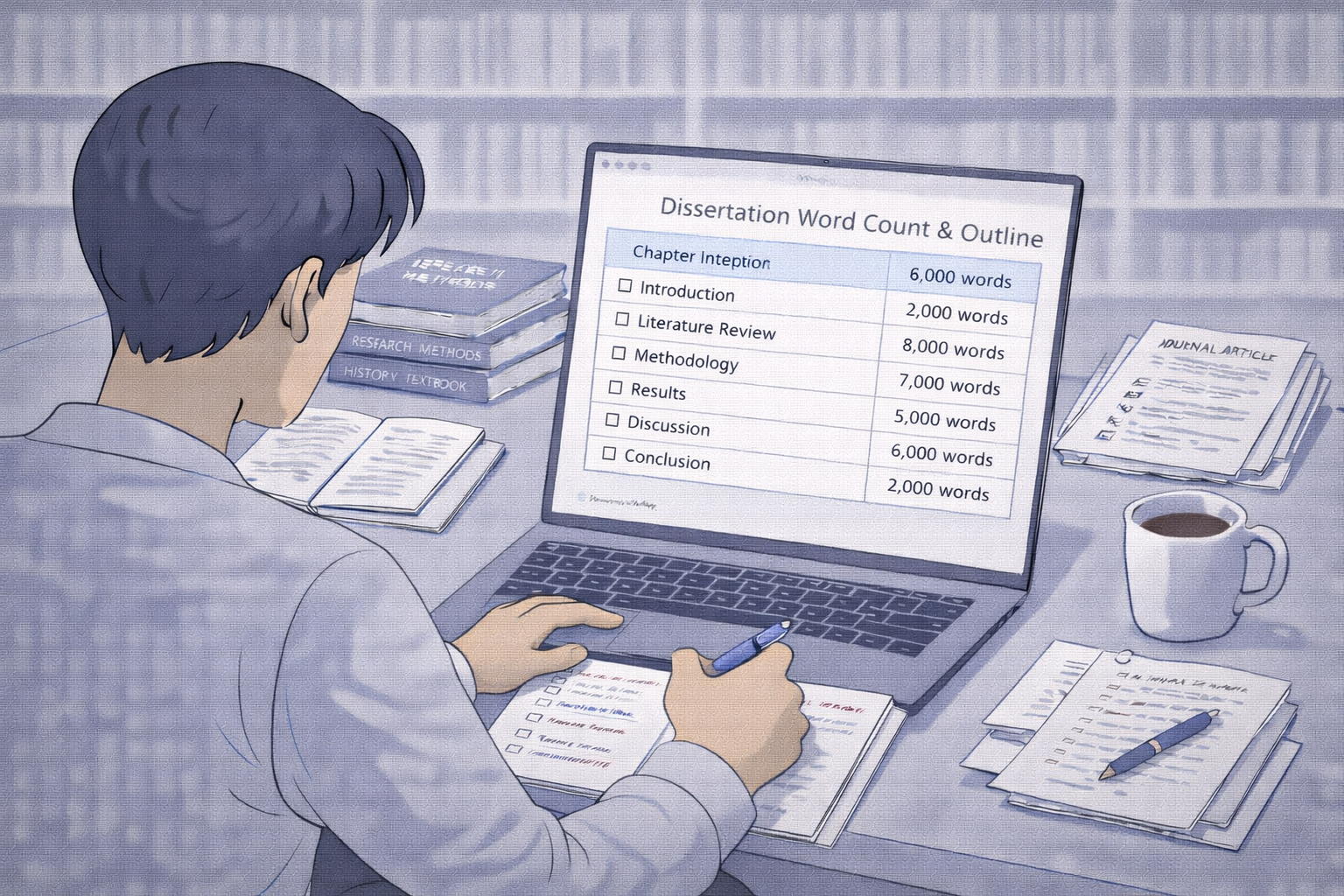
The distribution of words depends on the discipline and research methodology, but many theses follow a structure similar to the one shown below.
| Chapter | Suggested Word Count | Purpose |
|---|---|---|
| Introduction | 2,000 – 3,000 | Introduce research topic, objectives, and context |
| Literature Review | 5,000 – 6,000 | Critically analyse existing research |
| Methodology | 3,000 – 4,000 | Explain research design and methods |
| Results / Analysis | 4,000 – 5,000 | Present research findings |
| Discussion | 3,000 – 4,000 | Interpret results and link to literature |
| Conclusion | 1,000 – 2,000 | Summarise findings and implications |
This distribution helps maintain balance throughout the dissertation and ensures that key sections such as the literature review and methodology receive appropriate depth.
Why Thesis Word Count Limits Matter
Universities impose word count limits to ensure that students communicate their research concisely and effectively. Academic writing values clarity and precision, and excessive length can sometimes weaken the overall argument of the thesis.
Word limits encourage students to focus on the most relevant evidence, construct clear arguments, and avoid unnecessary repetition. A well structured thesis does not simply meet the required word count but uses the available space strategically to develop a coherent argument.
Students who struggle to organize their ideas within the required limits sometimes review examples or seek structured academic support. Services such as professional thesis writing support can help students refine their arguments and structure their research effectively.
Strategies for Managing Your Thesis Word Count
Managing a large research project requires careful planning. Without a clear writing strategy, students may find themselves exceeding the word limit or struggling to complete their thesis within the required length.
Several strategies can help students manage their thesis word count effectively:
- Create a chapter outline before beginning the writing process.
- Assign approximate word counts to each chapter.
- Focus on answering the research question directly.
- Remove redundant explanations during editing.
- Use tables or figures to present complex information efficiently.
Following these strategies helps ensure that each chapter contributes meaningfully to the overall research argument.
Common Mistakes Students Make with Thesis Length
Many students struggle to balance depth and conciseness when writing a thesis. Understanding common mistakes related to thesis word count can help students avoid these issues.
Some of the most frequent mistakes include:
- Writing an excessively long literature review
- Repeating similar arguments in multiple chapters
- Including unnecessary background information
- Failing to edit drafts for clarity and conciseness
Editing plays a crucial role in managing thesis length. After completing the initial draft, students should review the document carefully to identify sections that can be condensed or clarified.
Many graduate students refine their final dissertation using academic proofreading services, which help ensure that the thesis remains clear, concise, and professionally written.
A strong thesis is not defined by its length but by the clarity and strength of its academic argument.
Planning Your Thesis Word Count for Academic Success
Understanding thesis word count requirements is an essential part of the dissertation planning process. By knowing how long a thesis should be and how to distribute words across chapters, students can structure their research more effectively.
Rather than focusing solely on meeting a numerical word limit, students should aim to develop clear arguments supported by relevant evidence. Effective academic writing balances depth of analysis with clarity and conciseness.
When students plan their thesis carefully, distribute word counts strategically, and revise their drafts thoroughly, they can produce a well structured dissertation that meets academic expectations while presenting their research in a compelling and professional manner.


Comments