Academic reports are structured to communicate findings, arguments, and evidence clearly and efficiently. Alongside standard sections such as the introduction, literature review, methodology, and conclusion, many reports include one or more appendices — a specialised component that helps balance depth with readability. Understanding what a report appendices is and how it functions is an important skill for university students, particularly in disciplines where evidence and data are central to assessment.
Appendices are not decorative or optional add-ons; they serve a clear academic purpose. Yet many students struggle with when and how to use appendices effectively. Misuse — such as placing essential analysis in an appendix or failing to reference appendix content in the main text — can weaken assessment outcomes and signal a lack of academic rigor.
This article explains in depth what appendices are, why they are used in reports, what content is appropriate, and how to format and reference appendices correctly so that they strengthen, rather than weaken, your academic work.
Defining an Appendices in a Report
An appendices (plural: appendices) in a report refers to one or more sections placed after the main body and reference list that contain supplementary material. This material supports the arguments, data, or methods discussed in the main report, but is too detailed, extensive, or technical to be included in the core discussion. Appendices are referenced in the main text so readers know where to find additional information if they want to explore it further rather than be distracted by it in the primary narrative.
In academic contexts, an appendices differs from the main body precisely because it contains supporting documentation rather than essential analysis. Examiners use appendices as evidence that the writer has followed rigorous research and documentation practices, not as the primary source of argumentation. :contentReference[oaicite:0]{index=0}
Importantly, appendices are not a way to bypass word limits by storing core text outside the page count. If the material is central to the report’s argument, it must appear in the main body. :contentReference[oaicite:1]{index=1}
Academic rule: Appendices contain relevant but non-essential material that supports the report; they should never replace core argument, analysis, or interpretation.
Why Reports Use Appendices
Reports often involve extensive data collection, detailed methods, technical instruments, or large datasets. Including all this material in the main body can overwhelm readers or distract from the report’s central findings and conclusions.
Appendices solve this problem by housing the supporting material separately. This supports academic clarity by keeping the main text focused, while still making evidence accessible for verification, replication, or deeper study. In this way, appendices contribute to methodological transparency and academic integrity. :contentReference[oaicite:2]{index=2}
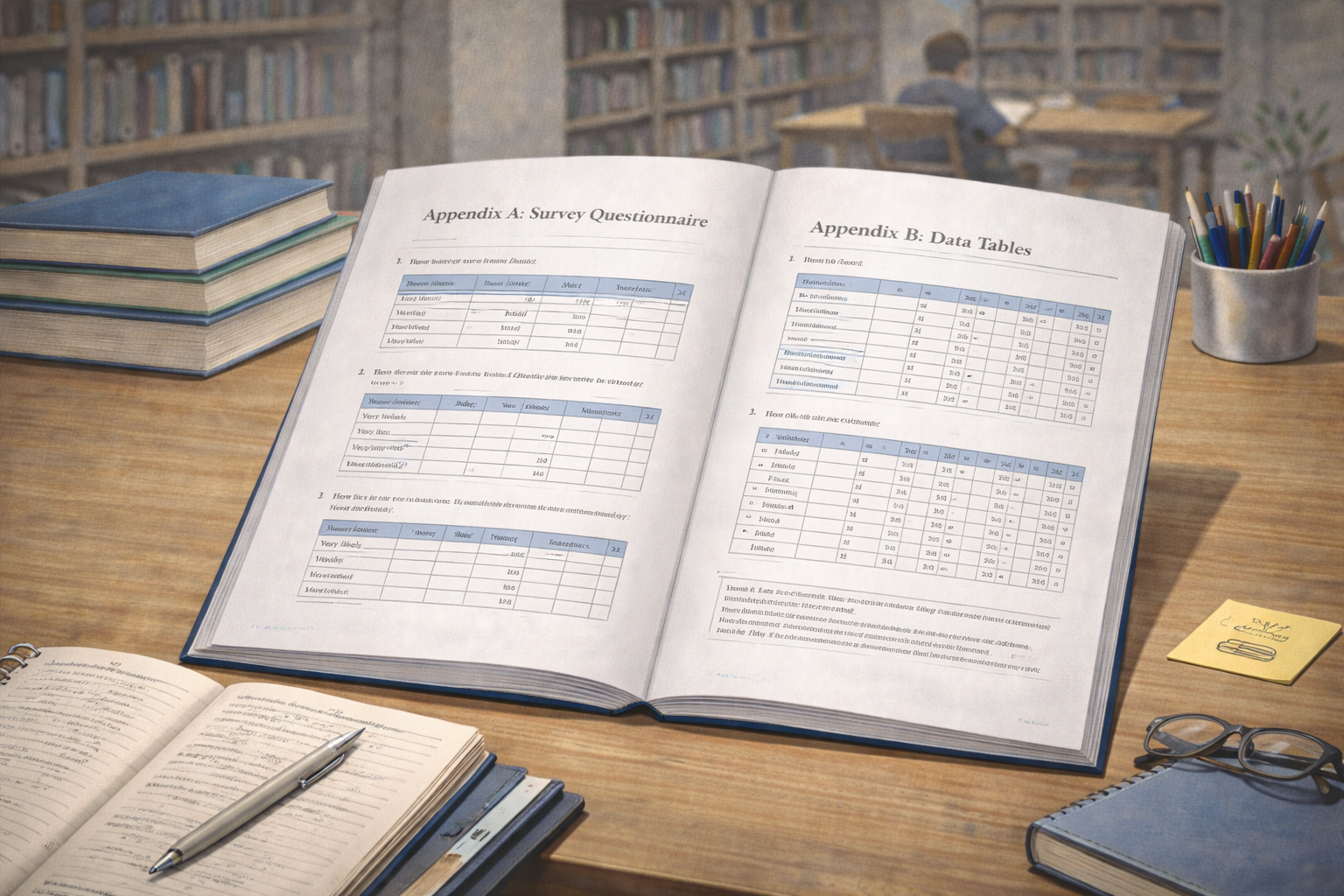
For example, if a report describes a survey instrument used to collect data, the main text might summarise the instrument’s design and purpose, while the full questionnaire appears in the appendices. This allows readers to evaluate the instrument without cluttering the narrative. :contentReference[oaicite:3]{index=3}
Similarly, raw or extended data tables are often placed in appendices so that the report can focus on interpreting trends rather than presenting undigested numbers. :contentReference[oaicite:4]{index=4}
Examples of What Belongs in an Appendices
Understanding what belongs in an appendices helps prevent common misuse, such as including analysis that should be in the main text or adding irrelevant material that distracts from the report’s purpose.
The following categories represent common and academically appropriate content for appendices in reports:
- Data collection instruments (e.g., survey questionnaires, interview guides)
- Raw or supplementary data (e.g., full datasets, extended tables)
- Detailed procedures or technical protocols (e.g., laboratory steps, calibration details)
- Ethical approval documents or consent forms
- Extended mathematical derivations or algorithms
- Extended excerpts such as interview transcripts
Each item included in the appendices must be referenced in the main text where relevant. For example, “The full survey instrument is provided in Appendix A.” This clearly signals to the reader what additional material is available and where to find it. :contentReference[oaicite:5]{index=5}
What Does Not Belong in an Appendices
Knowing what not to include is as important as knowing what to include. Because appendices are supplementary, they should not contain:
- Core arguments or conclusions that are central to the report’s purpose
- Primary evidence essential to understanding key claims
- Content that has not been referenced anywhere in the main text
- Informal notes, unfinished analysis, or draft sections
Placing such material in an appendices can confuse readers, weaken the logic of your report, or be perceived as an attempt to circumvent assignment criteria. :contentReference[oaicite:6]{index=6}
How to Format Appendices in a Report
Formatting appendices correctly ensures that they are easy to locate and understand. Although specific requirements can vary by institution or discipline, most academic reports follow a consistent set of conventions.
Appendices should appear after the conclusion and reference list. Each starts on a new page and is clearly labelled with a letter or number (most commonly alphabetical: Appendix A, Appendix B, etc.) followed by a descriptive title. This labelling helps readers identify the content quickly and aligns with examiner expectations. :contentReference[oaicite:7]{index=7}
Each appendix usually contains only one type of material — for example, all survey instruments appear in a single appendix, while raw data tables appear in another. Separate appendices with inconsistent content can confuse the reader and signal poor organisation. :contentReference[oaicite:8]{index=8}
Labeling and Titles
Labels should be concise and descriptive (e.g., “Appendix A: Survey Questionnaire,” “Appendix B: Raw Data Tables”). This practice enhances professional presentation and allows readers to understand purpose without needing to open every section. :contentReference[oaicite:9]{index=9}
Placement and Order
Appendices follow the reference list directly. If your report includes multiple appendices, they should be ordered logically — often mirroring the order in which they are first referenced in the main text. :contentReference[oaicite:10]{index=10}
The Role of Appendices in Assessment
Examiners typically evaluate appendices indirectly. They do not mark appendices as separate sections but use the material to verify claims made in the main body. If the appendices are referenced clearly and contain relevant material, they can support stronger assessment outcomes. :contentReference[oaicite:11]{index=11}
However, if the main argument depends on appendix content that is not summarised or analysed in the body, examiners may penalise the work. This reinforces the principle that appendices supplement rather than replace detailed explanation. :contentReference[oaicite:12]{index=12}
Referencing Appendices in the Main Text
Every appendix must be referenced in the report’s main text. This reference tells the reader why the appendices matter and where to find specific supplementary material. References are usually brief and functional — for example, “Detailed calculations are provided in Appendix C.” :contentReference[oaicite:13]{index=13}
Clear in-text references help ensure that the reader views appendices as integrated parts of your report rather than afterthoughts or optional extras.
Discipline-Specific Expectations and Appendices
The role and prevalence of appendices vary by academic discipline. Reports in science, engineering, business, and social sciences frequently include appendices due to the technical or empirical nature of the work. In contrast, essays and theoretical assignments in humanities may rarely require appendices at all. :contentReference[oaicite:14]{index=14}
Understanding these disciplinary norms helps students decide when appendices are appropriate and how extensive they should be. In empirical contexts, appendices often contain essential details that underpin methodological transparency; in interpretive contexts, they may have more limited but still important roles.
Common Mistakes and How to Avoid Them
Despite their usefulness, appendices are often mishandled. Common mistakes include neglecting to reference them in the text, including irrelevant material, formatting inconsistently, or placing core analysis there. :contentReference[oaicite:15]{index=15}
To avoid these pitfalls, review your report’s requirements early, plan appendices as part of your writing process, and check that each appendix item is referenced, relevant, and professionally formatted.
Final Guidance on Appendices in Academic Reports
An appendices in a report is a strategically valuable tool when used correctly. It helps balance detailed evidence with clarity of argument, supports methodological transparency, and aligns with academic expectations for professional presentation. :contentReference[oaicite:16]{index=16}
By understanding what appendices are, what belongs in them, and how to format and reference them effectively, students can enhance their academic writing and produce reports that are coherent, rigorous, and compelling.


Comments