
University study places heavy demands on students’ time, attention, and organisation. Unlike earlier stages of education, higher education requires students to manage multiple deadlines, independent research tasks, and long-term projects with limited external structure. In this environment, academic planning tools play a central role in academic success.
Academic planning tools are not merely digital calendars or productivity apps. They are structured systems that help students break down academic work, allocate time realistically, and align daily actions with long-term academic goals. This article explores what academic planning tools are, why they matter, and how students can use them responsibly and effectively.
Why Academic Planning Matters in Higher Education
One of the most significant transitions students face at university is the shift from guided learning to self-directed study. Lecturers set deadlines, but they rarely prescribe how students should reach them.
Without a clear planning framework, students may procrastinate, underestimate workloads, or focus on urgent tasks at the expense of important ones. Academic planning tools exist to provide structure where institutional guidance is intentionally minimal.
Effective planning is therefore not an optional skill but a core academic competence.
Examiner expectation: Students are assumed to manage their own time and workload across the academic term.
What Are Academic Planning Tools?
Academic planning tools are systems, frameworks, or instruments designed to support the organisation of academic tasks over time. They help students translate abstract requirements into concrete actions.
These tools can be digital or analogue, simple or complex, but they all share the same purpose: to make academic work manageable and visible.
Importantly, academic planning tools support learning rather than replacing academic effort.
Core Functions of Academic Planning Tools
Although academic planning tools vary widely in form, they tend to perform a small set of core functions that address common student challenges.
- Clarifying deadlines and milestones
- Breaking large assignments into smaller tasks
- Allocating realistic time to each task
- Tracking progress and identifying delays
- Balancing academic and non-academic commitments
When used consistently, these functions reduce last-minute pressure and improve work quality.
Types of Academic Planning Tools Students Use
Academic planning tools can be grouped into broad categories based on how they structure information and time. No single category suits every student equally.
Understanding these categories allows students to choose tools that match their learning style and academic context.
Calendar-Based Planning Tools
Calendar-based tools focus on deadlines and fixed commitments. They help students visualise the academic term and identify busy periods in advance.
These tools are particularly effective for managing multiple modules, overlapping deadlines, and examination periods.
However, calendars alone are often insufficient because they show when tasks are due but not how to complete them.
Task and Workflow Planning Tools
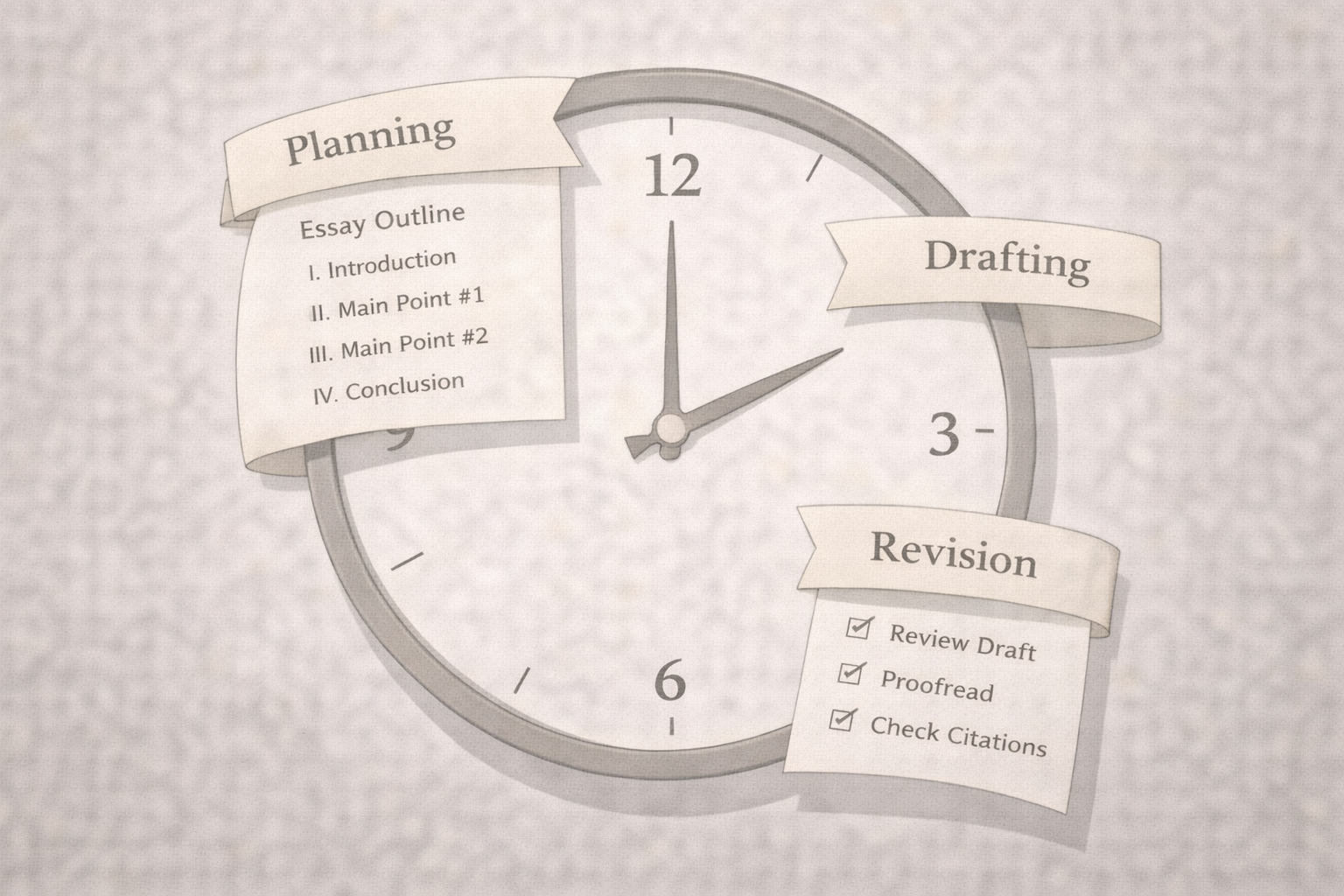
Task-based planning tools focus on breaking assignments into steps such as research, outlining, drafting, and revision.
They make hidden academic labour visible and reduce the tendency to treat writing as a single activity.
For essay-based courses, these tools are especially valuable.
| Tool Category | Main Focus | Best Used For |
|---|---|---|
| Calendars | Deadlines and dates | Term-level planning |
| Task planners | Step-by-step actions | Essays and projects |
| Time-blocking tools | Daily schedules | Routine study habits |
Many students combine tools from multiple categories to create a balanced planning system.
Time-Blocking as an Academic Planning Strategy
Time-blocking involves assigning specific periods of the day to particular academic tasks. Rather than relying on vague intentions, students commit time in advance.
This strategy helps protect study time from competing demands and reduces decision fatigue.
Time-blocking is most effective when paired with realistic workload estimates.
Academic Planning Tools and Long-Term Projects
Dissertations, research projects, and extended essays require planning across months rather than days. Short-term tools often fail in these contexts.
Long-term academic planning tools emphasise milestones rather than daily tasks. These milestones create structure without excessive rigidity.
Students who plan long projects incrementally report lower stress and higher completion rates.
The Role of Academic Planning Tools in Essay Writing
Essay writing is one of the most planning-intensive academic tasks. Strong essays emerge from structured processes rather than inspiration alone.
Planning tools help students allocate sufficient time to research, drafting, and revision. This prevents the common problem of spending all available time on drafting alone.
Effective planning directly influences argument quality and coherence.
Planning Tools and Cognitive Load
Academic work places heavy demands on working memory. When students hold deadlines and tasks mentally, cognitive overload is common.
Academic planning tools externalise this information, freeing mental resources for analysis and learning.
This cognitive benefit is often overlooked but highly significant.
Critical warning: Planning tools reduce stress only when they simplify decisions, not when they add complexity.
Common Mistakes When Using Academic Planning Tools
Despite their benefits, academic planning tools are frequently misused. One common error is overplanning, where students spend more time organising than studying.
Another mistake is treating plans as rigid rules rather than flexible guides. Academic work often requires adjustment.
Tools should support progress, not become an additional source of pressure.
Adapting Planning Tools to Individual Learning Styles
No planning tool works equally well for every student. Some learners benefit from visual layouts, while others prefer written lists.
Students should experiment with tools and adapt them over time rather than searching for a perfect system.
Effective planning systems evolve alongside academic experience.
Digital vs Analogue Academic Planning Tools
Digital tools offer convenience, reminders, and easy modification. Analogue tools, such as paper planners, offer simplicity and tactile engagement.
Research suggests that writing plans by hand can improve recall and commitment for some students.
The choice between digital and analogue tools should be guided by usability, not trends.
Using Academic Planning Tools Ethically
Academic planning tools support ethical study practices by encouraging early starts and steady progress.
They reduce the temptation to engage in last-minute shortcuts that compromise academic integrity.
Planning is therefore closely linked to responsible academic conduct.
How Lecturers Expect Students to Plan
While lecturers may not explicitly teach planning skills, assignment design assumes that students will manage time effectively.
Assessment criteria often reward depth, coherence, and revision—all outcomes of good planning.
Academic planning tools help students meet these implicit expectations.
Building a Personal Academic Planning System
Rather than relying on a single tool, many students benefit from building a small system that combines calendars, task lists, and review routines.
This system should be simple enough to maintain and flexible enough to adapt.
Consistency matters more than sophistication.
Reviewing and Adjusting Academic Plans
Planning is not a one-time activity. Students should regularly review their plans and adjust them based on progress and feedback.
This reflective approach improves future estimates and strengthens self-regulation skills.
Academic planning tools are most effective when paired with honest self-evaluation.
Academic Planning Tools and Student Wellbeing
Effective planning reduces anxiety by replacing uncertainty with clarity. Students know what to do and when to do it.
This sense of control is strongly linked to academic confidence and wellbeing.
Planning tools therefore support not only performance but also mental health.
Using Planning Tools Across the Academic Year
Academic planning tools should operate at multiple time scales: daily, weekly, and term-level.
Students who plan only at one level often miss important connections between tasks.
A layered planning approach offers the greatest resilience.
Academic Planning Tools as a Long-Term Skill
The ability to plan complex work extends beyond university. Research, professional roles, and postgraduate study all require advanced planning skills.
Using academic planning tools during university builds habits that transfer to future contexts.
In this sense, planning tools are part of broader academic development.
Planning for Success, Not Perfection
Academic planning tools are guides, not guarantees. Unexpected challenges are part of learning.
What matters is not perfect adherence to a plan but the ability to recover and adjust.
Planning supports progress, not flawless execution.
Using Academic Planning Tools With Confidence
Academic planning tools help students move from reactive studying to intentional learning. They transform large, intimidating tasks into manageable processes.
When used thoughtfully, these tools improve quality, reduce stress, and support ethical academic practice.
Ultimately, academic planning tools are most effective when they serve the student’s learning goals rather than controlling them.

Comments