Understanding the Purpose of APA Headings
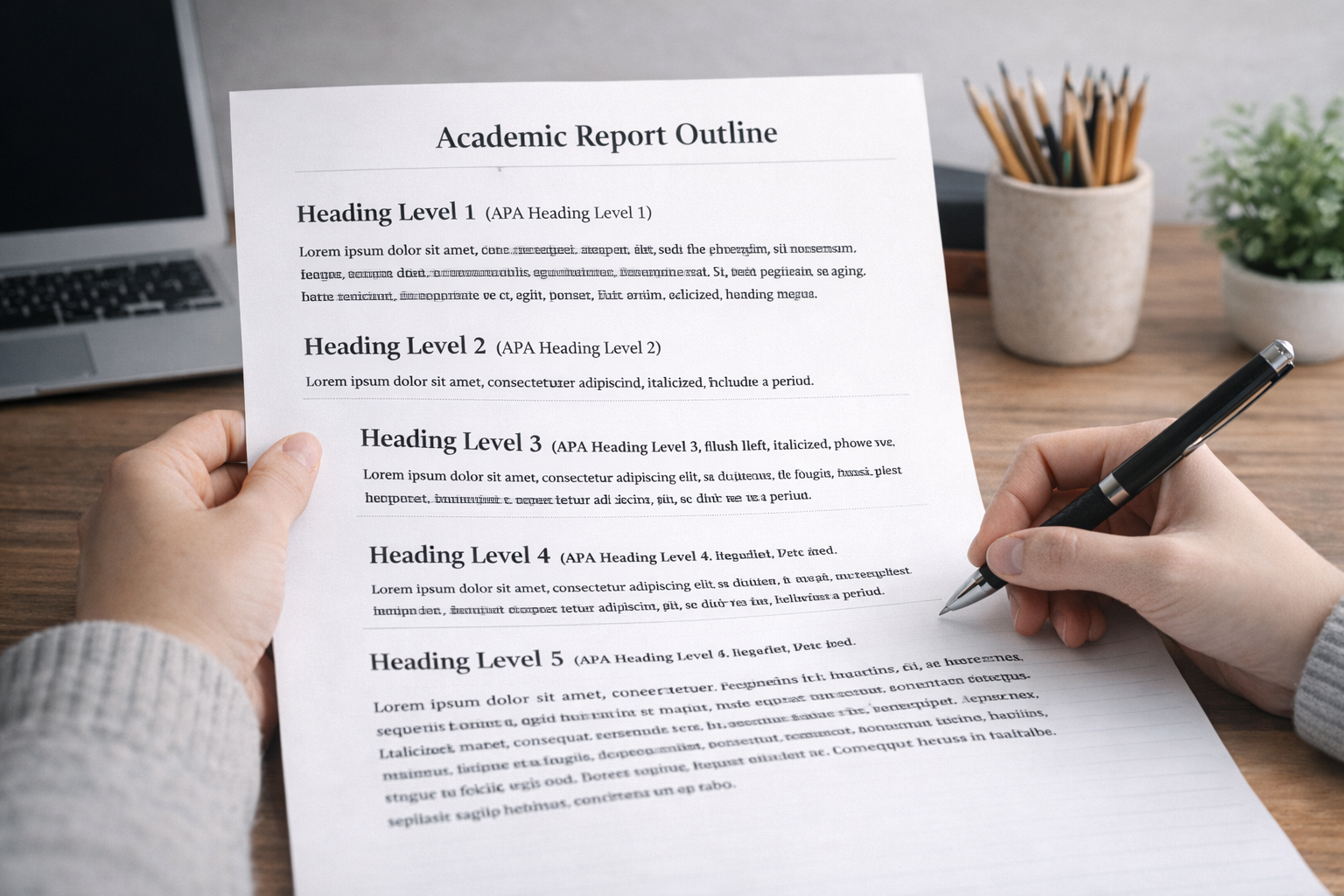
APA headings exist to organise scholarly writing into a clear, logical hierarchy. In academic work, structure is not decorative—it signals argument progression, methodological clarity, and analytical depth. The APA 7th edition provides five distinct heading levels that communicate how ideas relate to one another within a research paper, essay, literature review, or dissertation chapter.
When used correctly, headings improve readability, reduce examiner confusion, and strengthen coherence. They help readers quickly locate sections, understand conceptual relationships, and follow complex reasoning without losing track of the argument.
APA Headings Format Level 1 to 5 Explained
The five heading levels in APA style reflect increasing levels of specificity. Each level has a unique formatting requirement and must be applied consistently throughout the paper.
| Level | Formatting Style | Alignment | Purpose |
|---|---|---|---|
| Level 1 | Bold, Title Case | Centered | Main sections of the paper |
| Level 2 | Bold, Title Case | Flush Left | Subsections under Level 1 |
| Level 3 | Bold Italic, Title Case | Flush Left | Subsections under Level 2 |
| Level 4 | Bold, Title Case, Ending with Period. | Indented | Subsections under Level 3 |
| Level 5 | Bold Italic, Title Case, Ending with Period. | Indented | Subsections under Level 4 |
This hierarchy must be followed sequentially. You should not skip levels. For example, you cannot move from Level 1 directly to Level 3 without first introducing Level 2.
Level 1 Headings: Structuring Major Sections
Level 1 headings represent the primary divisions of your academic paper. These typically include major sections such as Method, Results, Discussion, or thematic divisions in essays. They are centered and bold in title case.
Level 1 headings signal substantial shifts in focus. Each one should introduce a clearly defined part of your analysis. Overuse of Level 1 headings in short essays can create fragmentation, so they should be reserved for meaningful structural divisions.
Level 2 Headings: Organising Core Subsections
Level 2 headings are bold and aligned flush left. They divide Level 1 sections into coherent subsections. For example, under a Method section, you may include Participants, Materials, and Procedure as Level 2 headings.
Each Level 2 heading must represent a distinct conceptual unit. Avoid using headings merely to shorten paragraphs. Headings should clarify structure, not compensate for weak organisation.
Level 3 Headings: Further Analytical Breakdown
Level 3 headings are bold and italicised, aligned flush left. They are used when a Level 2 subsection contains multiple analytical components that require further separation.
For instance, under Data Analysis (Level 2), you might include Descriptive Statistics and Inferential Analysis as Level 3 headings. This level is especially useful in empirical research reports where methodological detail is required.
Level 4 and Level 5 Headings: Advanced Structural Detail
Levels 4 and 5 are indented and formatted differently from Levels 1–3. Unlike higher levels, the text begins on the same line as the heading and continues as part of the paragraph.
Level 4 is bold and ends with a period. Level 5 is bold italic and also ends with a period. These levels are typically used in complex research papers, systematic reviews, or dissertations where highly detailed structure is necessary.
Critical rule: Only use Levels 4 and 5 if the structure genuinely requires deeper subdivision. Overuse can make writing appear mechanical and fragmented.
When to Use Each Heading Level in Student Assignments
Different types of assignments require different heading strategies. The depth of your hierarchy should match the complexity of your argument and the length of the paper.
- Short essays (under 1,500 words): Often require only Level 1 and Level 2 headings.
- Research reports: Typically use Levels 1–3 consistently.
- Dissertations or long research projects: May require all five levels.
Before finalising headings, review your assignment brief. Some instructors prefer minimal heading use in argumentative essays, while others expect clear hierarchical organisation.
Common Mistakes in APA Headings Formatting
Students frequently make structural errors that reduce academic clarity. These include inconsistent bold formatting, incorrect capitalisation, skipping levels, or using sentence case instead of title case.
Another common mistake is inserting headings without providing sufficient content beneath them. A heading should introduce a developed section consisting of multiple well-constructed sentences, not a single short paragraph.
Examiner expectation: Headings must reflect logical structure. They should never replace analytical depth.
Step-by-Step Guide to Applying APA Headings Correctly
To ensure your APA headings format level 1 to 5 is accurate and consistent, follow this structured workflow:
- Outline your paper’s logical structure before drafting.
- Identify major sections and assign Level 1 headings.
- Break complex sections into Level 2 subsections.
- Add Level 3–5 headings only when deeper clarity is required.
- Review formatting consistency before submission.
Careful application of this process ensures that headings enhance your argument rather than interrupt it.
Final Thoughts on Mastering APA Headings Format Level 1 to 5
Mastering APA headings format level 1 to 5 strengthens academic communication, improves structural clarity, and increases examiner confidence in your work. Headings are not cosmetic; they are structural signposts that guide readers through complex reasoning.
When applied strategically and consistently, APA heading levels transform scattered ideas into a coherent academic narrative. Precision in formatting reflects precision in thinking—an essential skill for university success.

Comments