Dissertation writing requires students to demonstrate analytical depth, methodological rigour, and academic discipline within strict structural and word-count constraints. One of the most effective tools for managing these demands is the use of appendices.
Appendices in a dissertation allow candidates to present supporting evidence, research instruments, and supplementary data without disrupting the logical flow of the main chapters. When used correctly, they strengthen credibility and transparency while preserving clarity.
This article explains what appendices are in a dissertation, why they matter, how they should be structured, and how examiners interpret them.
What Are Appendices in a Dissertation?
Appendices are supplementary sections placed after the reference list in a dissertation. They contain material that supports the research but is not essential for understanding the main argument.
The defining characteristic of appendices is non-essentiality. A reader should be able to follow the dissertation’s rationale, methods, analysis, and conclusions without consulting the appendices.
For this reason, appendices function as documentary evidence rather than analytical spaces.
Academic rule: If the reader must see it to understand your argument, it does not belong in the appendix.
Why Appendices Are Important in Dissertation Research
At advanced academic levels, dissertations are evaluated not only on originality but also on transparency and methodological integrity. Appendices support these criteria directly.
They allow examiners to verify how data were collected, how instruments were designed, and whether ethical standards were followed.
Well-organised appendices signal research maturity and respect for academic conventions.
When a Dissertation Should Include Multiple Appendices
Appendices are most common in empirical dissertations, particularly in the social sciences, health sciences, education, and business.
Quantitative studies often include survey instruments, extended statistical outputs, or robustness checks. Qualitative studies may include interview schedules, observation protocols, or coding frameworks.
Dissertations with complex designs frequently require multiple appendices to separate different types of supplementary material.
What Belongs in Dissertation Appendices
Appropriate appendix content documents the research process or provides additional evidence referenced in the main chapters.
Common materials placed in appendices include:
- Questionnaires and survey instruments
- Interview and focus group guides
- Ethics approval letters and consent forms
- Extended data tables or regression outputs
- Detailed coding manuals or analytical frameworks
Every appendix item must be explicitly cited in the dissertation text.
What Must Not Appear in Dissertation Appendices
Appendices are frequently misused as repositories for material removed from the main chapters to reduce word count.
The following content must always remain in the body of the dissertation:
- Literature review synthesis and critique
- Methodological justification and design rationale
- Interpretation of results
- Theoretical discussion and conclusions
Moving core analysis to appendices is a common reason for examiner criticism.
How to Structure Appendices in a Dissertation
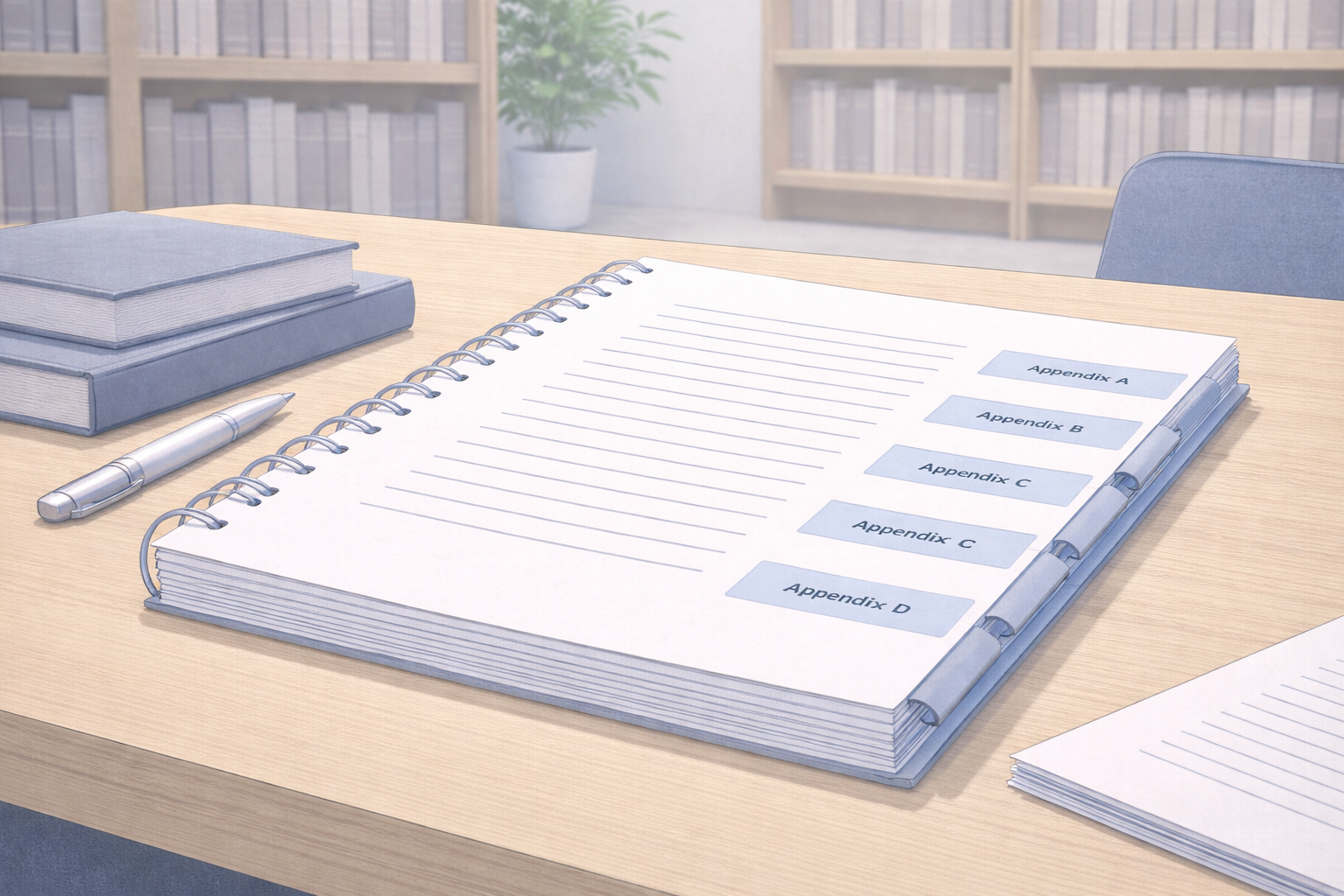
Each appendix must begin on a new page and be clearly labelled using capital letters, such as Appendix A, Appendix B, and Appendix C.
Appendix titles should be concise but descriptive, allowing examiners to understand their purpose immediately.
Ordering Multiple Appendices
Appendices should be ordered according to the sequence in which they are first referenced in the dissertation.
This ordering reinforces coherence and helps examiners navigate supplementary materials efficiently.
Referring to Appendices in Dissertation Chapters
Appendices should never appear without explanation. Every appendix must be introduced and contextualised in the main text.
Effective references explain why the appendix exists, not merely where it is located.
For example, a methods chapter may note that the full survey instrument is provided in Appendix A for transparency.
Appendices and Dissertation Word Count Regulations
Most universities exclude appendices from the formal word count.
However, this exclusion does not permit students to relocate required analytical content. Examiners are trained to identify such practices.
Appendices should complement, not compensate for, the main chapters.
How Examiners Use Dissertation Appendices
Examiners typically consult appendices selectively rather than reading them in full.
They use appendices to verify claims, confirm ethical approval, and assess methodological robustness.
Clear, well-labelled appendices increase examiner confidence in the credibility of the research.
Common Errors in Dissertation Appendices
Frequent mistakes include irrelevant material, duplication of content, and inconsistent labelling.
Another common issue is including raw data without adequate explanation or reference in the main text.
Effective appendices are planned during the research design stage, not assembled hastily before submission.
| Aspect | Main Chapters | Appendices |
|---|---|---|
| Purpose | Argument and analysis | Supporting documentation |
| Assessment weight | High | Secondary |
| Word count status | Included | Usually excluded |
| Reader priority | Essential | Consulted as needed |
Using Appendices Strategically in a Dissertation
Appendices should be treated as an integral but subordinate component of dissertation writing.
When used strategically, they enhance transparency, demonstrate research competence, and reinforce academic credibility.
Mastery of appendix use reflects advanced scholarly judgement and is a strong indicator of dissertation quality.

Comments