
Thesis writing requires careful judgement about what information belongs in the main body and what should be presented as supporting material. As research projects grow in scale and complexity, students often generate extensive data, instruments, and documentation that cannot be integrated directly into analytical chapters.
Appendices in a thesis exist to manage this challenge. When used correctly, they strengthen academic transparency and methodological rigour while preserving the clarity and focus of the core argument.
This article explains the role of appendices in a thesis, outlines best practices for structuring and referencing them, and clarifies how examiners interpret appendix material during marking.
What Are Appendices in a Thesis?
Appendices are supplementary sections placed at the end of a thesis, after the reference list, that contain material relevant to the research but not essential for understanding the main argument.
They support, rather than replace, the analysis presented in the main chapters. A well-written thesis must remain logically complete even if the appendices are not consulted.
In academic terms, appendices demonstrate transparency and good research practice by allowing readers to verify methods, data, and instruments without interrupting the narrative flow.
Key rule: Appendices support your thesis; they must never carry core arguments, analysis, or conclusions.
Why Appendices Matter in Thesis Writing
Most theses involve methodological detail that exceeds what can reasonably be included in chapters without harming readability. Appendices provide a structured solution to this problem.
They allow students to comply with word limits while still meeting expectations for openness, reproducibility, and academic integrity.
From an examiner’s perspective, appendices signal that the researcher understands how to balance depth with clarity in academic communication.
When a Thesis Should Include Appendices
Appendices are common in empirical research projects, including quantitative, qualitative, and mixed-methods theses. Surveys, interview protocols, and extended datasets typically belong in appendices.
Theoretical or conceptual theses may also use appendices when they rely on extensive primary texts, archival sources, or technical material that would disrupt the main discussion.
However, appendices should only be included when they add clear academic value and are explicitly referenced in the thesis text.
What Belongs in Thesis Appendices
Appendix content must be relevant, clearly organised, and directly linked to the research design or analysis.
Common materials included in thesis appendices are:
- Survey questionnaires and scales
- Interview or focus group guides
- Extended statistical tables or model outputs
- Ethics approval documentation
- Participant information sheets and consent forms
- Supplementary figures, diagrams, or technical schematics
Each item should support claims or methods discussed elsewhere in the thesis.
What Should Not Be Included in Thesis Appendices
A frequent academic mistake is using appendices as a storage space for content removed from chapters to meet word limits.
The following elements must always remain in the main body of the thesis:
- Research questions and objectives
- Literature review synthesis and critique
- Interpretation of results
- Discussion of implications and limitations
If an examiner must read an appendix to understand your argument, the thesis structure is academically flawed.
How to Structure Multiple Appendices in a Thesis
When a thesis includes more than one appendix, each must be clearly labelled and organised.
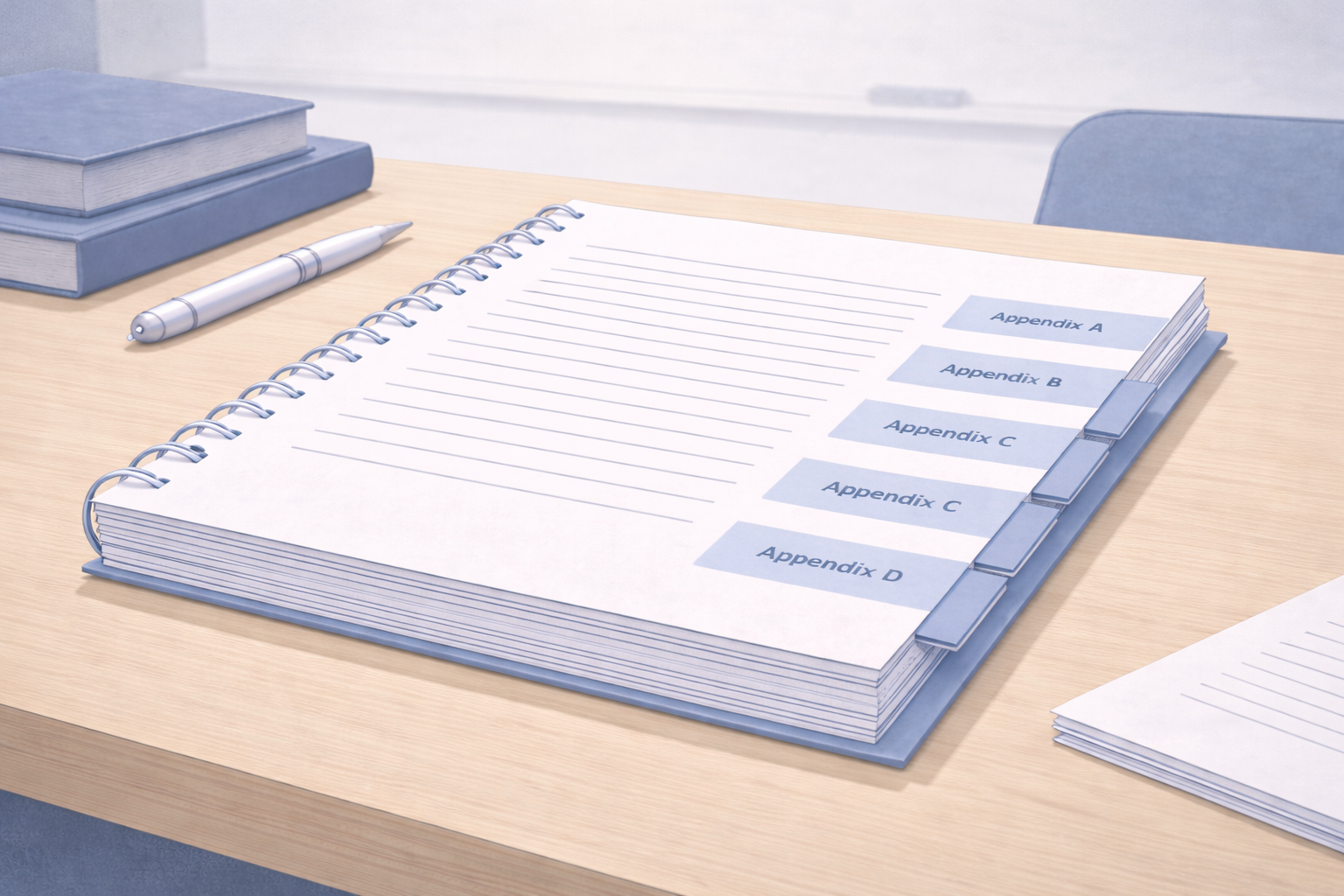
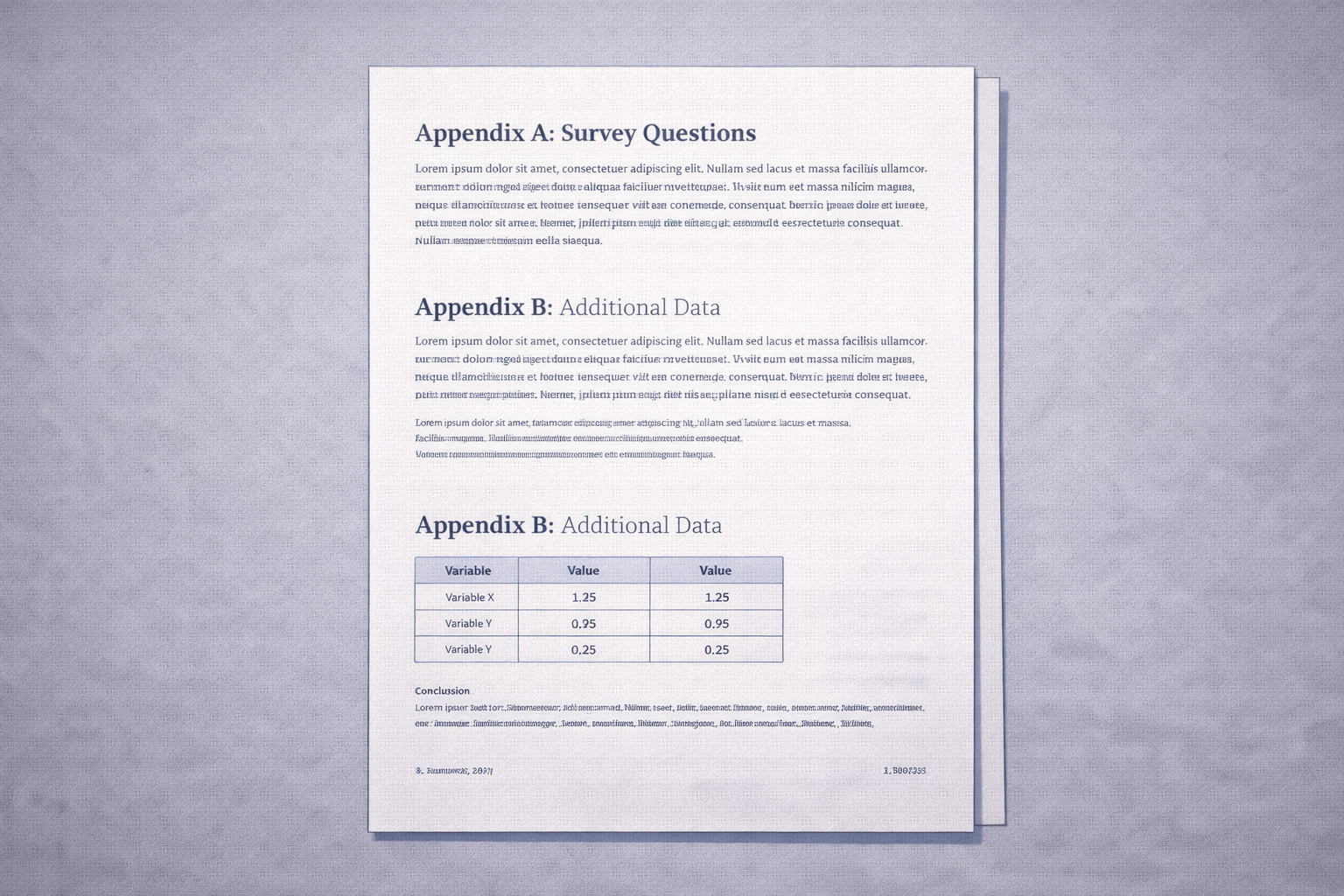
Appendices are identified using capital letters (Appendix A, Appendix B, Appendix C), not numbers, and each begins on a new page.
Appendix Titles and Descriptions
Every appendix should include a concise but descriptive title. Titles help examiners understand the relevance of the material before reading it.
For example, “Appendix C: Semi-Structured Interview Guide” is clearer and more professional than a generic label.
Ordering of Appendices
Appendices should be ordered according to the sequence in which they are first referenced in the thesis.
This logical alignment reinforces coherence and allows examiners to locate supporting material efficiently.
How to Refer to Appendices in the Thesis Text
All appendices must be explicitly referred to in the relevant chapters. Unreferenced appendices are often ignored during marking.
References should be integrated naturally into the prose, indicating why the appendix is relevant.
For example, a methodology chapter may note that the full survey instrument is provided in Appendix A.
Appendices and Thesis Word Count
In most institutions, appendices are excluded from the formal word count. However, this does not permit misuse.
Examiners are trained to identify attempts to move required discussion or analysis into appendices.
Appendices should enhance clarity, not function as a loophole for exceeding word limits.
How Examiners Use Thesis Appendices
Examiners rarely read appendices line by line. Instead, they consult them selectively to verify methodological claims or clarify data presentation.
Well-organised appendices increase examiner confidence in the research process and findings.
Poorly structured or excessive appendices, by contrast, may signal weak research design or lack of academic judgement.
Common Mistakes Students Make with Thesis Appendices
Frequent errors include failing to reference appendices, including irrelevant material, or presenting raw data without context.
Another common issue is duplicating content already summarised in the main chapters.
Effective appendices are planned early in the research process, not added hastily before submission.
| Aspect | Main Thesis Chapters | Appendices |
|---|---|---|
| Purpose | Argument, analysis, interpretation | Supporting documentation |
| Assessment weight | High | Low |
| Word count inclusion | Included | Usually excluded |
| Reader priority | Essential reading | Consulted as needed |
Using Appendices Strategically in a Thesis
Appendices should be designed as an integrated part of the thesis, not as an afterthought.
When planned carefully, they allow the main chapters to remain focused, analytical, and coherent.
Understanding how to use appendices effectively is therefore a key marker of advanced academic writing competence.

Comments