
Close reading is a foundational skill in literary studies, humanities, and many social science disciplines, yet it is often misunderstood by students. Many assume close reading simply means reading carefully or summarising a passage in detail. In academic contexts, however, close reading involves systematic analysis of how a text works at the level of language, structure, and form.
Examiners value close reading because it demonstrates intellectual discipline, attention to detail, and the ability to support interpretations with precise textual evidence. Essays that rely on close reading are usually more persuasive, rigorous, and credible.
This article explains close reading techniques step by step and shows how students can apply them effectively in academic writing.
What Close Reading Means in Academic Study
Close reading is the practice of analysing a text by focusing on its smallest meaningful units, such as words, phrases, syntax, imagery, and structure. Rather than treating the text as a source of general ideas, close reading treats it as a crafted object.
The purpose of close reading is to uncover how meaning is produced through specific textual choices. This requires slowing down the reading process and paying attention to patterns, repetitions, and deviations.
Close reading analyses how meaning is constructed, not just what the text says.
This analytical orientation distinguishes close reading from summary or paraphrase.
Why Close Reading Is Essential for Academic Essays
Close reading underpins strong textual analysis. Whether analysing a poem, novel, speech, or theoretical passage, close reading provides the evidence needed to support claims.
Without close reading, arguments often become vague or speculative. Assertions that are not grounded in textual detail rarely meet academic standards.
Developing close reading skills therefore improves both interpretation and argumentation.
Preparing a Text for Close Reading
Effective close reading begins before writing. Students should read the text multiple times, each time with a different focus.
The first reading establishes general meaning and context. Subsequent readings identify stylistic features, key terms, and structural shifts.
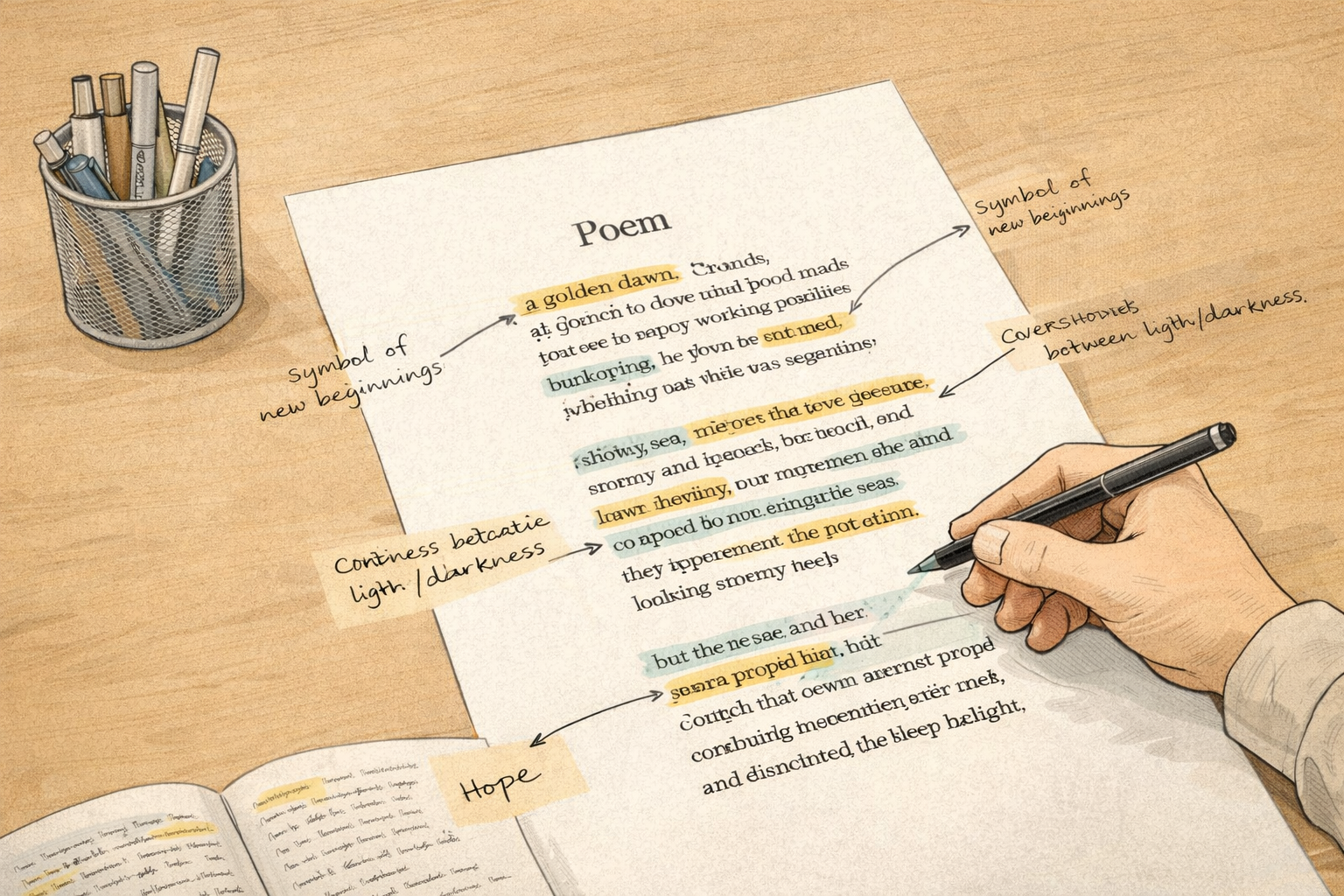
Annotating the text by underlining, highlighting, and making marginal notes helps capture observations for later analysis.
Core Close Reading Techniques
Although close reading can take many forms, several core techniques are commonly taught and assessed.
Analysing Word Choice and Diction
Diction refers to the author’s choice of words. Close reading examines why specific words are used instead of alternatives.
Students should consider connotations, tone, and register. A single word choice can signal attitude, emotion, or ideological positioning.
For example, describing an action as “assertive” rather than “aggressive” alters interpretation significantly.
Examining Syntax and Sentence Structure
Syntax involves how sentences are constructed. Long, complex sentences may convey uncertainty or elaboration, while short sentences may create emphasis or urgency.
Close reading pays attention to punctuation, pauses, and sentence rhythm. These features often shape how readers experience the text.
Analysing syntax is particularly valuable in poetry, speeches, and theoretical writing.
Identifying Imagery and Figurative Language
Imagery appeals to the senses and often carries symbolic meaning. Metaphors, similes, and personification can reveal underlying themes.
Close reading asks how imagery functions rather than simply identifying it. Students should explain how images contribute to tone or argument.
Effective analysis connects figurative language directly to interpretation.
Tracing Patterns and Repetition
Repetition is rarely accidental. Repeated words, phrases, or ideas often signal central concerns.
Close reading tracks these patterns and considers how repetition reinforces meaning or develops emphasis.
Changes in repetition can also indicate shifts in perspective or tone.
Analysing Structure and Organisation
Structure refers to how a text is organised, including paragraphing, stanza form, or argumentative progression.
Close reading examines how structure supports or complicates meaning. For example, abrupt transitions may reflect conflict or instability.
Structural analysis is particularly important in longer texts and formal arguments.
Close Reading Questions Students Should Ask
Close reading is guided by analytical questions rather than general impressions.
- Why is this word used here?
- What effect does this sentence structure create?
- How does this image shape interpretation?
- What patterns emerge across the passage?
- How does this moment relate to the whole text?
These questions encourage depth rather than surface-level reading.
Applying Close Reading in an Essay Paragraph
Close reading becomes meaningful when integrated into academic writing. Each paragraph should focus on a specific textual feature.
Evidence from the text should be quoted briefly and followed by detailed explanation. Long quotations without analysis weaken close reading.
Example of Close Reading in Practice
The repeated use of harsh consonant sounds creates a sense of tension, reinforcing the speaker’s emotional strain. This sonic pattern mirrors the thematic conflict, suggesting that the struggle is both internal and external.
The analysis links linguistic detail to broader meaning.
Close Reading vs Summary
One of the most common student errors is confusing close reading with summary. Summary describes what happens, while close reading explains how meaning is produced.
While brief context may be necessary, close reading prioritises interpretation over narration.
Examiners typically penalise essays that rely heavily on retelling content.
Using Close Reading to Build Arguments
Close reading supports argumentation by providing concrete evidence. Interpretive claims become persuasive when grounded in textual detail.
Each analytical point should contribute to a larger thesis. Close reading without a clear argument can appear fragmented.
Strong essays balance micro-level analysis with macro-level interpretation.
Common Mistakes in Close Reading
Several recurring issues weaken close reading analysis.
- Quoting without explanation
- Making claims not supported by the text
- Overgeneralising from isolated details
- Ignoring context while focusing on details
Close reading requires interpretation, not just observation.
Avoiding these mistakes improves analytical quality.
Close Reading Across Disciplines
Although close reading is often associated with literature, it is widely used across disciplines.
In history, close reading analyses primary sources. In philosophy, it examines argumentative structure. In social sciences, it interprets policy texts and theoretical frameworks.
Understanding disciplinary expectations helps tailor close reading appropriately.
Assessment Criteria Linked to Close Reading
Examiners often assess close reading implicitly through criteria related to evidence and analysis.
| Criterion | What Examiners Look For |
|---|---|
| Use of Evidence | Precise, relevant textual quotations |
| Depth of Analysis | Explanation of how language creates meaning |
| Coherence | Clear connection between detail and argument |
| Critical Insight | Interpretation beyond surface meaning |
Mastering close reading directly improves performance in these areas.
Practising and Developing Close Reading Skills
Close reading improves through regular practice. Short passages are often better for training analytical focus.
Comparing multiple interpretations of the same passage can also sharpen critical awareness.
Over time, close reading becomes an intuitive part of academic analysis.
Using Close Reading Techniques Confidently
Close reading techniques allow students to engage deeply with texts and produce evidence-based arguments. By focusing on language, structure, and patterns, analysis becomes precise and persuasive.
These skills are transferable across assignments and disciplines, making close reading a core academic competency.
By applying the techniques outlined in this guide, students can approach close reading with clarity, confidence, and analytical rigour.

Comments