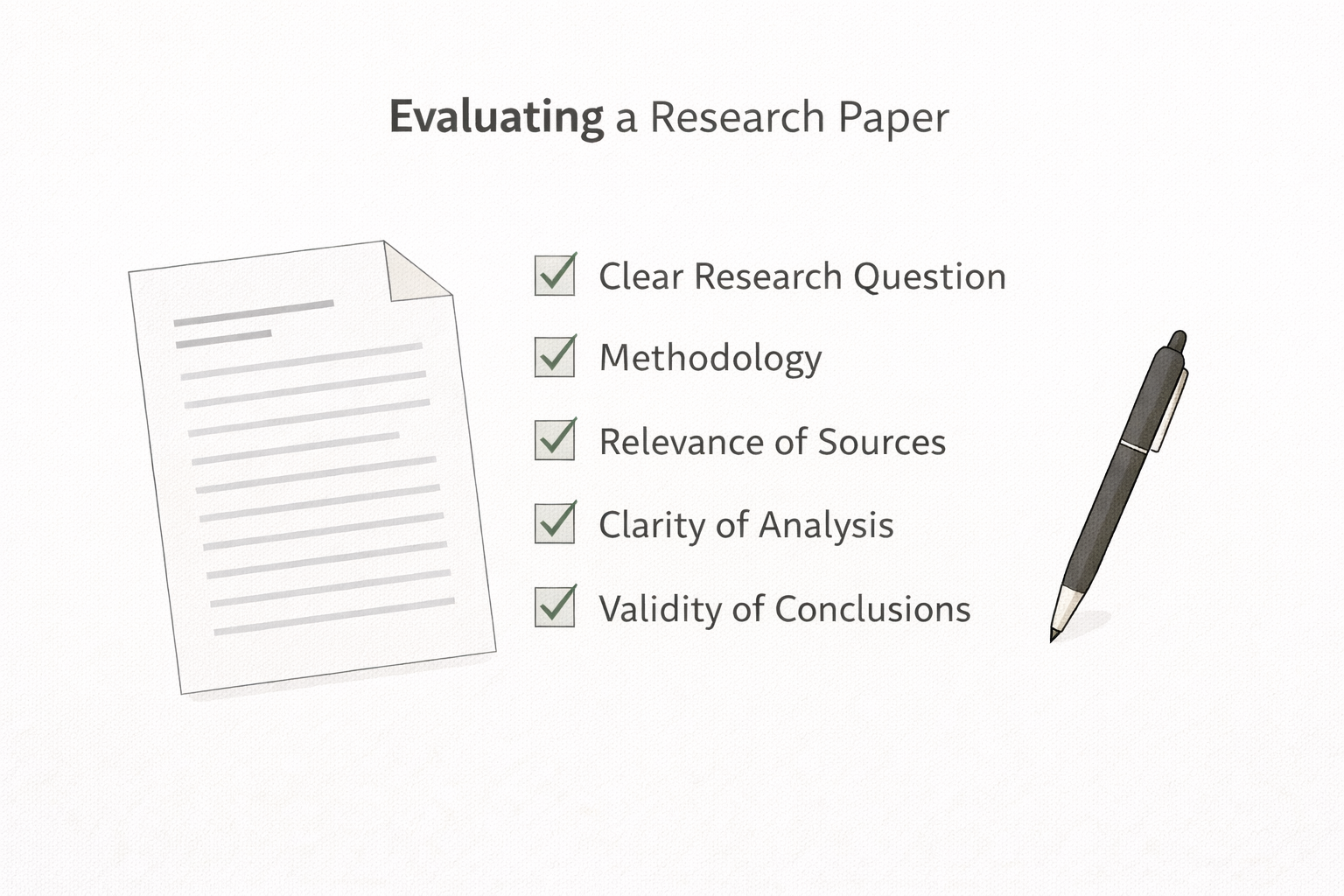
Critical appraisal is a central skill in academic research, particularly at university and postgraduate level. It goes beyond summarising what a study says and instead evaluates how well the research was conducted, how trustworthy the findings are, and how useful the study is for a specific research question. To support this process, many disciplines rely on a critical appraisal checklist.
Students often struggle with critical appraisal because expectations are rarely made explicit. Feedback such as “lacks critical depth” or “too descriptive” is common when appraisal is attempted informally or inconsistently. A checklist helps transform critical appraisal from an abstract concept into a practical, repeatable process.
This article explains what a critical appraisal checklist is, why it matters, and how to use one effectively. It provides a comprehensive, discipline-neutral framework that students can adapt for essays, literature reviews, and systematic reviews.
What a Critical Appraisal Checklist Is
A critical appraisal checklist is a structured set of questions used to evaluate the quality and relevance of a research study. Each question focuses on a specific aspect of research design, execution, or interpretation.
Rather than producing a score, a checklist guides analytical judgement. It prompts the reader to consider strengths, limitations, and potential sources of bias.
A critical appraisal checklist structures judgement; it does not replace it.
This distinction is important for academic integrity and independent thinking.
Why Critical Appraisal Is Essential in Academic Work
Universities expect students to engage critically with sources, not treat all published research as equally valid. Critical appraisal demonstrates awareness that research quality varies.
In literature reviews, appraisal helps justify why some studies are emphasised and others treated cautiously. In systematic reviews, it determines how evidence is weighted.
Without critical appraisal, academic arguments lack credibility and rigour.
When Students Are Expected to Use a Critical Appraisal Checklist
Critical appraisal checklists are commonly used in literature reviews, systematic reviews, evidence-based assignments, and research proposals.
They are particularly important in health, social sciences, education, and psychology, but the underlying principles apply across disciplines.
Even when a checklist is not explicitly required, examiners still expect evidence of appraisal.
Key Principles Behind All Critical Appraisal Checklists
Although many formal checklists exist, they share common principles. Each aims to assess validity, reliability, and applicability of research.
Validity concerns whether the study measures what it claims to measure. Reliability concerns consistency and methodological robustness. Applicability concerns relevance to the research context.
Understanding these principles helps students adapt any checklist intelligently.
Structure of a General Critical Appraisal Checklist
A comprehensive critical appraisal checklist usually follows the logical flow of a research study. It begins with clarity of purpose and ends with interpretation of findings.
The checklist below provides a general framework suitable for most qualitative and quantitative studies.
| Section | Key Focus | Purpose |
|---|---|---|
| Research aim | Clarity of research question | Establish study focus |
| Design | Appropriateness of methodology | Assess internal validity |
| Sampling | Selection and size | Evaluate representativeness |
| Data collection | Tools and procedures | Assess reliability and bias |
| Analysis | Analytical approach | Assess rigour |
| Findings | Clarity and consistency | Evaluate credibility |
| Limitations | Acknowledgement of weaknesses | Assess transparency |
| Relevance | Applicability to research question | Determine usefulness |
This framework can be adapted to specific study types.
Appraising the Research Aim and Question
The first step in critical appraisal is assessing whether the research aim is clearly stated. A vague or poorly defined aim weakens the entire study.
Students should consider whether the research question is specific, focused, and aligned with the chosen methodology.
Clarity at this stage sets expectations for the rest of the appraisal.
Evaluating Research Design and Methodology
Research design determines how well a study can answer its research question. Critical appraisal asks whether the chosen design is appropriate.
For example, qualitative designs suit exploratory questions, while quantitative designs suit measurement and comparison. Mismatches indicate methodological weakness.
Students should also consider whether alternative designs might have been more suitable.
Assessing Sampling Strategy and Participants
Sampling decisions affect representativeness and generalisability. A critical appraisal checklist prompts examination of how participants were selected.
Key considerations include sample size, inclusion criteria, and recruitment methods.
Small or biased samples do not invalidate a study but limit interpretation.
Critically Appraising Data Collection Methods
Data collection tools must be appropriate, reliable, and valid. Checklists encourage scrutiny of instruments such as surveys, interviews, or observations.
Students should consider whether tools were piloted, standardised, or validated.
Poorly described data collection raises concerns about reliability.
Evaluating Data Analysis Procedures
Analysis determines how raw data are transformed into findings. A critical appraisal checklist asks whether analytical methods are suitable and clearly explained.
In quantitative studies, this includes statistical techniques and assumptions. In qualitative studies, it includes coding and thematic development.
Transparency in analysis strengthens trustworthiness.
Interpreting Results and Findings
Findings should be presented clearly and logically. Critical appraisal considers whether results align with the data presented.
Students should assess whether conclusions are justified or overstated.
Conclusions must be supported by data, not speculation.
This step protects against uncritical acceptance of claims.
Identifying Bias and Limitations
All research has limitations. A critical appraisal checklist encourages identification of potential bias and methodological constraints.
Transparency about limitations is a strength, not a weakness. Failure to acknowledge them reduces credibility.
Students should consider both acknowledged and unacknowledged limitations.
Assessing Ethical Considerations
Ethical approval, consent, and participant protection are important appraisal criteria, particularly in human research.
A checklist prompts examination of whether ethical issues were addressed appropriately.
Ethical oversight contributes to research legitimacy.
Evaluating Relevance and Applicability
Critical appraisal also considers whether a study is useful for a specific research purpose. High-quality studies may still be irrelevant.
Students should assess contextual similarity, population relevance, and conceptual alignment.
This step links appraisal directly to research synthesis.
Using a Critical Appraisal Checklist in Literature Reviews
In literature reviews, checklists support selective emphasis rather than inclusion or exclusion alone.
Appraisal findings can be integrated into synthesis by highlighting stronger or weaker evidence.
This strengthens analytical depth.
Using Critical Appraisal Checklists in Systematic Reviews
In systematic reviews, critical appraisal often determines study weighting or eligibility.
Checklist results may be reported explicitly or summarised in tables.
Transparency is essential in this context.
Common Student Mistakes When Using Appraisal Checklists
A common mistake is treating checklist questions as yes-or-no answers without explanation. This leads to superficial appraisal.
Another error is copying checklist wording directly into assignments without interpretation.
Checklists should inform writing, not replace it.
Integrating Appraisal into Academic Writing
Critical appraisal should be woven into discussion rather than presented as a separate list.
Students can integrate appraisal by commenting on strengths, limitations, and implications while discussing sources.
This approach demonstrates analytical sophistication.
Adapting a Checklist to Different Study Types
Not all checklist questions apply equally to all studies. Qualitative, quantitative, and mixed-methods research require different emphases.
Students should adapt checklists thoughtfully rather than applying them mechanically.
Methodological awareness improves appraisal accuracy.
Critical Appraisal as a Transferable Research Skill
Learning to use a critical appraisal checklist develops skills beyond a single assignment.
It supports evidence-based thinking, informed decision-making, and academic integrity.
These skills are valuable in postgraduate study and professional research contexts.
Applying a Critical Appraisal Checklist with Confidence
A critical appraisal checklist provides structure, clarity, and consistency in evaluating research.
When used thoughtfully, it helps students move beyond description into critical engagement.
By applying appraisal systematically and integrating it into academic writing, students can produce rigorous, credible, and high-quality research work.


Comments