
Evaluating sources for a research paper is one of the most important academic skills students must develop at university level. Strong arguments and insightful analysis lose academic value if they are built on weak, outdated, or unreliable sources. For examiners, the quality of sources used often signals the overall quality of a student’s research practice.
Many students assume that finding sources is sufficient, but academic research requires a further step: critical evaluation. Not all published material is suitable for academic use, and not all scholarly-looking sources meet university standards. Distinguishing between credible academic evidence and unsuitable material is therefore essential.
This article explains how to evaluate sources for a research paper systematically and confidently. It provides clear academic criteria, practical examples, and examiner-focused guidance to help students select sources that strengthen their work and protect their academic integrity.
Why Source Evaluation Matters in Academic Research
Source evaluation is not an optional academic skill; it is central to research credibility. Universities assess not only what students argue, but also the evidence used to support those arguments. Weak sources can undermine even well-written papers by raising questions about validity and scholarly engagement.
High-quality sources demonstrate that a student understands disciplinary standards and has engaged critically with existing research. They also allow arguments to be situated within broader academic debates, which is especially important in literature reviews and dissertations.
Conversely, poorly evaluated sources expose students to risks such as factual inaccuracies, outdated theories, and unintentional bias. In extreme cases, reliance on unreliable sources may result in academic penalties.
Examiners do not reward the quantity of sources, but the quality and relevance of evidence used.
Understanding What Counts as an Academic Source
An academic source is typically produced by experts, subjected to editorial or peer review, and grounded in evidence or scholarly reasoning. These sources are designed to contribute to knowledge rather than persuade a general audience.
Common academic sources include peer-reviewed journal articles, scholarly books, conference proceedings, and official reports from recognised institutions. These materials are usually written in formal academic language and include references that allow claims to be verified.
By contrast, non-academic sources such as blogs, opinion pieces, and general websites may be useful for background understanding but rarely meet the evidentiary standards required for academic arguments.
Applying the Core Criteria for Evaluating Sources
Evaluating sources effectively requires a structured approach rather than intuition. Most universities implicitly or explicitly assess sources using a consistent set of criteria. Applying these criteria systematically allows students to justify their source choices academically.
The table below outlines the core criteria commonly used to evaluate sources for a research paper.
| Criterion | Key Question | Academic Implication |
|---|---|---|
| Authority | Who is the author and what are their credentials? | Determines expertise and reliability |
| Accuracy | Is the information supported by evidence? | Reduces risk of factual error |
| Currency | How recent is the source? | Ensures relevance to current research |
| Relevance | Does it directly address the research question? | Strengthens argument alignment |
| Purpose | Why was the source created? | Reveals potential bias or agenda |
Using these criteria together prevents overreliance on any single indicator, such as publication date or journal prestige alone.
Evaluating Author Authority and Institutional Credibility
Author authority refers to the expertise and academic standing of the individual or organisation responsible for a source. In academic research, authorship matters because it signals familiarity with the field and methodological competence.
Students should examine author affiliations, academic qualifications, and publication history. Sources written by university researchers, subject specialists, or recognised institutions generally carry greater academic weight than anonymous or unverified authors.
Institutional credibility is equally important. Journals published by academic publishers and reports issued by established research bodies are typically more reliable than content hosted on personal or commercial websites.
Assessing Accuracy, Evidence, and Methodological Transparency
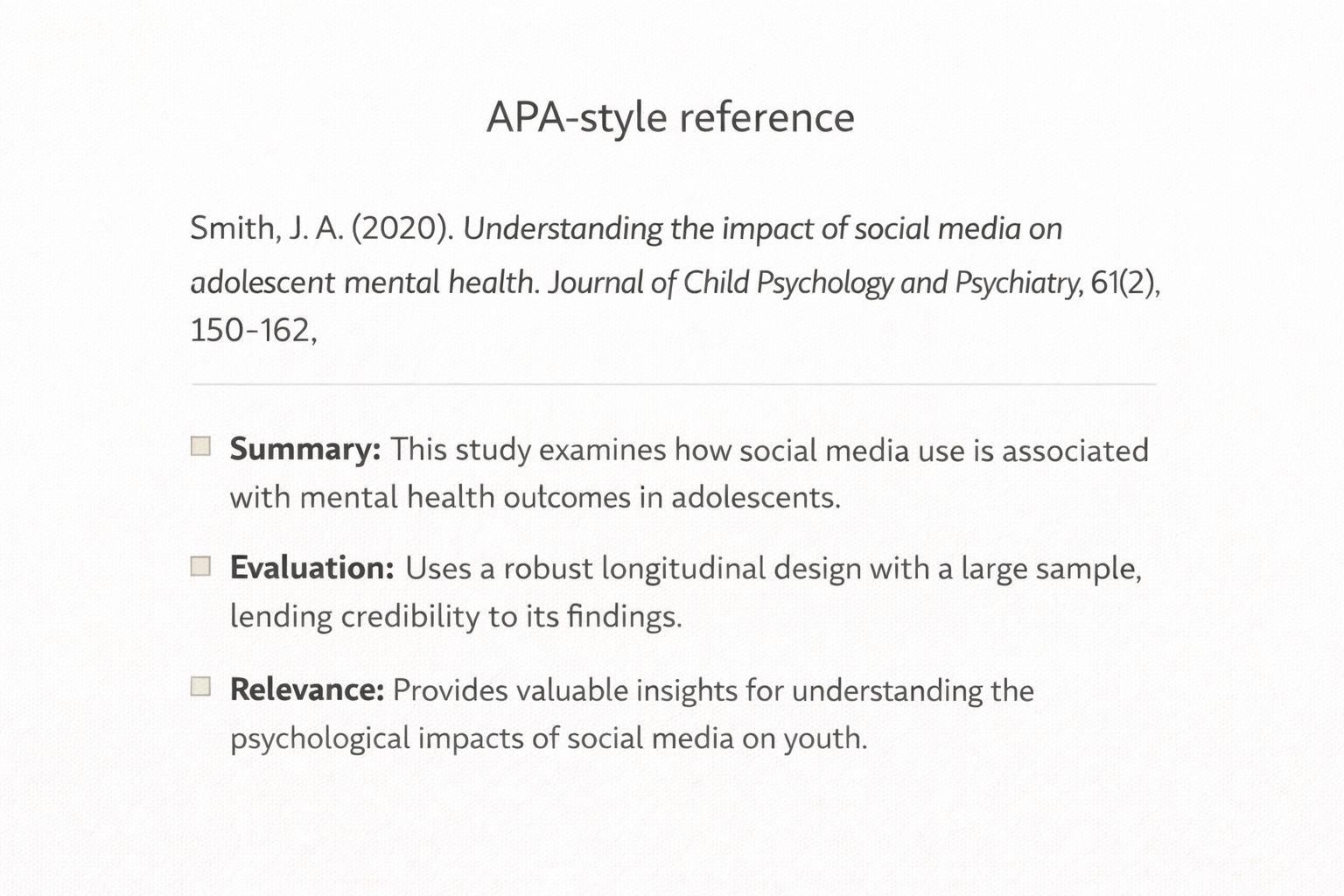
Accuracy involves evaluating whether a source presents claims supported by evidence. Academic sources should clearly explain how data were collected, analysed, or interpreted. Unsupported assertions weaken credibility and should be treated with caution.
Reliable sources also acknowledge limitations and engage with counterarguments. This transparency reflects scholarly integrity and strengthens the trustworthiness of the research.
Sources that make strong claims without evidence should never be used as core academic support.
Checking reference lists is an effective way to assess accuracy. Sources that cite reputable academic literature are more likely to meet scholarly standards.
Judging Currency Without Oversimplifying Recency
Currency refers to how recent a source is, but recency must be interpreted within disciplinary context. In rapidly evolving fields, such as technology or health sciences, outdated sources may be inappropriate. In contrast, foundational theories in humanities or social sciences may remain relevant for decades.
Students should balance current research with seminal works where appropriate. A strong research paper often combines recent studies with established theoretical foundations.
Rather than applying arbitrary date cut-offs, students should justify why a source is temporally appropriate for their research question.
Evaluating Relevance to the Research Question
Even highly credible sources lose value if they are not directly relevant to the research focus. Relevance requires alignment between the source’s content and the specific research question or argument being developed.
Students should avoid including sources solely to increase reference counts. Each source should play a clear role, such as providing theoretical context, supporting evidence, or methodological justification.
Evaluating relevance also involves considering scope. Sources that address a topic broadly may be less useful than those that engage with it at the appropriate depth.
Identifying Bias and Purpose in Academic Sources
All sources are produced within particular contexts and may reflect specific perspectives or assumptions. Evaluating purpose involves identifying whether a source aims to inform, persuade, critique, or advocate.
Academic sources may still contain bias, particularly in interpretive or theoretical work. However, scholarly bias is usually acknowledged and debated rather than concealed.
Students should critically assess how a source’s purpose influences its conclusions and consider this when integrating it into their own arguments.
Common Mistakes Students Make When Evaluating Sources
One common mistake is assuming that peer-reviewed automatically means relevant. Peer review ensures quality control, but it does not guarantee suitability for a specific research question.
Another frequent error is overreliance on secondary citations without consulting original studies. This practice can lead to misinterpretation and weak academic grounding.
Students should also avoid mixing academic and non-academic sources without clear justification, as this often signals weak research judgement.
Developing a Confident and Defensible Source Evaluation Strategy
Evaluating sources for a research paper is ultimately about informed academic judgement. By applying consistent criteria and engaging critically with evidence, students can demonstrate research maturity and scholarly responsibility.
Strong source evaluation strengthens arguments, supports originality, and protects academic integrity. When sources are chosen deliberately and justified clearly, the entire research paper gains credibility and coherence.
Approaching source evaluation as an ongoing analytical process rather than a final checklist allows students to produce research that meets and exceeds university expectations.
Comments