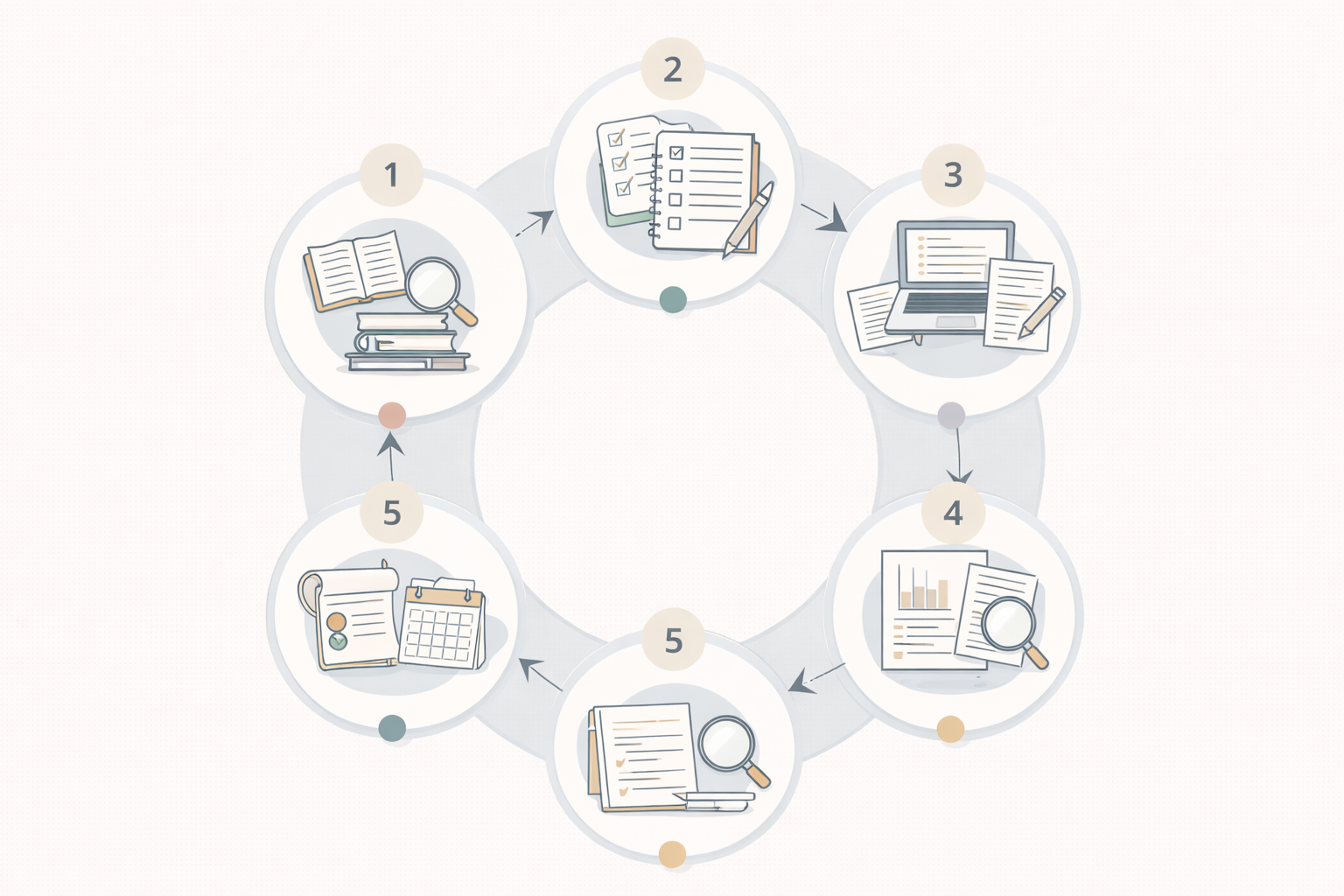
University research papers are rarely failed because students lack ideas; they are more often weakened by poor planning, rushed structure, and misalignment with academic conventions. The six-day research paper workflow illustrated above reflects a realistic academic process rather than a productivity hack. Each day corresponds to a distinct scholarly function that examiners expect to see clearly executed. This article explains how to write a research paper in six days by unpacking what each stage accomplishes academically, why it matters for assessment, and how students can apply it to real coursework under deadline pressure.
The approach is particularly relevant for students working with empirical studies, extended essays, and undergraduate dissertations, where clarity of research focus, evidence integration, and methodological transparency are explicitly assessed. Where appropriate, this guide links to in-depth academic resources on Epic Essay that expand specific skills such as structuring arguments, writing introductions, and managing research papers.
Day 1: Defining a Focused Research Question and Building an Outline
The first day is devoted entirely to intellectual orientation. Academically, a focused research question functions as the controlling logic of the entire paper. Examiners evaluate whether arguments, evidence, and conclusions remain aligned to a clearly articulated problem. When students skip or rush this step, papers often drift into description, overgeneralisation, or unfocused literature summaries.
A strong research question should be specific, researchable within the word limit, and grounded in an identifiable academic debate. At this stage, students should also produce a one-page outline that maps the logical progression of the paper. This outline is not a draft; it is a structural blueprint that determines how claims will unfold. Guidance on structuring arguments coherently can be found in Essay Structure Explained for University Students.
A research paper without a clear research question cannot demonstrate critical engagement, no matter how many sources it cites.
From an assessment perspective, a focused outline allows markers to see intentional design rather than accidental organisation. This is particularly important in higher-level modules where structure itself is an explicit grading criterion.
Day 2: Collecting, Skimming, and Thematically Grouping Sources
The second day centres on evidence selection rather than writing. Academic research is evaluated not only on the number of sources used but on how strategically they are chosen and synthesised. Skimming key sources allows students to identify dominant arguments, methodological approaches, and unresolved tensions in the literature without becoming lost in excessive detail.
Grouping sources into three to five thematic clusters reflects how literature reviews are assessed. Examiners look for synthesis—evidence that the student can connect studies conceptually rather than summarise them one by one. Each theme should represent a coherent line of debate, theoretical approach, or empirical finding that relates directly to the research question.
This process lays the foundation for a critical literature review rather than an annotated bibliography. Students writing extended research projects may also benefit from professional guidance outlined in Dissertations and Research Papers, which explains how thematic organisation supports higher-order academic analysis.
Day 3: Writing the Introduction and Literature Review Together
Writing the introduction and literature review on the same day is an academically strategic decision. These sections are intellectually linked: the introduction frames the problem, while the literature review demonstrates why the problem exists. When written separately, students often repeat content or introduce gaps that undermine coherence.
A strong academic introduction narrows from a broad disciplinary context to a specific research gap, signalling the contribution of the paper. Detailed guidance on this process is available in How to Write an Essay Introduction: A Clear Academic Guide. The literature review should then justify that gap by critically engaging with existing scholarship, highlighting limitations, contradictions, or omissions.
From a marking standpoint, coherence between these sections demonstrates intellectual control. Examiners expect the literature review to do analytical work, not merely provide background. Writing both sections within the same conceptual window helps maintain argumentative alignment.
Day 4: Writing the Methodology with Transparency and Precision
The methodology section is often misunderstood as a technical formality, yet it is a core site of academic credibility. Examiners assess whether the chosen methods are appropriate for answering the research question and whether the research process is transparent enough to be evaluated critically.
On this day, students should clearly define variables, participants or data sources, instruments, and analytical procedures. Even in qualitative or theoretical papers, methodological justification is required. Ambiguity or missing detail here often results in significant mark deductions, especially in empirical disciplines.
| Methodological Element | What Examiners Look For |
|---|---|
| Research design explanation | A clear justification of why the chosen approach is suitable for addressing the research question. |
| Data or sample description | Transparent explanation of what data were used and how they were selected. |
| Analytical procedure | Logical, replicable steps showing how findings were generated or interpreted. |
Writing methodology in one focused session reduces the risk of inconsistencies and ensures alignment with earlier sections.
Day 5: Presenting Results and Linking Evidence to Objectives
The fifth day is dedicated to results or analysis. Academically, this section demonstrates whether the research actually answers the question posed. Examiners expect results to be presented clearly and linked explicitly to research objectives rather than described in isolation.
Where appropriate, tables should be used to present complex data succinctly. However, tables never replace analysis; they support it. Each table or piece of evidence must be interpreted in relation to the research question and existing literature.
Students often lose marks by presenting results without commentary or by discussing implications prematurely. Maintaining a clear boundary between results and broader interpretation signals academic discipline and improves clarity for the reader.
Day 6: Writing the Discussion, Conclusion, and Conducting Final Checks
The final day integrates interpretation, synthesis, and academic integrity checks. The discussion section explains what the findings mean in relation to the literature reviewed earlier, while the conclusion draws together the paper’s contribution without introducing new evidence.
This stage also includes reviewing logical flow, verifying citations, and assessing plagiarism risk. Examiners penalise strong research that is poorly edited or inconsistently referenced, making this final review academically essential rather than cosmetic.
A well-argued paper can still fail if citation, coherence, or academic integrity checks are neglected.
By reserving a full day for synthesis and review, students protect the quality of their work and ensure it meets institutional standards.
Writing a Research Paper in 6 Days Without Compromising Academic Standards
The six-day research paper workflow is effective because it mirrors how academic knowledge is produced: question formulation, evidence engagement, methodological justification, analysis, and synthesis. When each day is treated as an intellectual task rather than a writing sprint, students can produce work that is coherent, credible, and assessment-ready.
Rather than encouraging shortcuts, this structure enforces discipline and alignment with university marking criteria. For students working under tight deadlines, it provides a realistic path to maintaining academic standards while managing time effectively.

Comments