One of the most common questions students ask when beginning their research project is how long is a dissertation. Unlike shorter academic assignments, dissertations represent the culmination of extensive independent research, which means their length is typically much greater than standard essays or coursework.
However, there is no single universal word count for all dissertations. The length depends largely on the academic level, the discipline, and the specific requirements set by the university. Undergraduate dissertations are generally shorter, while doctoral dissertations may extend to several hundred pages depending on the complexity of the research.
Understanding the expected length of a dissertation helps students plan their research, organise their chapters effectively, and ensure they meet institutional requirements. This guide explains typical dissertation lengths, how word counts are distributed across chapters, and how students can structure their writing to maintain clarity and academic depth.
Typical Dissertation Length by Academic Degree
The expected length of a dissertation varies significantly between academic programs. Universities design dissertation word limits to reflect the level of research and analysis required at each stage of higher education.
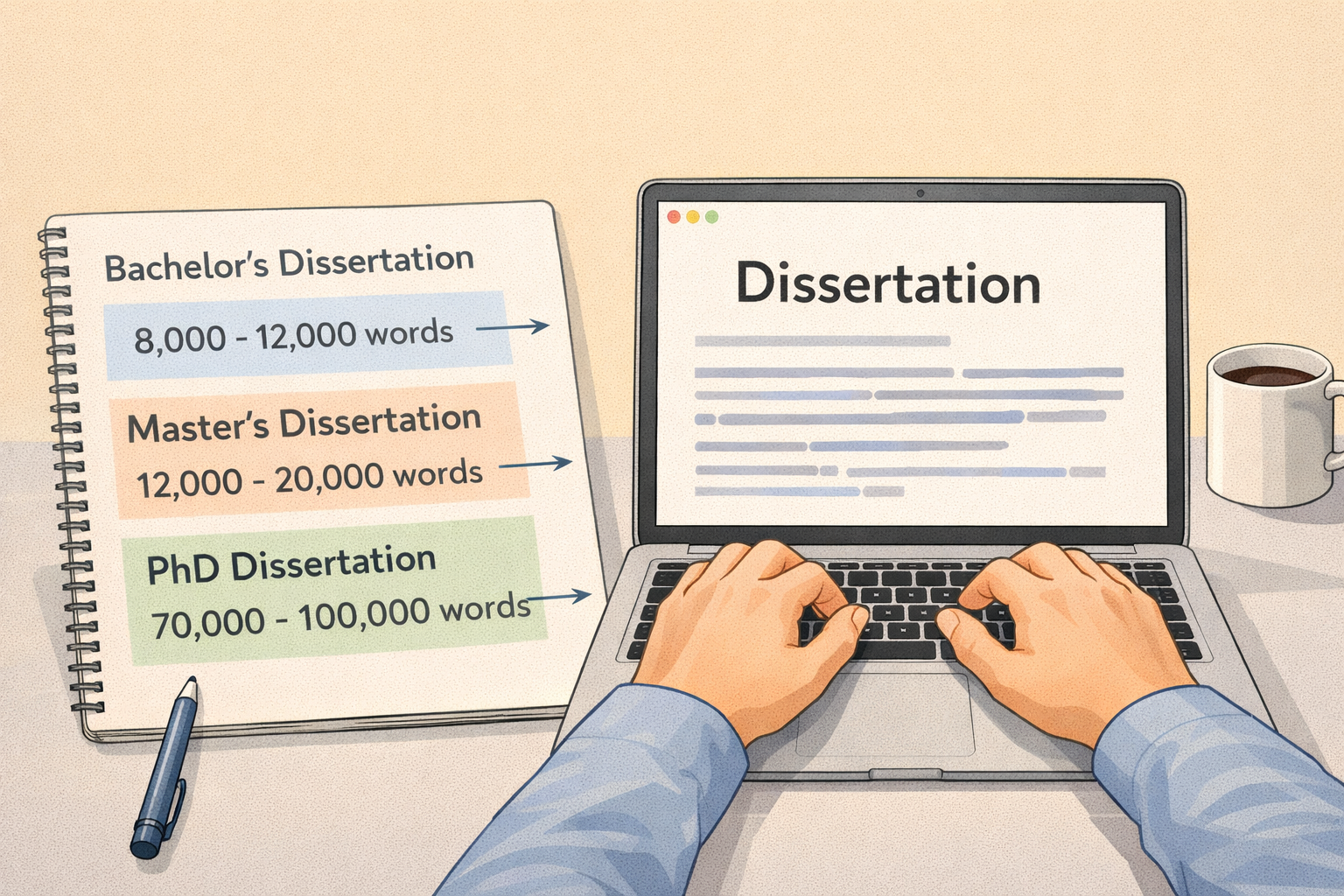
The following table provides an overview of common dissertation lengths across different degree levels.
| Academic Level | Typical Word Count | Approximate Pages |
|---|---|---|
| Bachelor's Degree | 8,000 – 12,000 words | 30 – 40 pages |
| Master's Degree | 15,000 – 25,000 words | 60 – 100 pages |
| PhD Dissertation | 70,000 – 100,000 words | 200 – 300 pages |
These ranges are general guidelines rather than strict rules. Some universities allow slight variations depending on the discipline or research methodology used.
Why Dissertation Length Varies Between Subjects
The subject area of a dissertation plays a major role in determining its length. Disciplines that rely heavily on theoretical analysis, such as humanities and social sciences, often require longer dissertations because they involve detailed literature reviews and extensive discussion.
In contrast, dissertations in science and engineering fields may be slightly shorter because much of the research is presented through data, figures, and experimental results rather than extended textual analysis.
Several factors influence the final length of a dissertation, including:
- The complexity of the research question
- The number of research methods used
- The depth of the literature review
- The amount of data collected and analysed
- The institutional guidelines provided by the university
Because of these variables, students should always consult their university's dissertation handbook before beginning the writing process.
Typical Word Count Distribution Across Dissertation Chapters
Although the total word count may vary, dissertations typically follow a predictable structure. Each chapter contributes a specific portion of the overall word count to ensure that the research argument develops logically.
| Chapter | Typical Percentage of Word Count |
|---|---|
| Introduction | 10% |
| Literature Review | 30% |
| Methodology | 15% |
| Results / Findings | 20% |
| Discussion | 15% |
| Conclusion | 10% |
This distribution helps ensure that the dissertation remains balanced and that each stage of the research process receives appropriate attention.
Planning Dissertation Length Before Writing
Effective dissertation planning begins long before the writing process. Students should develop a detailed outline that estimates the word count for each chapter and subsection. This approach prevents chapters from becoming too long or too short.
Careful planning also allows students to maintain a clear research narrative. When each section contributes a defined portion of the word count, the dissertation becomes easier to manage and revise.
A practical planning process typically includes:
- Identifying the required total word count
- Dividing the dissertation into major chapters
- Allocating approximate word counts to each section
- Creating detailed subsection outlines
- Adjusting the structure as research progresses
By planning the dissertation structure early, students can avoid the common problem of exceeding or falling short of the required word count.
What Is Included in the Dissertation Word Count?
Another important question related to dissertation length is what actually counts toward the official word limit. Most universities specify which sections of the dissertation are included in the word count and which sections are excluded.
Typically, the following sections are included in the word count:
- Main chapters of the dissertation
- Introduction and conclusion
- Literature review and discussion sections
On the other hand, several components are usually excluded from the word count.
- Title page
- Abstract
- Table of contents
- Reference list
- Appendices
- Tables and figures
Students should confirm these details with their institution because word count policies may differ slightly between universities.
Exceeding the dissertation word limit can result in academic penalties or require substantial revisions before submission.
Balancing Depth and Clarity in a Dissertation
A common misconception among students is that a longer dissertation automatically reflects stronger research. In reality, academic examiners evaluate dissertations based on the quality of the research, the clarity of the argument, and the effectiveness of the analysis.
An excessively long dissertation may contain unnecessary repetition or poorly organised sections. Conversely, a dissertation that is too short may lack sufficient explanation or evidence to support the research argument.
Successful dissertations maintain a balance between depth and conciseness. Each chapter should contribute meaningful insight while maintaining a clear connection to the central research question.
Strategies for Managing Dissertation Length
Managing dissertation length requires careful attention throughout the research and writing process. Students should regularly review their chapters to ensure that the word count remains within the expected range.
Effective strategies for controlling dissertation length include:
- Writing concise literature reviews that focus on relevant sources
- Avoiding repetition across chapters
- Presenting complex data through tables or figures
- Maintaining clear connections between research questions and findings
These strategies help ensure that the dissertation remains focused while still demonstrating thorough academic analysis.
Understanding Dissertation Length for Academic Success
Understanding how long a dissertation should be is an important step in planning a successful research project. While the exact word count varies between degrees and disciplines, most dissertations follow predictable ranges that reflect the level of academic research required.
By carefully planning chapter structure, distributing word counts effectively, and focusing on clarity rather than excessive length, students can produce dissertations that meet both academic expectations and institutional guidelines.
A well balanced dissertation demonstrates rigorous research, structured argumentation, and professional academic presentation—qualities that are far more important than simply reaching a high word count.


Comments