
For many university students, the literature review is the most conceptually demanding part of a research paper. Unlike other sections, it does not simply report facts or present results. Instead, it requires students to demonstrate intellectual control over an academic field by analysing, synthesising, and evaluating existing research.
Learning how to write a literature review for a research paper is therefore not just a technical skill. It is a foundational academic practice that shapes the quality, credibility, and originality of the entire study. This guide explains what a literature review is, what examiners expect, and how to write one step by step at university level.
What a Literature Review Is in Academic Research
A literature review is a critical overview of scholarly research relevant to a specific research question or topic. Its purpose is not to list everything that has been written, but to identify patterns, debates, theoretical positions, and gaps within existing knowledge.
In a research paper, the literature review establishes the intellectual context of the study. It shows how the current research fits into an existing academic conversation and justifies why the study is necessary. Without a strong literature review, a research paper lacks scholarly grounding.
A literature review demonstrates what is known, what is contested, and what still needs to be explored.
This section signals to examiners that the writer understands the field and can engage with it critically rather than descriptively.
Why Literature Reviews Matter to Research Quality
At university level, a literature review is used as an indicator of academic maturity. It reveals how well a student can evaluate sources, identify relationships between studies, and construct an informed research position.
A weak literature review often leads to a weak research paper overall. When prior research is poorly analysed or disconnected, research questions become vague, methodologies appear unjustified, and conclusions lack significance.
By contrast, a strong literature review clarifies the direction of the study and strengthens every section that follows.
Preparing to Write a Literature Review
Before writing begins, students must complete several preparatory steps. Writing without preparation often results in fragmented summaries rather than coherent synthesis.
Clarifying the Research Focus
A literature review must be guided by a clear research question or objective. Without this focus, source selection becomes unfocused and overwhelming.
Students should define key concepts, variables, or themes before searching for literature. This ensures that sources are selected strategically rather than randomly.
Conducting a Systematic Literature Search
Effective literature reviews rely on high-quality academic sources such as peer-reviewed journal articles, scholarly books, and reputable conference papers.
- Use academic databases relevant to your discipline
- Prioritise recent studies unless foundational theory is required
- Track recurring authors, theories, and methodologies
Keeping structured notes during this stage significantly improves synthesis later.
Organising Literature Review Content
Organisation is the defining feature of an effective literature review. Rather than discussing sources one by one, literature should be grouped conceptually.
The structure chosen depends on the research question and disciplinary norms, but coherence is always essential.
| Approach | Best Used When |
|---|---|
| Thematic | Examining key concepts or recurring ideas |
| Chronological | Tracing the development of research over time |
| Methodological | Comparing research designs and approaches |
| Theoretical | Analysing competing frameworks or models |
Most university research papers benefit from a thematic structure because it promotes synthesis rather than description.
Writing the Literature Review Step by Step
Once preparation and organisation are complete, the writing process becomes more controlled and analytical.
Writing the Opening Section
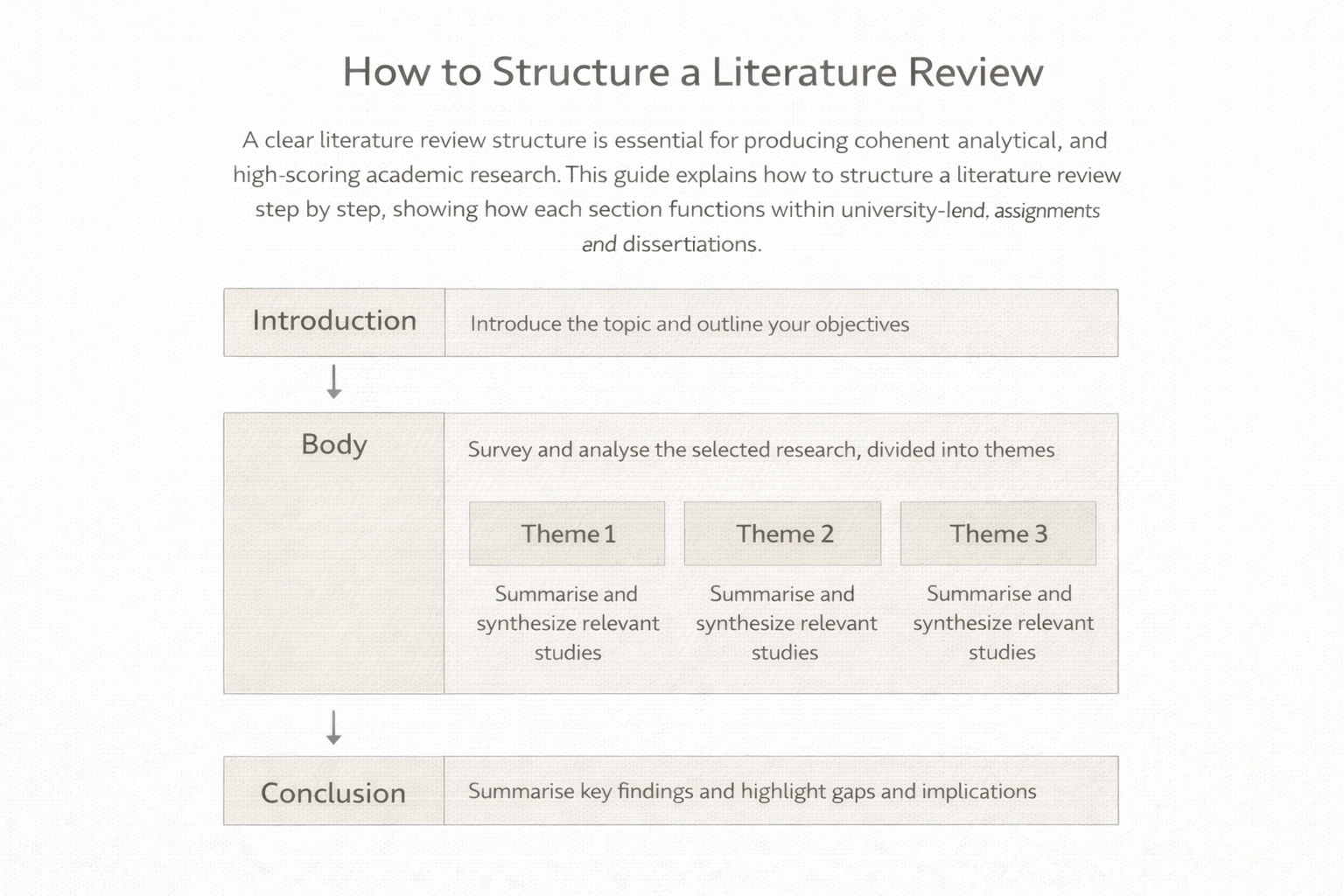
The opening of a literature review should define the scope and purpose of the review. It explains what areas of literature are covered and why they are relevant to the research question.
This section should also introduce the organisational logic of the review, preparing the reader for how the discussion will unfold.
Developing Thematic or Analytical Sections
Each body section of the literature review should focus on a specific theme, debate, or research strand.
- Introduce the theme or issue
- Summarise key contributions across multiple sources
- Compare similarities and differences between studies
- Evaluate strengths, limitations, and gaps
Analysis should dominate these sections. Summary is necessary but must always serve evaluation.
Integrating Sources Critically
Critical integration means showing how studies relate to each other, not just to your topic. This involves identifying trends, contradictions, and unresolved questions.
Effective literature reviews frequently use comparative language to position sources in dialogue rather than isolation.
If your literature review reads like a list, it is descriptive, not analytical.
Common Mistakes in Literature Reviews
Understanding frequent errors helps students avoid them during drafting and revision.
- Over-summarising individual studies
- Failing to link literature to the research question
- Including outdated or low-quality sources
- Lack of critical evaluation
Another major mistake is treating the literature review as an independent essay rather than a foundation for the research paper.
Maintaining Academic Tone and Referencing Accuracy
Literature reviews require a formal, objective academic tone. Claims should be supported by evidence, and evaluative language must remain measured.
Accurate referencing is essential. Citation errors undermine credibility and may raise academic integrity concerns.
Students should follow the required referencing style consistently and ensure that all cited works appear in the reference list.
Revising and Refining the Literature Review
Revision is a critical stage in literature review writing. Initial drafts often reveal structural weaknesses or analytical gaps.
During revision, students should ask whether each section contributes directly to the research purpose and whether synthesis is clear.
Peer feedback, supervisory guidance, or professional academic editing can be particularly valuable at this stage.
Positioning Your Research Through the Literature Review
The final role of the literature review is to justify the current study. By identifying limitations or gaps in existing research, the review creates a clear rationale for the research paper.
This positioning transforms the literature review from a background section into an active scholarly argument.
Mastering the Literature Review as an Academic Skill
Learning how to write a literature review for a research paper is a long-term academic investment. It strengthens critical thinking, improves research design, and enhances overall academic writing quality.
Students who master this skill produce research papers that are clearer, more persuasive, and more credible within their disciplines.


Comments