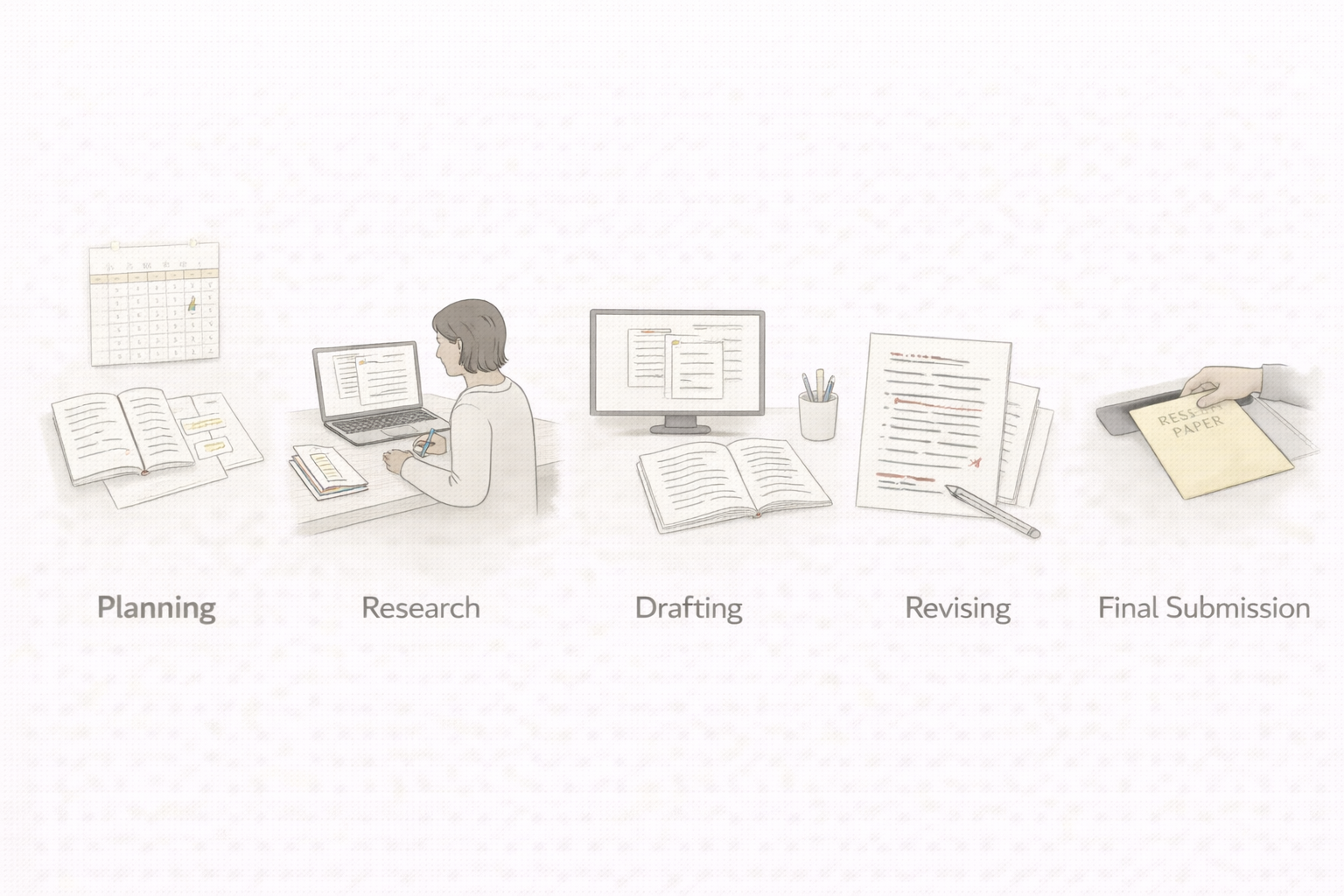
Writing a research paper is one of the most important academic skills students must master at university. Unlike short essays or reflective pieces, research papers require rigorous planning, systematic inquiry, and disciplined writing. Yet many students struggle because they lack a clear roadmap for tackling this complex task.
Understanding how to write a research paper step by step demystifies the process, transforming uncertainty into academic confidence. This guide provides a structured, evidence-based approach that helps students progress from initial idea generation to a polished final document that meets university standards.
Understanding the Research Paper Task
The first step in any academic task is to understand what is being asked. Research paper assignments often include a description of expected length, formatting style, research scope, and evaluation criteria. Reading the brief carefully and clarifying any uncertainties with your instructor prevents misinterpretation later on.
Many students benefit from structured support such as the guidance available in the Epic Essay academic blog, which covers a range of writing fundamentals from introductions to conclusions. :contentReference[oaicite:0]{index=0}
Careful analysis at this stage ensures your work aligns with the assignment’s intellectual expectations and avoids unnecessary revisions later.
Step 1: Choosing and Narrowing Your Topic
Choosing a strong topic is the foundation of successful research writing. A good topic should be interesting, researchable, and appropriately scoped for the assignment’s length. Too broad a topic can overwhelm you with information; too narrow a topic may lack sufficient sources.
Begin by brainstorming broad interests within your field, then progressively narrow these based on preliminary reading and question specificity. Research questions that are too general often yield descriptive papers rather than analytical ones. Focusing your topic early enables more efficient research and clearer argument development.
Step 2: Conducting Preliminary Research
Once your topic is defined, conduct preliminary research to assess the availability and relevance of academic sources. Use academic databases such as JSTOR, Google Scholar, Scopus, and subject-specific repositories to find peer-reviewed articles, books, and credible reports.
Take organised notes that capture key arguments, evidence, and references. Developing a working bibliography at this stage helps ensure that your final paper’s references are comprehensive and academically credible.
Step 3: Crafting a Strong Research Question or Thesis
A research question or thesis statement anchors your entire paper. It defines what you intend to explore or argue. A strong research question is clear, focused, and researchable, often beginning with “how,” “why,” or “to what extent.”
For empirical papers, the question might guide data collection and analysis. For analytical or theoretical work, it shapes your argument and interpretation of sources. Ensure your thesis or question reflects the academic genre of your discipline and aligns with assignment expectations.
Step 4: Creating a Research Plan and Outline
Planning is essential to manage time and ensure logical structure. An outline serves as a roadmap that ties together key sections of your research paper, from introduction to conclusion. A detailed outline prompts explicit thinking about how each section contributes to your central argument.
A typical outline might include:
- Introduction with thesis statement
- Literature review summarising relevant research
- Methodology (if applicable)
- Findings or analysis
- Discussion interpreting results
- Conclusion synthesising key points
Having an outline also makes it easier to avoid tangents that stray from your central argument.
Step 5: Engaging With Literature Effectively
Academic credibility depends on how well you engage with existing scholarship. A literature review synthesises key themes, debates, and gaps in the relevant research. It should do more than summarise sources: it must show how these studies relate to each other and to your own research question.
| Less Effective | More Effective |
|---|---|
| Lists studies without connection | Synthesises themes and debates |
| Provides descriptive summaries | Critically evaluates strengths and limitations |
| Lacks clear direction | Identifies research gaps and context |
Strong literature engagement demonstrates your understanding of the academic conversation surrounding your topic.
Step 6: Choosing Research Methods
If your research requires primary data collection, clearly articulate your methodological approach. Whether qualitative, quantitative, or mixed-methods, your methodology section should justify your choices and show how they align with your research question.
Describe sampling strategies, instruments, analytical tools, and any ethical considerations. Clear methodological description enhances the transparency and reliability of your research.
Step 7: Writing the First Draft
With your outline and research complete, begin drafting. Start with sections that feel most straightforward (like literature review or methodology) to build momentum, then tackle analysis and introduction.
Ensure each paragraph has a clear topic sentence, evidence, and analysis that ties back to your thesis. Avoid long quotations without critical interpretation, as academic readers expect your voice to lead the discussion.
Step 8: Revising for Structure and Argumentation
Revising is where good papers become strong. This stage involves rethinking structure, strengthening argument flow, and checking whether each section contributes to your research question.
Many students benefit from external review at this stage. Services like professional editing and proofreading ensure clarity, coherence, and academic tone across your document. :contentReference[oaicite:1]{index=1}
Step 9: Final Editing and Academic Standards
Final editing focuses on sentence-level clarity, grammar, and adherence to your required citation style (APA, MLA, Chicago, etc.). Accurate referencing is non-negotiable in academic writing because it displays scholarly integrity and allows readers to verify sources.
Pay attention to formatting, citation consistency, and presentation details such as page numbers, headings, and table captions. These small elements contribute to a professional academic impression.
Step 10: Preparing for Submission
Before submission, conduct a final review using a checklist that covers essential academic criteria: alignment with the research question, clarity of argument, source integration, methodological transparency, and formatting accuracy. This systematic check reduces the risk of oversight.
Research papers require disciplined organisation and careful revision at every stage. Approaching the writing process step by step makes a complex task manageable and increases confidence and performance.
Developing Academic Confidence Through Practice
Understanding how to write a research paper step by step equips students with skills that extend beyond a single assignment. These include critical thinking, analytical reasoning, evidence-based communication, and disciplined revision— competencies that underpin academic success across disciplines.
By following a structured approach and engaging deeply with sources, students can produce research papers that reflect not only knowledge but also scholarly maturity and academic rigor.


Comments