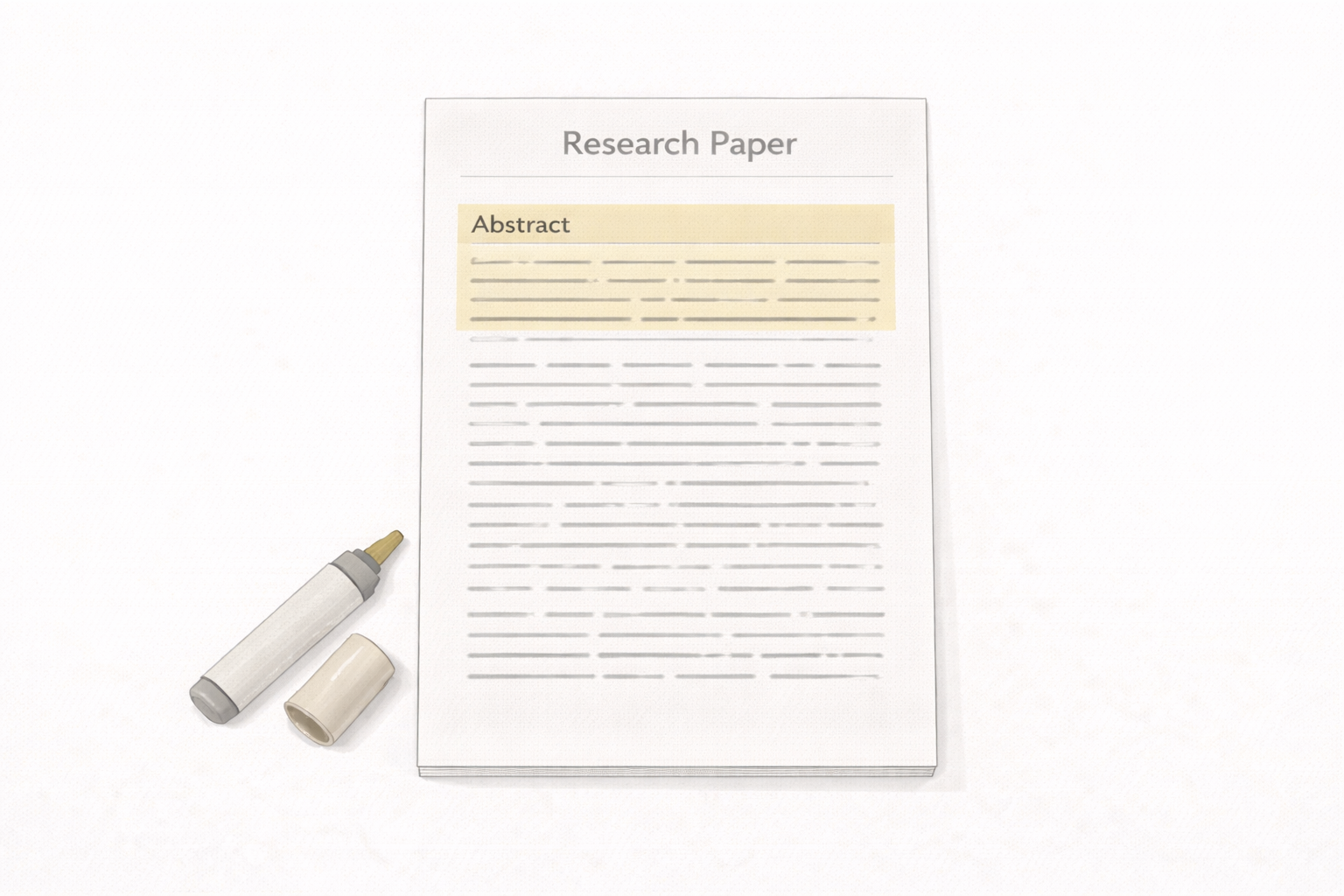
An abstract is often the first part of a research paper that examiners, supervisors, or journal reviewers read. Despite its short length, it plays a decisive role in shaping how the entire study is perceived. A clear and well-structured abstract signals academic competence, while a vague or poorly written one can undermine confidence in the research before the paper is even read.
Many students struggle with abstracts because they attempt to summarise complex research in very limited space. Common problems include including too much background, omitting key findings, or writing in an overly descriptive rather than analytical way. These issues are particularly damaging in dissertations, conference submissions, and journal-style assignments.
This article explains how to write an abstract for a research paper step by step. It clarifies what examiners expect, how abstracts are structured across disciplines, and how students can produce concise, accurate summaries that reflect the quality of their research.
What an Abstract Is and Why It Matters Academically
An abstract is a brief, standalone summary of a research paper. Its purpose is to allow readers to quickly understand what the study is about, how it was conducted, and what it found, without reading the full paper. In academic contexts, abstracts function as both summaries and evaluative tools.
Examiners often use the abstract to assess whether the research question is clear, the methodology is appropriate, and the study makes a meaningful contribution. In journal databases, abstracts also determine whether other researchers choose to read or cite the paper.
An abstract must stand on its own, providing a complete and accurate snapshot of the research without relying on the main text.
Because of this evaluative role, abstracts require precision, balance, and discipline. They are not introductions, and they are not persuasive essays.
Understanding the Core Components of an Academic Abstract
Although abstract length and emphasis vary by discipline, most academic abstracts follow a predictable structure. This structure mirrors the logic of the research paper itself but in highly condensed form.
At minimum, a strong abstract addresses four elements: the research purpose, the methodological approach, the key findings, and the main conclusion or implication. Omitting any of these elements weakens clarity and completeness.
The table below outlines these core components and their academic function.
| Component | Key Question Answered | Academic Purpose |
|---|---|---|
| Research Aim | What is the study about? | Establishes focus and relevance |
| Methodology | How was the research conducted? | Demonstrates rigour and design |
| Findings | What was discovered? | Shows contribution and results |
| Conclusion | Why do the findings matter? | Highlights significance |
These components should be integrated smoothly rather than presented as separate bullet points.
How Abstract Expectations Differ Across Disciplines
Abstract conventions are shaped by disciplinary norms. While the core components remain consistent, their emphasis varies depending on whether the research is empirical, theoretical, or applied.
In scientific and quantitative fields, abstracts often prioritise methodology and results, sometimes including numerical outcomes. In humanities and qualitative disciplines, greater emphasis may be placed on the research problem, theoretical framing, and interpretive contribution.
Students should always consult assignment briefs or journal guidelines, as word limits and stylistic expectations differ. However, deviation from disciplinary norms without justification is rarely rewarded.
Step-by-Step Process for Writing an Effective Abstract
Abstracts should be written after the research paper is complete. Attempting to write the abstract first often leads to misalignment between the summary and the actual content of the paper.
A systematic writing process helps ensure accuracy and coherence. The steps below outline a practical academic approach.
- Identify the central research aim and question.
- Summarise the methodology in one precise sentence.
- Condense the main findings to their most essential points.
- State the key conclusion or implication clearly.
- Edit ruthlessly for clarity, brevity, and accuracy.
Each step should be guided by the principle of relevance: only information essential to understanding the study belongs in the abstract.
Academic Language and Style in Abstract Writing
Abstracts must be written in formal academic language, but clarity should never be sacrificed for complexity. Sentences should be concise, direct, and free from unnecessary qualifiers.
Most abstracts are written in the past tense, as they describe completed research. Passive constructions are common but should be used judiciously to avoid obscuring meaning.
Do not cite sources, define terms, or include quotations in an abstract.
Technical terms should only be included if they are central to the research and unavoidable.
Common Mistakes Students Make When Writing Abstracts
One frequent mistake is including background information that belongs in the introduction rather than the abstract. Abstracts should focus on what was done and found, not on broad contextual discussions.
Another common error is being vague about findings, using phrases such as “the results are discussed” instead of stating what the results actually show. This weakens the informative value of the abstract.
Students also often exceed word limits or attempt to compress too much information, resulting in dense, unreadable text. Precision is more valuable than coverage.
Examples of Strong vs Weak Abstract Focus
Strong abstracts are specific, balanced, and proportional. They allocate space according to importance, with the greatest emphasis placed on findings and conclusions.
Weak abstracts tend to overemphasise aims and methods while neglecting results. This imbalance signals uncertainty or incomplete understanding of the research contribution.
Evaluating abstracts in published journal articles within the relevant discipline is an effective way to internalise strong conventions.
Refining and Editing the Abstract for Academic Precision
Editing is essential in abstract writing. Because abstracts are short, even minor inaccuracies or ambiguities are magnified. Each sentence should be reviewed for clarity and necessity.
Students should check that the abstract accurately reflects the final version of the paper. Any changes to results or conclusions must be mirrored in the abstract.
Reading the abstract independently of the paper is a useful test. If the research can be understood without additional context, the abstract is likely effective.
Writing an Abstract That Meets Examiner and Journal Expectations
A strong abstract demonstrates academic maturity by balancing concision with completeness. It shows that the student understands their research at a conceptual level and can communicate it efficiently.
By following a structured approach, adhering to disciplinary norms, and prioritising clarity, students can write abstracts that enhance rather than weaken their research papers.
When written well, an abstract becomes a powerful academic tool that invites engagement, signals credibility, and supports strong evaluation outcomes.


Comments