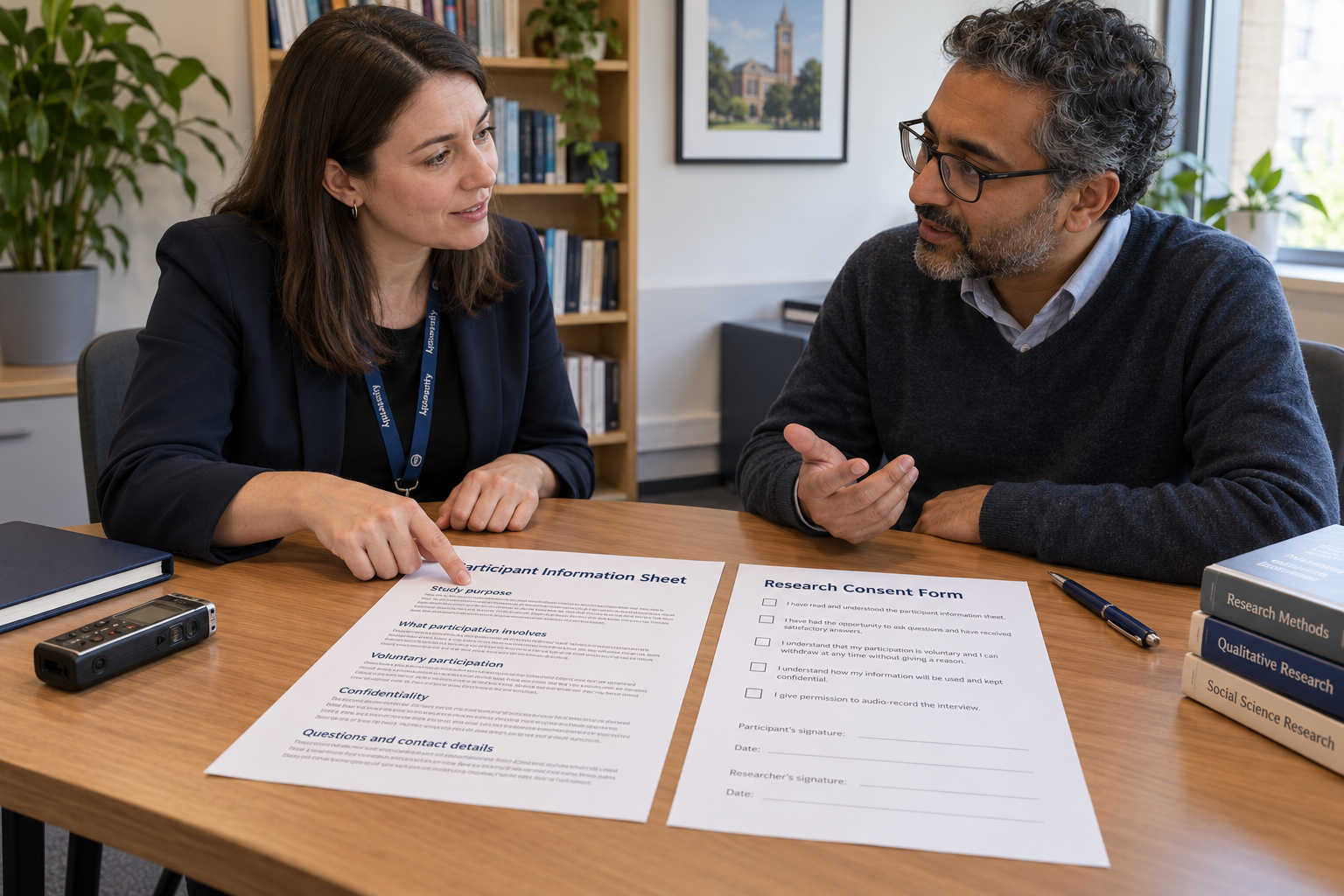
Research involving people carries responsibilities that extend beyond collecting accurate data and answering a research question. Participants may give researchers access to their experiences, opinions, behaviours, personal information, or sensitive details about their lives. Ethical research therefore requires participants to understand what they are being asked to do and to make a voluntary decision about whether they wish to take part.
Informed consent in research is the process through which this decision is supported and documented. For students completing dissertations, theses, research proposals, surveys, interviews, focus groups, or other participant-based projects, consent is not simply a signature at the bottom of a form. It depends on appropriate information, comprehension, voluntariness, capacity to consent, and a genuine opportunity to decline participation without inappropriate pressure.
Many students understand that they need a consent form but remain uncertain about what the document should contain, how it differs from a participant information sheet, whether online surveys require consent, and what to write about withdrawal, confidentiality, recordings, or future data use. This guide explains informed consent step by step and provides a practical consent form structure that can be adapted to institutional requirements without inventing ethical procedures that a study does not actually use.
What Is Informed Consent in Research?
Informed consent is an ethical process through which an eligible person receives relevant information about a research project, has an appropriate opportunity to understand and consider that information, and voluntarily agrees to participate. The emphasis is on an informed and voluntary decision. A signed document can provide evidence of consent, but the signature itself does not make consent ethically adequate if the participant did not understand what participation involved.
Consent is particularly important because researchers and participants do not always occupy equal positions. A university researcher may possess specialist knowledge that participants do not have, while a lecturer, healthcare professional, employer, or other authority figure may also hold power over potential participants. Ethical recruitment and consent procedures should reduce the risk that individuals feel obliged to participate because of that relationship.
Epic Essay's guide to writing a research methodology section identifies informed consent, confidentiality, data protection, and institutional approval as central ethical considerations in studies involving human participants. These elements should be explained as actual research procedures rather than inserted as generic ethical terminology.
Informed consent is a process of communication and voluntary decision-making. A consent form documents that process; it does not replace it.
What Makes Research Consent Truly Informed?
Several conditions normally need to work together for consent to be meaningful. Participants need sufficient information about the research, that information needs to be understandable, participation must be voluntary, and the person must have the capacity required to make the relevant decision. The precise legal and institutional requirements depend on the study and jurisdiction.
The UK Research and Innovation guidance on research consent treats consent as an ongoing process and emphasises appropriate information about matters such as participation, data use, confidentiality, and withdrawal. This is useful for student researchers because it shifts attention away from obtaining a signature and toward whether the participant has actually been supported in making an informed choice.
The core elements can be summarised as follows.
| Element | What It Means | Researcher Responsibility |
|---|---|---|
| Information | Participants receive relevant information about the research | Explain purpose, procedures, risks, data use, and participant rights clearly |
| Comprehension | Information is presented in a form participants can reasonably understand | Avoid unnecessary jargon and adapt materials where appropriate |
| Voluntariness | The decision is made without inappropriate pressure or coercion | Make refusal possible without unfair consequences |
| Capacity | The person can make the relevant informed decision | Follow applicable institutional procedures where capacity is an issue |
| Agreement | The participant actively indicates willingness to participate | Use an appropriate approved method to document or record consent |
| Continuing consent | Participation remains voluntary as the study progresses | Respect participant choices and approved withdrawal arrangements |
These elements show why researchers should not treat consent as an administrative formality completed once at recruitment. If the nature of participation changes substantially, new uses of data are proposed, or unexpected circumstances arise, further ethical consideration may be required under the institution's approved procedures.
Participant Information Sheet vs Consent Form: What Is the Difference?
A participant information sheet and a consent form perform related but different functions. The information sheet explains the research so that the potential participant can make an informed decision. The consent form records the participant's agreement to relevant aspects of participation after that information has been provided.
A participant information sheet may explain why the study is being conducted, why the individual has been invited, what they will do, how long participation will take, foreseeable risks or benefits, how data will be handled, confidentiality arrangements, withdrawal procedures, and whom to contact with questions. The exact content should follow the university's approved template and ethics requirements.
The consent form is usually more concise. It commonly contains a series of statements that the participant actively confirms, such as having read the information sheet, understanding participation is voluntary, understanding relevant withdrawal arrangements, agreeing to participate, and separately agreeing to optional procedures such as audio recording where required.
| Feature | Participant Information Sheet | Consent Form |
|---|---|---|
| Main purpose | Provides information needed to make a decision | Records agreement to participate and relevant procedures |
| Typical content | Purpose, procedures, risks, data use, confidentiality, withdrawal, contacts | Specific consent statements requiring acknowledgement |
| Typical format | Explanatory document | Short statements with confirmation mechanism |
| Researcher's question | Have I explained participation adequately? | What exactly has the participant agreed to? |
| Should one replace the other? | No | No, where both are required by the approved procedure |
Students should therefore avoid trying to squeeze the entire participant information process into a few consent checkboxes. Where institutional procedures require separate documents, each should perform its own function clearly.
What Information Should Participants Receive Before Consenting?
Participants need enough information to make a meaningful decision without being overwhelmed by irrelevant methodological detail. The information should focus on matters that reasonably affect the decision to participate. Researchers should use the terminology and content required by their ethics committee or university rather than assuming one universal template applies everywhere.
Depending on the study, participants may need information about:
- The title and purpose of the research
- Why they have been invited to participate
- What participation involves
- The approximate time commitment
- Whether interviews or activities will be recorded
- Foreseeable risks, discomforts, or inconveniences
- Potential benefits, where relevant
- Whether participation is voluntary
- Applicable withdrawal procedures and limits
- How personal information and research data will be handled
- Confidentiality or anonymity arrangements
- How quotations or other research material may be reported
- Whether data may be retained, archived, or reused where applicable
- Researcher and institutional contact information
- Relevant ethics approval or complaints information where required
The list should be adapted to the research rather than copied mechanically. A recorded qualitative interview creates different information requirements from an anonymous questionnaire, and a study involving sensitive health experiences requires different risk communication from a survey about library use.
How to Write a Clear Research Consent Form
A consent form should be written in direct, accessible language. Participants need to understand what each statement means before confirming it, so complex legalistic or academic wording can undermine the purpose of the document. Technical terms should be included only when they are necessary and appropriately explained.
Each consent item should ideally deal with a clear issue. Combining several unrelated permissions into one long statement can make it difficult for participants to understand what they are agreeing to. This is especially important when some activities are optional, such as being audio-recorded or permitting future data reuse.
The form should also be consistent with the participant information sheet and ethics application. If the information sheet promises pseudonymised reporting but the consent form refers to anonymous data, the documents create uncertainty. Ethical documentation should tell one coherent and accurate story about how the study operates.
Do not copy a consent form from another dissertation and change only the project title. Consent documents must reflect the actual participants, procedures, risks, data practices, and institutional requirements of your own study.
Research Consent Form Structure for Student Projects
Universities often provide mandatory consent templates, and those templates should take priority over a generic example. Where students are asked to develop their own draft, however, a clear structure helps ensure that major consent issues are considered before submission for ethics review.
The following structure shows the function of common sections rather than providing a universal legal form.
| Section | Purpose | Example of What It May Address |
|---|---|---|
| Study identification | Connects the form to the correct project | Research title, researcher, department or institution |
| Information acknowledgement | Confirms access to relevant study information | Participant has read or received the participant information |
| Opportunity for questions | Supports informed decision-making | Participant has had an opportunity to ask questions |
| Voluntary participation | Clarifies freedom of choice | Participation is voluntary |
| Withdrawal | Records understanding of withdrawal arrangements | How and until when withdrawal may occur under the approved protocol |
| Data and confidentiality | Confirms understanding of relevant data practices | How research information will be stored, used, or reported |
| Recording | Obtains permission where recording requires consent | Audio or video recording of an interview |
| Quotations | Addresses use of participant words where relevant | Use of anonymised or pseudonymised quotations in the dissertation |
| Optional future use | Records separate permissions where applicable | Archiving or secondary use of data |
| Agreement to participate | Records the participant's decision | Signature, date, electronic confirmation, or other approved mechanism |
The table deliberately separates optional permissions from basic participation. Whether separate consent is required for recordings, quotations, data sharing, or future reuse depends on the project and applicable institutional requirements. Researchers should not add permissions merely because they appear in an example.
Example Consent Statements for a Dissertation
Consent statements should correspond directly with information already provided to participants. The following examples illustrate common functions and need to be adapted to the approved research protocol. They should not be presented as a substitute for an institution's required consent form.
I confirm that I have received and understood the participant information for this study and have had an opportunity to ask questions. I understand that my participation is voluntary and that the withdrawal arrangements described in the participant information apply. I understand how information collected during the study will be used and protected. I voluntarily agree to participate in this research.
Where interviews are recorded, a separate statement might be required: "I agree to the audio recording of my interview for the purposes described in the participant information." If quotations will be used, the approved form may separately explain whether participants consent to anonymised or pseudonymised quotations being included in academic outputs.
Separating such statements can improve clarity because a participant may be willing to take part while having questions about an optional activity. Researchers should follow the permissions approved for their particular study rather than assuming that consent to participate automatically covers every possible use of the data.
How Informed Consent Works in Interview Research
Qualitative interviews often generate detailed personal accounts, making consent particularly important. Participants should understand the topics they will be invited to discuss, the approximate interview duration, whether recording will occur, how quotations may be used, and what confidentiality protections can realistically be provided. Sensitive interview topics may require additional information about foreseeable discomfort and available procedures.
Consent should continue during the interview itself. A participant who agreed to participate does not thereby lose the right to decline an individual question or request a break where the approved protocol allows this. Interviewers should remain attentive to discomfort rather than treating the signed form as unlimited permission to pursue every topic.
Researchers also need to distinguish confidentiality from anonymity. In an interview, the researcher normally knows who the participant is, so complete anonymity from the researcher cannot truthfully be promised. Pseudonyms, participant codes, removal of identifying details, and controlled access can instead support confidentiality and de-identification.
This distinction should be reflected consistently across the consent form, information sheet, ethics application, methodology chapter, and eventual reporting. Overpromising anonymity creates an ethical and methodological problem that careful wording can prevent.
How Consent Works in Online Surveys
Online surveys may use an electronic consent process rather than a handwritten signature. Participants can be shown the required study information before accessing the questionnaire and asked to indicate that they meet the eligibility criteria, understand the information, and voluntarily agree to participate. The exact mechanism should follow institutional ethics requirements.
Researchers should consider what happens if a respondent begins but does not submit the questionnaire. They should also understand whether the survey platform collects IP addresses, email addresses, login details, cookies, or other potentially identifying information. A survey should not be described as anonymous merely because it does not ask participants to type their names.
Withdrawal can also operate differently in genuinely anonymous surveys. Once an anonymous response has been submitted without an identifier that allows it to be located, the researcher may be unable to identify and remove a particular person's data. If this limitation applies, it should be explained before consent rather than discovered after a participant requests withdrawal.
The consent process should therefore reflect the technical design of the survey. Researchers need to understand the platform they use rather than relying on generic claims about anonymity and data protection.
Consent for Audio and Video Recording
Recording creates ethical considerations beyond ordinary participation because audio and video can contain identifiable information. Participants should know whether recording will occur, why it is necessary, who can access the files, and how the recordings will be handled according to the approved research plan. Video can be particularly identifying because faces, voices, environments, and other contextual details may reveal identity.
Where recording is optional under the research design, consent documentation should make that choice clear. Where recording is essential to participation, potential participants should know this before agreeing to take part so that they can decide whether the research is acceptable to them.
Researchers should also avoid claiming that recordings will be destroyed immediately unless this is genuinely consistent with the approved data-management plan. Transcription, checking, analysis, auditing, or institutional retention requirements may affect how long recordings need to be kept.
The methodology should later report what actually happened. If interviews were audio-recorded with participant consent and transcribed for analysis, that procedure should correspond with the information and permissions participants received.
Voluntary Participation and Avoiding Coercion
Consent is not genuinely voluntary when participants face inappropriate pressure to participate. This issue can arise when researchers recruit people over whom they have authority or from whom they depend on cooperation. Lecturer-student, manager-employee, clinician-patient, and similar relationships deserve particular attention.
Students should consider whether potential participants might believe that refusing could affect grades, employment, access to services, professional relationships, or other outcomes. Appropriate recruitment procedures can reduce this risk. For example, an invitation may explain explicitly that participation or refusal will not affect the relevant relationship.
Payments, incentives, or reimbursements may also require ethical consideration. Compensation is not automatically coercive, but the amount and context should be reviewed according to institutional requirements. Researchers should describe approved incentives accurately and avoid using rewards in ways that undermine voluntary choice.
Voluntariness is therefore created through the overall recruitment environment, not merely through a sentence stating that participation is voluntary. Researchers should examine how a reasonable potential participant might experience the invitation.
The Right to Withdraw: What Should Students Write?
The right to withdraw is commonly included in participant information and consent materials, but students sometimes promise more than their research design can deliver. A participant may be able to withdraw from an interview immediately, yet removing their data later may become impossible after irreversible anonymisation or integration into a dataset. The exact arrangements need to be established in advance.
Researchers should state how withdrawal can be requested, whether a deadline applies, and what happens to information already collected. These terms should match the approved ethics documentation. A generic promise that participants can "withdraw at any time" can be misleading if practical or methodological limits exist.
Withdrawal from participation and withdrawal of previously collected data may also be distinct. Someone can decide to stop an interview without necessarily requesting deletion of everything already provided, depending on the consent arrangements and applicable rules. Clear information prevents misunderstandings about these different decisions.
Never promise unlimited withdrawal simply because the phrase sounds ethical. State the actual withdrawal process approved for your study and explain any legitimate limits before participants consent.
Consent, Confidentiality, and Anonymity
Participants need realistic information about how their identities and research data will be protected. Confidentiality means that information entrusted to the research team is protected from unauthorised disclosure. Anonymity means that identity is not known or cannot reasonably be linked to the information, depending on the context.
Pseudonymisation is another common strategy. Names can be replaced with codes such as P01 or Interviewee 4 while the researcher separately protects any information capable of reconnecting the code with the individual. Pseudonymised data should not automatically be described as anonymous if re-identification remains possible.
Small samples create particular challenges. A quotation from "a female finance director with 25 years of experience at the organisation" may identify a person even when their name has been removed. Consent information should therefore reflect how quotations and contextual characteristics will be reported.
Students can explore these issues further when writing the ethical section of their methodology. Epic Essay's research proposal structure guide specifically identifies informed consent, confidentiality, and data protection as issues that may need to be addressed during ethical planning.
Consent When Research Involves Children or Vulnerable Participants
Research involving children or people whose capacity to consent may be limited can require additional safeguards. Researchers should not assume that an ordinary adult consent form can simply be reused. Requirements vary by jurisdiction, participant group, research context, and institution, making formal ethics guidance particularly important.
Depending on the project, researchers may need to consider parental or guardian permission, participant assent, capacity assessment, accessible information materials, safeguarding arrangements, or other protections. Assent and consent are not interchangeable concepts, and the applicable procedure should come from the institution's ethics framework.
Vulnerability can also arise from circumstances rather than belonging permanently to a particular category. Power imbalance, dependence, severe distress, precarious legal status, or exposure to social consequences may affect the ethics of recruitment and consent. Researchers should therefore assess the actual research context rather than relying only on labels.
Do not design consent procedures for higher-risk or vulnerable populations from a generic online template. Use the specific requirements of your institution, ethics committee, discipline, and applicable legal framework.
Is Signed Consent Always Required?
Written signatures are common, but they are not the only possible way of documenting consent. Depending on the research context and approved ethics procedure, consent may be documented electronically, verbally, through an online confirmation, or by another appropriate mechanism. Some research contexts may also justify alternative approaches when signed documentation creates practical or ethical problems.
This does not mean researchers can simply choose whichever method is easiest. The method should be suitable for the level of risk, participant population, type of data, institutional policy, and legal context. Ethics approval should cover the intended procedure where approval is required.
Researchers should distinguish documentation of consent from consent itself. A signed form documents a decision, whereas informed consent refers to the quality and voluntariness of the decision-making process. This distinction helps explain why a technically complete form can still accompany an ethically inadequate recruitment process.
For a student dissertation, the safest approach is to follow the university's required template and ethics decision rather than improvising an alternative consent mechanism after recruitment has begun.
Where Should the Consent Form Appear in a Dissertation?
The methodology chapter should explain the consent process, but the full consent form usually functions as supporting documentation rather than core analysis. Where institutional rules permit, it can therefore be included in the dissertation appendices alongside related materials such as the participant information sheet, questionnaire, interview guide, or ethics approval documentation.
Epic Essay's guide to dissertation appendices specifically identifies consent forms and ethics approval documentation as appropriate appendix material. The main methodology should still explain how consent operated; placing the form in an appendix does not replace that explanation.
For example, the methodology might state that eligible participants received a participant information sheet and provided informed consent before interviews began, with the approved consent form reproduced in Appendix B. This gives the reader the essential methodological information while allowing the supporting document to remain available for verification.
Students should remove or avoid including completed forms containing participant signatures or other personal information unless their institution specifically requires and permits this. Usually, the relevant appendix is a blank version of the research instrument or consent document rather than participants' identifiable records.
How to Describe Informed Consent in a Research Proposal
A proposal describes what will happen rather than what has already occurred. The ethics section should therefore explain the planned recruitment and consent procedure using future-oriented language. It should also show that consent has been considered alongside confidentiality, risk, data protection, and any required institutional approval.
A suitable proposal statement might explain that potential participants will receive study information before participation, will have an opportunity to ask questions where appropriate, and will provide consent through the approved mechanism before data collection begins. It can also state how voluntariness and withdrawal will be communicated.
The statement should not claim that ethics approval "has been obtained" unless that is already true. Similarly, it should not describe a consent form as approved if it remains under review. Precision about the stage of the research demonstrates methodological integrity.
Epic Essay's research proposal outline places ethical considerations within the standard proposal structure. Planning consent at this stage ensures that recruitment, instruments, data management, and ethics documentation are designed consistently before data collection begins.
How to Report Informed Consent in a Completed Dissertation
A completed dissertation should use past tense to describe the consent procedure that genuinely occurred. Readers need to understand how participants were informed, how agreement was obtained, and any relevant protections associated with the data-collection method. The explanation should be concise but specific enough to demonstrate ethical practice.
For example, an interview study might state that participants received the approved information sheet before the interview and provided informed consent before recording commenced. It could then explain that participation was voluntary, relevant withdrawal arrangements were communicated, and identifying details were handled according to the approved confidentiality procedure.
The methodology should match the documentary evidence. If the appendix contains a consent form that refers to audio recording, but the methodology states that interviews were not recorded, the inconsistency raises questions about the research process. Ethics documentation, methodology, and actual practice should align.
The Epic Essay methodology guide emphasises transparent explanation of how a study was designed and conducted. Consent should be reported with the same precision as sampling, data collection, and analysis.
Common Informed Consent Mistakes Students Should Avoid
One frequent mistake is treating the consent form as the entire ethical process. Students may obtain signatures but provide inadequate information about recordings, withdrawal, data use, or risks. A completed form cannot compensate for missing information that participants reasonably needed before deciding.
A second mistake is promising complete anonymity when the researcher knows participants' identities. Interviews and focus groups often require confidentiality and pseudonymisation rather than true anonymity. The terminology should describe the actual level of protection accurately.
Students also sometimes use vague consent statements such as "I agree that my data can be used for research." This may fail to explain what research use means, particularly if quotations, recordings, future reuse, publication, or data sharing are relevant. Specific permissions should follow institutional requirements.
Finally, researchers may change their methods without considering whether the existing consent still covers the revised procedure. Adding video recording, collecting a new category of personal data, or changing the intended use of data can create new ethical issues. Where a material change occurs, students should consult their supervisor or ethics process before implementing it.
A Step-by-Step Informed Consent Checklist for Student Researchers
Before recruiting participants, students should compare their information sheet, consent form, methodology, data-collection instrument, and ethics application. These materials should describe the same research procedures and should not make conflicting promises about participant rights or data handling.
A practical checklist is:
- Check your university's current research ethics and consent requirements.
- Identify exactly who will be invited and whether additional safeguards are required.
- Prepare clear participant information explaining the study and participation.
- Describe foreseeable risks, discomforts, and relevant benefits accurately.
- Explain whether participation is voluntary and how recruitment avoids inappropriate pressure.
- Define the approved withdrawal process and any legitimate limits.
- Explain confidentiality, anonymity, or pseudonymisation accurately.
- State whether audio, video, or other identifiable recording will occur.
- Explain how quotations and research data may be used where relevant.
- Use separate permissions for optional activities where required.
- Make sure consent language is understandable to the intended participants.
- Ensure the consent form matches the participant information sheet.
- Obtain required ethics approval before beginning recruitment or data collection.
- Keep consent records securely according to the approved data-management plan.
- Report the actual consent procedure accurately in the final dissertation.
This checklist is not a substitute for institutional ethics requirements. Its purpose is to help students identify inconsistencies before they become problems during ethics review or data collection.
Writing an Informed Consent Process That Protects Participants
Informed consent in research is fundamentally about enabling people to make knowledgeable and voluntary decisions about participation. Information, comprehension, voluntariness, appropriate capacity, and clear agreement all contribute to that process. A signature can document consent, but it cannot replace meaningful communication between the researcher and participant.
For student research, the participant information sheet and consent form should work together. The information sheet explains what participation involves, while the consent form records agreement to relevant procedures. Both documents should align with the ethics application, methodology, recruitment process, data-management plan, and actual conduct of the study.
The strongest approach is therefore not to search for a universal consent form and copy it unchanged. Start with the specific research design, identify what participants genuinely need to know, use the university's approved guidance and templates, and describe the resulting procedure accurately. When consent is treated as an ethical process rather than paperwork, it protects participants while also strengthening the transparency and credibility of the dissertation.



Comments