A literature review is one of the most demanding sections of academic research writing because it requires more than summarising sources. Students are expected to demonstrate critical reading, analytical thinking, and the ability to synthesise existing scholarship into a coherent academic narrative. For many, seeing a clear literature review example is essential to understanding what is expected.
Despite detailed marking criteria, students often struggle to distinguish between descriptive writing and analytical review. Common problems include listing studies without evaluation, failing to show connections between sources, and not clearly linking the literature to the research question. These issues frequently result in low marks, especially in dissertations and research proposals.
This article explains what a strong literature review looks like in practice. It breaks down structure, analytical techniques, and provides a detailed literature review example with commentary, helping students model their own work confidently and correctly.
What a Literature Review Is Expected to Demonstrate
A literature review demonstrates a student’s understanding of existing research related to their topic. Its primary purpose is to position the current study within the academic conversation by identifying what is already known, what remains contested, and where gaps exist.
Examiners look for evidence of critical engagement rather than passive reporting. This means evaluating sources, comparing findings, and identifying patterns or contradictions across studies. A strong literature review shows that the student can think like a researcher rather than a note-taker.
A literature review is an argument about existing research, not a catalogue of sources.
This expectation shapes both structure and writing style, which must remain analytical throughout.
Key Structural Elements of an Effective Literature Review
Although literature reviews vary by discipline, most follow a recognisable academic structure. Understanding this structure helps students organise material logically and avoid fragmented discussion.
Typically, a literature review begins with a thematic or conceptual overview, followed by grouped discussion of key debates or variables. It ends by identifying gaps, limitations, or unresolved issues that justify the current research.
The table below outlines common structural components found in high-quality literature reviews.
| Section Focus | Purpose | Academic Outcome |
|---|---|---|
| Contextual overview | Introduce the research area | Establish relevance |
| Thematic discussion | Compare and evaluate studies | Demonstrate critical synthesis |
| Methodological review | Assess research approaches | Highlight strengths and weaknesses |
| Research gap | Identify limitations in literature | Justify the current study |
These elements should be integrated smoothly rather than treated as isolated sections.
Common Mistakes Students Make Before Looking at an Example
Before examining a literature review example, it is important to understand frequent student errors. One of the most common mistakes is writing source summaries in isolation, where each paragraph describes a single study without linking it to others.
Another frequent issue is excessive quotation. Literature reviews should prioritise paraphrasing and synthesis rather than reproducing source language. Over-quotation suggests limited understanding and weak analytical control.
Students also often fail to explain why reviewed studies matter. Without explicit relevance to the research focus, even high-quality sources lose academic value.
A Literature Review Example (Extract with Analysis)
The example below illustrates how a literature review paragraph integrates multiple sources, compares findings, and maintains analytical focus. The topic used is illustrative and suitable for social science or education research.
Example literature review paragraph:
Recent studies on student engagement in online learning environments emphasise the role of interaction and instructional design. Smith (2019) found that structured discussion forums significantly improved participation rates, while Lee and Chen (2020) argued that peer-to-peer collaboration was more influential than instructor presence. However, both studies relied on short-term interventions, limiting their ability to assess sustained engagement. In contrast, Brown (2021) adopted a longitudinal approach, demonstrating that initial engagement gains often declined without adaptive feedback mechanisms. These findings suggest that while interactive features are essential, long-term engagement depends on responsive instructional strategies rather than static design elements.
This paragraph does not merely describe studies. It compares findings, evaluates limitations, and draws an analytical conclusion that sets up a research gap.
Why This Literature Review Example Works Academically
The effectiveness of the example lies in synthesis. Multiple sources are discussed within a single paragraph, allowing similarities and differences to be highlighted explicitly. This approach signals critical engagement.
The paragraph also evaluates methodology, noting the limitations of short-term studies. This evaluative dimension is essential at undergraduate and postgraduate levels.
Finally, the paragraph ends with an interpretive insight rather than a summary, showing how the literature informs the direction of the research.
Developing Thematic Paragraphs Using a Model Approach
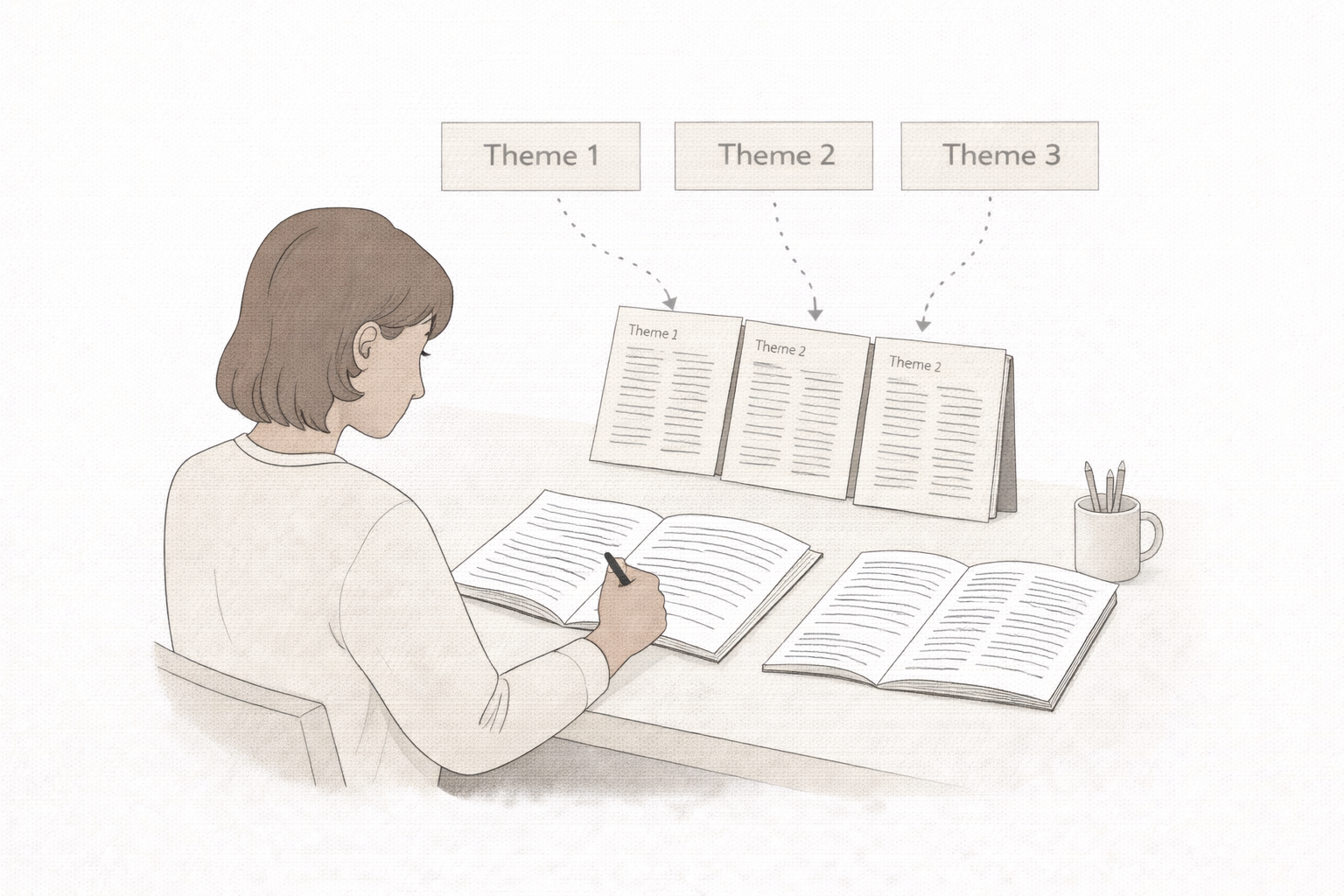
Thematic organisation is a defining feature of strong literature reviews. Rather than organising by author, themes group studies around concepts, variables, or debates.
To develop thematic paragraphs, students should first identify recurring ideas across sources. These ideas then become the organising logic of each paragraph.
This approach encourages comparison and reduces repetition, making the review more coherent and persuasive.
Balancing Description and Critical Analysis
Description is unavoidable in a literature review, but it should never dominate. Each descriptive statement should be followed by analysis that explains significance, limitation, or relevance.
A useful rule of thumb is that no source should be mentioned without an evaluative comment. This ensures that the review remains analytical rather than narrative.
If a paragraph could appear in an annotated bibliography, it is not analytical enough.
Maintaining this balance is essential for higher-level academic work.
Using Methodological Comparison in Literature Reviews
Beyond findings, literature reviews often assess research methods used in previous studies. Methodological comparison strengthens justification for the chosen research design.
Students may comment on sample size, data collection techniques, or analytical frameworks. These observations show methodological awareness and research maturity.
Such comparisons are especially important in dissertations and research proposals.
Linking the Literature Review to the Research Question
A strong literature review remains tightly aligned with the research question. Every theme and source should contribute to refining, supporting, or challenging the study’s focus.
Irrelevant literature weakens coherence and signals poor research judgement. Students should continually ask how each source informs their specific research aim.
This alignment becomes explicit toward the end of the literature review, where gaps and unresolved issues are identified.
Ending a Literature Review with a Clear Research Gap
The final function of a literature review is to justify the current study. This is achieved by identifying gaps, inconsistencies, or limitations in existing research.
A research gap does not mean that no studies exist, but that important questions remain unanswered. Clearly articulating this gap demonstrates originality.
A well-written ending prepares the reader for the methodology or research design that follows.
How to Use a Literature Review Example Effectively
Literature review examples are learning tools, not templates to copy. Students should focus on structure, analytical tone, and synthesis techniques rather than content.
By modelling paragraph construction, source integration, and evaluative language, examples help students internalise academic expectations.
When combined with careful reading and planning, a strong literature review example can significantly improve writing quality and confidence.



Comments