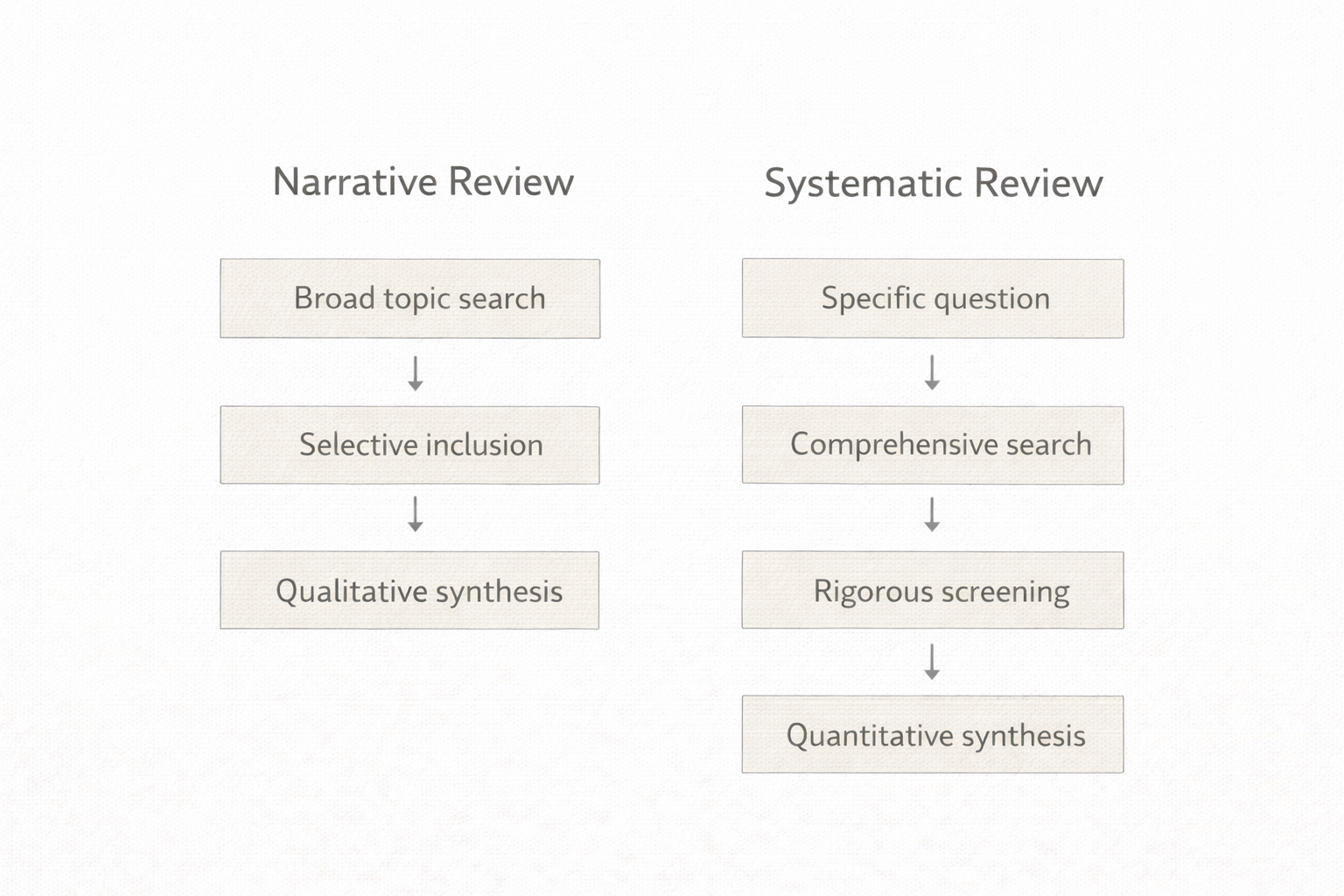
Literature reviews are a core component of academic research writing, yet students often struggle to distinguish between different review types. One of the most common points of confusion is the difference between a narrative literature review and a systematic review. Although both engage with existing scholarship, they are designed for different purposes and are assessed using different academic criteria.
Misunderstanding this distinction can lead to serious problems, including inappropriate methodology, unclear justification, or failure to meet assignment requirements. Examiners frequently penalise work that claims to be systematic but lacks transparent methods, or narrative reviews that attempt to mimic systematic processes without sufficient rigour.
This article explains narrative literature review vs systematic review in depth. It outlines their defining features, methodological expectations, strengths, and limitations, helping students select and apply the correct approach with academic confidence.
Understanding the Purpose of Literature Reviews in Research
All literature reviews aim to engage with existing research to situate a study within an academic field. However, the purpose of that engagement varies depending on the review type. Purpose determines structure, scope, and methodological expectations.
Narrative literature reviews prioritise interpretation, conceptual development, and critical discussion. Systematic reviews prioritise transparency, completeness, and methodological reproducibility. Recognising this difference is essential before choosing an approach.
Both forms are academically valid when used appropriately. Problems arise only when expectations are misunderstood or misapplied.
What Is a Narrative Literature Review?
A narrative literature review, sometimes called a traditional literature review, provides an interpretive overview of existing research on a topic. Its primary goal is to explore, compare, and critique ideas, theories, and findings within a field.
Narrative reviews are flexible in structure and allow the researcher to shape the discussion around themes, debates, or theoretical perspectives. Source selection is guided by relevance rather than exhaustive coverage.
A narrative literature review tells the story of a research field through critical interpretation.
This approach is widely used in undergraduate essays, theoretical papers, and dissertation literature review chapters.
What Is a Systematic Review?
A systematic review is a methodologically rigorous approach to identifying, evaluating, and synthesising all relevant studies on a specific research question. Its defining feature is a transparent, predefined process that minimises selection bias.
Systematic reviews follow explicit steps, including protocol development, comprehensive searching, inclusion and exclusion criteria, quality appraisal, and structured synthesis. Each decision is documented so the process can be replicated.
A systematic review is defined by its method, not its topic.
This approach is common in postgraduate research, health sciences, and evidence-based disciplines.
Key Methodological Differences Between Narrative and Systematic Reviews
The most significant differences between narrative literature reviews and systematic reviews lie in methodology. These differences affect how sources are selected, analysed, and reported.
The table below summarises the core distinctions that examiners and supervisors expect students to understand.
| Dimension | Narrative Literature Review | Systematic Review |
|---|---|---|
| Primary purpose | Interpret and critique research | Comprehensively synthesise evidence |
| Search strategy | Selective and flexible | Predefined and exhaustive |
| Source selection | Based on relevance | Based on explicit criteria |
| Transparency | Implicit | Explicit and documented |
| Replicability | Not required | Required |
These differences explain why the two approaches are not interchangeable.
Strengths of Narrative Literature Reviews
Narrative literature reviews are particularly strong at developing conceptual understanding. They allow researchers to explore theoretical frameworks, historical development, and intellectual debates in depth.
This flexibility supports originality and critical voice. Students can synthesise literature creatively, identify emerging perspectives, and challenge dominant interpretations.
Because of this, narrative reviews are well suited to exploratory research and theory-driven disciplines.
Limitations of Narrative Literature Reviews
The main limitation of narrative reviews is potential subjectivity. Because search and selection processes are not fully specified, readers cannot always assess whether important studies were omitted.
Without clear methodological boundaries, narrative reviews may also be criticised for bias or lack of comprehensiveness, particularly in evidence-based fields.
These limitations do not invalidate narrative reviews but must be acknowledged and managed through critical transparency.
Strengths of Systematic Reviews
Systematic reviews are valued for their methodological rigour and transparency. By following predefined procedures, they reduce bias and increase confidence in the findings.
This approach allows readers to trace decisions at every stage, from search strategy to synthesis. As a result, systematic reviews are often considered high-level evidence.
In policy, clinical, and applied research, systematic reviews support evidence-based decision-making.
Limitations of Systematic Reviews
Despite their strengths, systematic reviews have limitations. They are time-intensive and require advanced planning, database access, and methodological expertise.
Systematic reviews may also prioritise breadth over depth, limiting theoretical exploration or nuanced interpretation. This can be restrictive in conceptually complex fields.
For many undergraduate assignments, a full systematic review is neither expected nor appropriate.
How Examiners Evaluate Narrative vs Systematic Reviews
Examiners assess literature reviews based on alignment with stated methodology. A narrative review is judged on analytical depth, synthesis, and critical engagement.
A systematic review is judged on methodological transparency, completeness, and justification of procedures. Failing to meet these expectations results in significant penalties.
Claiming a review is systematic without systematic methods is a critical academic error.
Clear methodological positioning protects students from misinterpretation.
Choosing Between a Narrative Literature Review and a Systematic Review
The choice between a narrative literature review and a systematic review should be guided by assignment instructions, research goals, and academic level.
Narrative reviews are appropriate when the aim is to explore ideas, build theory, or contextualise research questions. Systematic reviews are appropriate when the aim is to synthesise all available evidence on a narrowly defined question.
Students should never choose a systematic review simply because it appears more advanced.
Hybrid and Semi-Systematic Approaches
Some research projects adopt hybrid approaches, combining narrative synthesis with structured searching. These are sometimes referred to as semi-systematic or integrative reviews.
While these approaches can be effective, they must be clearly described and justified. Ambiguity about review type weakens academic credibility.
Clarity of method is more important than methodological labels.
Common Student Errors When Comparing Review Types
A common error is treating systematic reviews as extended literature searches rather than methodological studies. Another is assuming narrative reviews lack rigour.
Students also frequently underestimate the workload involved in systematic reviews, leading to incomplete or poorly documented processes.
Avoiding these errors requires early planning and careful reading of assignment criteria.
Applying the Correct Review Type with Academic Confidence
Understanding narrative literature review vs systematic review empowers students to make informed methodological decisions. Each approach has a legitimate place within academic research.
When the review type aligns with research goals and is executed properly, it strengthens argumentation and credibility.
Academic success depends not on choosing the most complex method, but on choosing the most appropriate one and applying it with rigour.



Comments