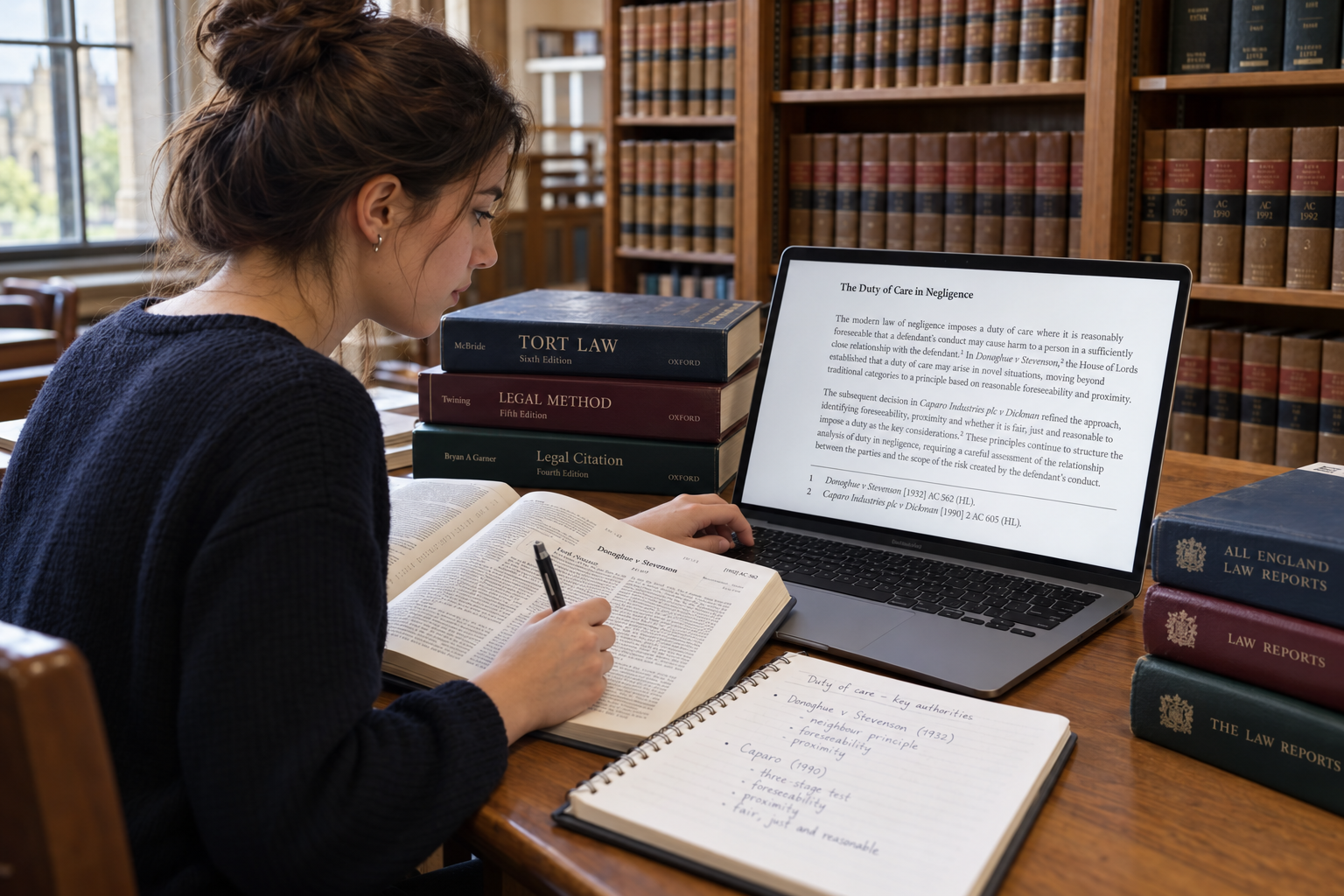
Legal academic writing depends on authority. A law essay, problem question, case note, or dissertation does not become persuasive simply because its argument sounds convincing; the reader must be able to identify the cases, legislation, academic commentary, and other legal materials on which that argument is based. OSCOLA referencing provides a systematic way of identifying those authorities while keeping citations separate from the main flow of legal analysis.
OSCOLA stands for the Oxford University Standard for Citation of Legal Authorities. The current fifth edition was published in 2026 and is maintained by the University of Oxford Faculty of Law. Unlike author-date systems such as Harvard, OSCOLA primarily uses numbered footnotes, making it particularly suited to legal writing in which students regularly cite cases, statutory provisions, journal articles, books, and other authorities.
Students commonly struggle with OSCOLA because different legal sources require different citation structures. Cases are not formatted like legislation, legislation is not cited like books, and the bibliography has rules that differ from the footnotes. This OSCOLA referencing guide explains these distinctions step by step, focusing on footnotes, bibliographies, cases, legislation, secondary sources, pinpoint citations, and the mistakes that most often create inconsistent legal referencing.
What Is OSCOLA Referencing and How Does It Work?
OSCOLA is a footnote-based legal citation system designed to make legal authorities easy for readers to identify and locate. According to the University of Oxford Faculty of Law's official OSCOLA guidance, the system is used by law schools as well as journal and book publishers in the UK and beyond. Its underlying approach emphasises consistency and consideration for the reader, meaning that accurate citation is not merely a formatting exercise but part of clear legal communication.
The most visible difference between OSCOLA and common author-date systems is where the citation appears. Instead of inserting an author and year in brackets into the body of a sentence, OSCOLA places a superscript footnote marker after the relevant proposition and gives the citation in the corresponding footnote. This allows the main legal argument to remain relatively uncluttered while still providing precise authority for claims.
OSCOLA also distinguishes between primary and secondary legal sources. Primary sources include authorities such as cases and legislation, while secondary sources include books, journal articles, chapters, and scholarly commentary. Understanding that distinction is essential because the type of source determines both how it is cited and where it belongs in the supporting material at the end of a substantial piece of legal writing.
OSCOLA is not an author-date referencing system. Legal authorities are normally acknowledged through numbered footnotes, with citation formats determined by the type of source being used.
Students who need a broader explanation of why citation matters before learning OSCOLA-specific conventions can consult Epic Essay's academic referencing guide. OSCOLA follows the same fundamental principles of attribution and traceability, but adapts them to the distinctive sources and citation practices of legal scholarship.
How to Use OSCOLA Footnotes Correctly
Footnotes are central to OSCOLA referencing. When a proposition, quotation, argument, or legal rule depends on an authority, a superscript footnote number directs the reader to the citation at the bottom of the page. Footnote numbering normally proceeds consecutively through the work, allowing readers to move between the legal analysis and its supporting authorities without interrupting the sentence with lengthy citation details.
A citation should be attached closely to the proposition it supports. If a sentence explains a rule derived from a particular case, the footnote should make it clear that the cited case is the authority for that rule. When several authorities support different propositions in a paragraph, waiting until the end of the entire paragraph to provide a single footnote can create ambiguity about which authority supports which statement.
OSCOLA footnotes can contain more than one authority where several sources genuinely support the same proposition. However, citation density should not replace analysis. A string of authorities demonstrates research only when the sources are relevant to the proposition being made and the writer explains their legal significance in the main text.
The basic relationship between legal writing and its footnotes can be understood as follows:
- State the legal proposition or argument clearly in the main text.
- Insert the footnote marker at the appropriate point.
- Provide the authority in the corresponding footnote using the OSCOLA format for that source type.
- Add a pinpoint reference when directing the reader to a particular paragraph, page, section, or other precise location.
- Use the appropriate short form and cross-reference when citing the source again.
This approach keeps evidence connected to argument. Epic Essay's guide to academic citation rules explains the wider principle: citations should allow readers to distinguish sourced propositions from the writer's own analysis. In legal writing, OSCOLA footnotes perform that function without overwhelming the body of the argument.
How to Cite Cases in OSCOLA
Cases are among the most important primary sources in legal writing, and OSCOLA provides a structured hierarchy for citing them. A modern case may have a neutral citation, a report citation, or both. Where both are available, the neutral citation appears before the report citation, allowing the reader to identify both the judgment and its published report.
A typical case citation therefore contains the case name followed by the appropriate citation information. Pinpoint references are then added when the writer relies on a specific part of the judgment. Modern judgments commonly use numbered paragraphs, making paragraph numbers particularly useful when directing readers to the precise passage supporting a legal proposition.
The table below illustrates the functions of the main components rather than replacing the detailed rules in the official OSCOLA guide.
| Component | Purpose | Illustrative Form |
|---|---|---|
| Case name | Identifies the parties or case | Party A v Party B |
| Neutral citation | Identifies the court, year, and judgment number where available | [2024] UKSC 10 |
| Law report citation | Identifies the published report | [2024] 2 AC 100 |
| Pinpoint | Directs the reader to the precise paragraph or passage relied upon | [35] |
The distinction between the neutral citation and the law report citation is important. They perform different identification functions and should not be treated as interchangeable pieces of information. Students should obtain citation details from reliable legal databases or authoritative reports rather than reconstructing citations from memory or copying incomplete references from secondary websites.
Case citations also require attention to the hierarchy of law reports. Where an authoritative report is available, students should follow OSCOLA and relevant institutional guidance concerning the preferred report series. The safest approach is to check the case against a recognised legal database and then confirm its format against the official OSCOLA guide before submission.
How to Cite Legislation in OSCOLA
Legislation follows a different citation structure because statutes do not have authors in the conventional academic sense. A UK Act is generally identified by its short title and year, such as the Human Rights Act 1998. When a particular statutory provision is relevant, the citation should direct the reader to the appropriate section, subsection, schedule, paragraph, or other subdivision rather than citing the entire Act without precision.
Pinpointing legislation matters because statutes can be lengthy and individual provisions may perform very different functions. If an argument depends specifically on section 6 of an Act, citing only the title of the Act forces the reader to locate the provision independently. Accurate pinpointing therefore supports one of OSCOLA's fundamental purposes: allowing readers to verify legal propositions efficiently.
Students should also distinguish primary legislation from statutory instruments and other forms of legislative material. These sources have different citation requirements, so one generic formula should not be applied to every legislative authority. The exact structure should always be checked against the current OSCOLA rules where the source is unfamiliar.
The following table shows the practical distinctions students need to recognise.
| Source Type | Core Citation Information | Pinpoint Example |
|---|---|---|
| Act of Parliament | Short title and year | Section or subsection |
| Statutory instrument | Title, year, and SI number | Regulation or article |
| Schedule to legislation | Legislation details | Schedule and paragraph |
The important lesson is that legal citation should identify not only the authority but also the precise part of that authority supporting the proposition. A student discussing a statutory duty, exception, procedural rule, or definition should therefore cite the relevant provision whenever possible. Precision makes the legal analysis easier to verify and demonstrates familiarity with primary legal material.
How to Cite Books and Journal Articles in OSCOLA
Secondary sources provide commentary, interpretation, criticism, theoretical perspectives, and context for primary legal authorities. Books and journal articles are therefore essential in many law essays and dissertations, particularly where the assignment requires students to evaluate doctrine rather than simply identify legal rules. OSCOLA gives these materials citation structures that differ from those used for cases and legislation.
A book citation normally identifies the author, title, edition where relevant, publisher, year, and any required pinpoint. Journal articles require information such as the author, article title, publication year, volume where applicable, journal abbreviation or title, and opening page. The current OSCOLA rules also distinguish between journals that use a year as part of their volume identification and journals that use consecutively numbered volumes.
Students should not assume that punctuation and ordering conventions from Harvard, APA, or another referencing style can be transferred into OSCOLA. For example, OSCOLA does not use an author-date parenthetical citation in the main text. Switching between systems within the same assignment creates inconsistency even where all the necessary bibliographic information is technically present.
The distinction between common source categories is summarised below.
| Source | Core Information | Useful Pinpoint |
|---|---|---|
| Book | Author, title, edition where relevant, publisher, year | Page or chapter where appropriate |
| Journal article | Author, article title, year, volume where applicable, journal, opening page | Specific page |
| Chapter in an edited book | Chapter author and title, editor, book title, publication details | Specific page |
| Online material | Details required for the source type plus relevant online information | Page, paragraph, section, or other locator where available |
The table should be treated as a checklist of information rather than a substitute for the official format. Source types can contain additional complications, particularly where authorship, editions, electronic publication, institutional responsibility, or unusual publication structures are involved. Students should therefore record complete source details during research instead of attempting to reconstruct them immediately before submission.
How Pinpoint References Work in OSCOLA
A citation identifies a source, whereas a pinpoint directs the reader to the precise location within that source that supports the writer's proposition. This distinction is particularly important in law because judgments, statutes, and scholarly works can be extensive. Citing an entire 200-page judgment or a lengthy Act when only one paragraph or provision is relevant makes verification unnecessarily difficult.
The form of the pinpoint depends on the authority. Cases may use numbered paragraphs or pages, legislation uses subdivisions such as sections and subsections, and secondary literature commonly uses page numbers. The aim is consistent even though the notation changes: the reader should be able to move from the proposition in the student's writing to the exact supporting material efficiently.
Pinpoints are especially important when quoting directly. A quotation without an exact locator tells the reader which source was used but not where the wording can be checked. The same principle applies to close discussion of a judge's reasoning, a statutory definition, or a particular academic argument.
When your argument depends on a precise passage, provision, or proposition, cite the precise location rather than only identifying the source as a whole.
How to Handle Repeated Sources and Subsequent OSCOLA Citations
Long legal assignments frequently cite the same authority more than once. Repeating a complete citation every time can make footnotes unnecessarily long, so OSCOLA provides rules for subsequent citations. Under the current fifth edition, a later citation can briefly identify the source and cross-refer to the footnote containing the full citation.
An important change for students familiar with older OSCOLA material concerns the use of Latin citation shortcuts. The fifth edition instructs writers not to use ibid for subsequent citations. Older online guides based on the fourth edition may still recommend it, which is why students should check that the guidance they are following reflects the current edition rather than automatically copying an older referencing example.
For a case, a subsequent citation may use a shortened case name followed by a cross-reference to the earlier footnote and a new pinpoint where necessary. Legislation can also use an established or defined short form where this improves readability. Secondary sources can similarly be identified in abbreviated form where the reader can unambiguously trace them back to the full citation.
This is a good example of why referencing should be checked against current authoritative guidance rather than treated as a fixed set of rules learned once. The official OSCOLA resource maintained by Oxford's Faculty of Law provides access to current fifth-edition information and should take priority over examples based on superseded editions.
How to Structure an OSCOLA Bibliography
The bibliography serves a different function from the footnotes. Footnotes show the authority supporting a particular proposition at the point where it is used, whereas the end matter gives readers an organised account of relevant sources in accordance with OSCOLA requirements and any additional rules imposed by the student's university. Students should therefore not assume that footnote citations can simply be copied unchanged into a bibliography.
One important distinction is the treatment of primary and secondary material. Cases and legislation are normally handled separately from the bibliography of secondary sources, commonly through tables of cases and legislation where required. The bibliography itself organises secondary materials according to OSCOLA conventions, making it easier for readers to identify the scholarship underpinning the work.
Author names and ordering also require careful attention in a bibliography. A citation that is correct in a footnote may need adjustment when placed in the bibliography because bibliography organisation is designed for alphabetical retrieval. This is one reason students should conduct a separate bibliography check instead of assuming that correctly formatted footnotes guarantee correctly formatted end matter.
A practical final check should consider the following:
- Whether cases and legislation have been treated separately where required.
- Whether secondary sources are presented in the correct bibliography structure.
- Whether entries are ordered consistently according to OSCOLA rules.
- Whether author names and publication details are complete.
- Whether the university or module requires any additional tables or variations.
- Whether the work follows one edition of OSCOLA consistently.
Students should also distinguish an OSCOLA bibliography from an annotated bibliography. An annotated bibliography contains evaluative or explanatory commentary beneath individual sources, whereas an ordinary OSCOLA bibliography is designed to record sources rather than analyse each one. Epic Essay's annotated bibliography guide explains this distinction in more detail.
Common OSCOLA Referencing Mistakes Students Should Avoid
One of the most common mistakes is mixing OSCOLA with another citation style. A student may use OSCOLA footnotes for cases but accidentally format books in Harvard style or insert author-date citations into the main text. The result is not a hybrid improvement but an inconsistent referencing system that makes the assignment appear poorly checked.
Another problem is incomplete case citation. Students sometimes copy only a case name from lecture notes, a textbook, or a website without confirming the authoritative citation or providing a pinpoint. Lecture materials may help identify an authority, but the student should locate the underlying legal source and obtain accurate citation information before relying on it in assessed work.
Incorrect use of outdated guidance can create subtler errors. Because OSCOLA's fifth edition was published in 2026, many university webpages, reference-management templates, and older online tutorials may still contain fourth-edition conventions. Always establish which OSCOLA edition your institution requires and check current rules before applying examples found online.
Finally, students often postpone referencing until the essay is finished. This creates unnecessary work because page numbers, report citations, publication details, and URLs may need to be rediscovered. Recording complete citation information while researching and adding footnotes during drafting is usually more reliable than reconstructing an entire citation system immediately before the deadline.
A Practical OSCOLA Referencing Checklist Before Submission
Final proofreading should treat referencing as a separate task from checking grammar and argument. A paper can contain strong legal analysis but still appear careless if footnotes vary in format, pinpoints are missing, or bibliography entries are inconsistent. Reviewing citations independently makes these technical problems easier to detect.
Start by checking primary authorities. Confirm case names, neutral citations, law report citations, statutory titles, years, and specific provisions against reliable legal sources. Then review secondary materials to ensure books, chapters, journal articles, and online sources follow the appropriate OSCOLA structure rather than conventions imported from another style.
Next, inspect the relationship between the main text and footnotes. Every footnote should have an identifiable purpose, and every authority should support the proposition to which it is attached. Check subsequent citations carefully, particularly if earlier drafts were created using older OSCOLA conventions or automatically generated references.
Reference-management software can assist with citation organisation, but generated references still require human checking. The Oxford Faculty of Law notes that some available reference-management styles continue to relate to the fourth edition, making manual verification particularly important during the transition to OSCOLA 5. A tool can accelerate formatting, but responsibility for the accuracy of the submitted citation remains with the writer.
Using OSCOLA Referencing Accurately in Legal Writing
Effective OSCOLA referencing begins with understanding what kind of authority is being cited. Cases, legislation, books, journal articles, and other legal materials perform different functions and therefore require different citation structures. Once students recognise those categories, OSCOLA becomes more systematic and less dependent on memorising isolated examples.
Accuracy also depends on precision. Footnotes should connect authorities to specific propositions, pinpoints should direct readers to the relevant passage or provision, and subsequent citations should allow previously identified sources to be located without unnecessary repetition. The bibliography and any tables of authorities should then provide an organised end-of-document record appropriate to the assignment requirements.
Most importantly, students should use current guidance. OSCOLA is intended to make legal authorities easier for readers to navigate, so consistency and clarity matter as much as punctuation. By recording source details during research, following the fifth edition carefully, checking institutional requirements, and proofreading citations separately before submission, students can make OSCOLA referencing a reliable part of legal analysis rather than a last-minute formatting problem.



Comments