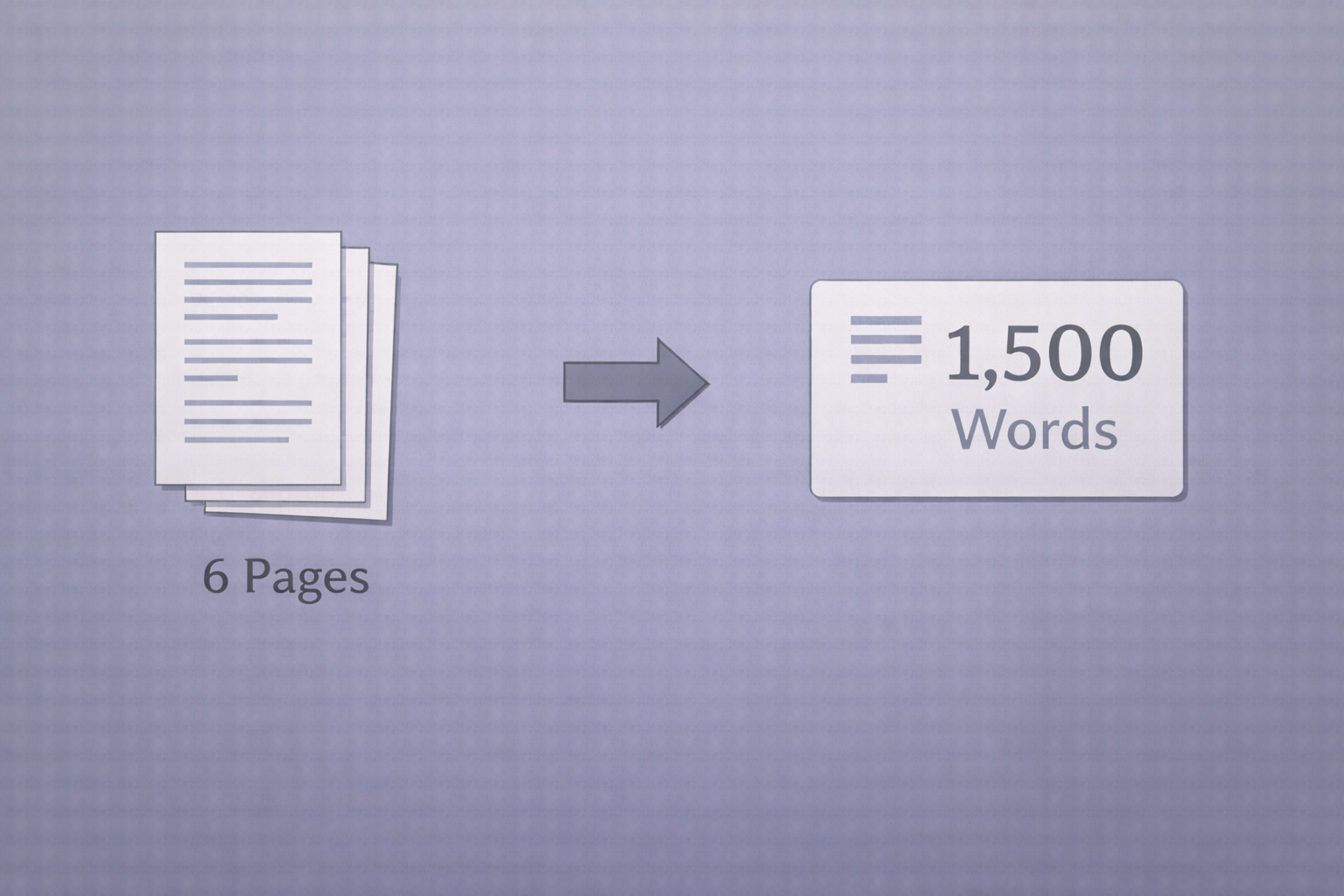
In academic writing, assignment instructions often refer to length in either pages or words, sometimes interchangeably and sometimes inconsistently. Students are frequently required to submit essays, reports, or dissertations that meet strict length expectations, yet the relationship between pages and words is rarely explained in detail.
This lack of clarity creates unnecessary anxiety, especially when penalties are attached to under- or over-length submissions. Understanding how pages convert to words, and why those conversions vary, is therefore a practical academic skill rather than a trivial formatting concern. This article explains the pages-to-words relationship in depth and shows how to apply it reliably across common academic contexts.
Why Page and Word Counts Matter in Academic Assessment
Page and word limits are used by academic institutions to standardise workload, ensure fairness, and assess students’ ability to communicate concisely. Exceeding or falling short of these limits can signal poor planning or a failure to follow instructions, even when the content itself is strong.
Markers typically expect students to remain within a small tolerance range, but this tolerance is based on word count rather than page count. As a result, word count is usually the decisive metric, even when page length is mentioned in the brief.
Understanding pages to words conversions helps students plan drafts more accurately and avoid unnecessary revisions at the final stage.
Examiner expectation: Word count takes precedence over page count unless the brief explicitly states otherwise.
The Standard Pages to Words Conversion Explained
In most academic contexts, a “standard page” assumes specific formatting conventions. These conventions form the basis for commonly cited pages-to-words estimates.
Under standard university formatting, one double-spaced page contains approximately 250–300 words. A single-spaced page typically contains 450–500 words. These figures are approximations rather than guarantees.
Students should treat these numbers as planning guides, not as substitutes for an actual word count.
Common Academic Formatting Assumptions
Pages-to-words estimates usually assume the following formatting:
- 12-point font size
- Times New Roman or a similar serif font
- Double spacing
- Standard margins (2.5 cm or 1 inch)
Any deviation from these assumptions will affect how many words fit on a page.
Pages to Words Conversion Table
The table below provides commonly used estimates for pages-to-words conversion under standard academic formatting. These figures are useful for early planning and outlining.
| Number of pages | Double-spaced (≈250 words/page) | Single-spaced (≈500 words/page) |
|---|---|---|
| 1 page | 250 words | 500 words |
| 2 pages | 500 words | 1,000 words |
| 5 pages | 1,250 words | 2,500 words |
| 10 pages | 2,500 words | 5,000 words |
These conversions provide a planning baseline, but the final word count should always be checked using a word processor.
Factors That Change Pages to Words Ratios
Pages-to-words ratios are not fixed because page length depends on multiple formatting variables. Ignoring these variables is one of the most common causes of confusion.
Understanding what influences page density allows students to predict changes more accurately and avoid formatting errors.
Font Type and Font Size
Different fonts occupy different amounts of horizontal space. For example, Arial generally fits fewer words per page than Times New Roman at the same font size.
Increasing font size even slightly can significantly reduce the number of words per page, potentially leading to misleading page counts.
Line Spacing and Paragraph Spacing
Double spacing dramatically reduces the number of words per page compared to single spacing. Additional spacing between paragraphs also affects total page length.
Academic formatting guidelines usually specify spacing precisely, and deviations may be penalised.
Margins and Page Layout
Narrower margins allow more words per page, while wider margins reduce word density. Universities typically require standard margins to ensure consistency.
Altering margins to manipulate page length is generally considered poor academic practice.
Pages Versus Words in Assignment Instructions
Some assignment briefs specify page length, while others specify word count. Occasionally, both are mentioned, creating uncertainty.
When this occurs, students should prioritise word count unless the brief explicitly states that page count is the primary requirement.
If ambiguity remains, it is advisable to seek clarification or follow institutional guidance on academic writing standards.
Critical rule: Never assume that a “page” means the same thing across different modules or departments.
Using Pages to Words for Writing Planning
Pages-to-words estimates are particularly useful during the planning stage of an assignment. They allow students to allocate word limits proportionally across sections.
For example, knowing that a 10-page essay is approximately 2,500 words helps students design an outline with balanced sections and realistic paragraph lengths.
This planning approach reduces the likelihood of extensive restructuring late in the writing process.
Common Student Mistakes with Pages to Words
One frequent mistake is relying solely on page count instead of checking the actual word count. This can lead to unintentional over-length submissions.
Another common issue is assuming that all formatting styles produce identical page densities, which is rarely true.
Awareness of these pitfalls helps students maintain academic accuracy and professionalism.
Digital Tools and Word Count Accuracy
Modern word processors provide precise word count tools that should always be used before submission. These tools typically exclude references if required, depending on institutional policy.
Online academic writing support platforms often emphasise word count accuracy as part of good academic practice, particularly within structured academic writing services.
Ultimately, word count tools eliminate guesswork and should be trusted over visual page estimates.
When Page Counts Are Still Relevant
Although word count dominates academic assessment, page count still matters in certain contexts. Printed submissions, formatting reviews, and visual presentation assessments may consider page length.
However, even in these cases, page count is typically secondary to clarity, structure, and adherence to academic conventions.
Students should therefore treat page length as a formatting concern, not as a primary measure of content volume.
Applying Pages to Words Knowledge Confidently
Understanding how pages convert to words empowers students to interpret assignment instructions accurately and plan their writing efficiently. It reduces uncertainty and improves compliance with academic expectations.
By combining pages-to-words estimates with precise word count checks, students can submit work that is both structurally sound and technically correct.
This practical awareness supports stronger academic performance and reflects a professional approach to university-level writing.
Comments