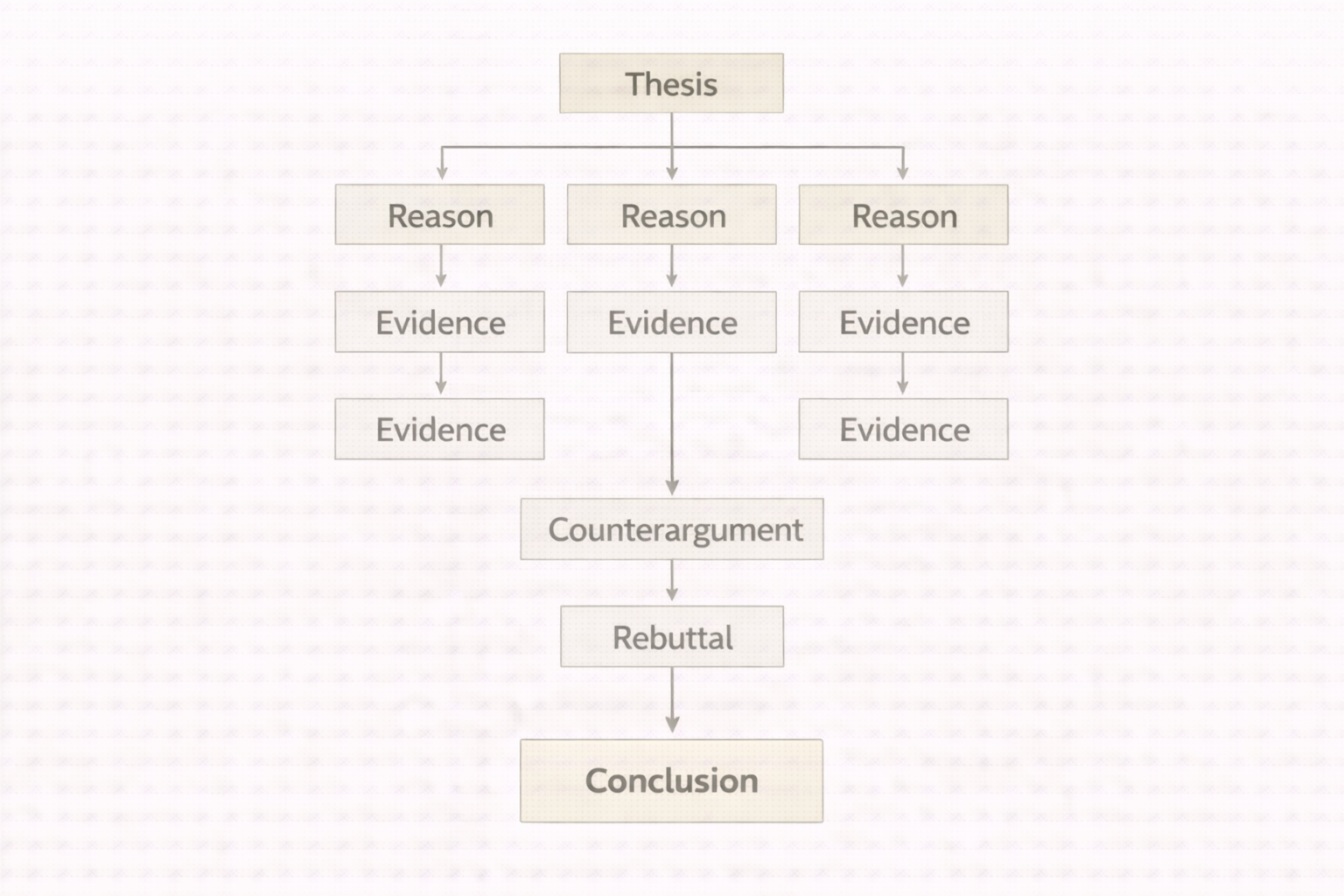
Persuasive essays are a central feature of university assessment because they test a student’s ability to argue, reason, and influence an academic audience. Unlike purely informative writing, persuasive essays require careful planning to ensure that claims are logically developed, evidence is compelling, and counterarguments are addressed convincingly. For this reason, many students rely on a persuasive essay outline template to structure their work effectively.
An outline functions as a strategic planning tool rather than a rigid formula. It allows writers to organise arguments, anticipate reader objections, and maintain coherence across the essay. This article explains how persuasive essay outlines work in academic contexts and provides a detailed template suitable for most university assignments.
What Is a Persuasive Essay Outline?
A persuasive essay outline is a structured plan that maps out how an argument will be presented and defended. It identifies the central position, supporting reasons, evidence, and responses to opposing views before full drafting begins.
At university level, persuasive outlines differ from basic school outlines because they emphasise critical reasoning and evidence rather than emotional appeal alone. They help students align their essays with academic marking criteria that prioritise logic, credibility, and analytical depth.
A persuasive essay outline ensures that persuasion is achieved through structured reasoning and credible evidence, not unsupported opinion.
Why Persuasive Essays Require Structured Outlines
Persuasive essays often fail not because ideas are weak, but because arguments are poorly organised. Without an outline, essays may drift between points, repeat ideas, or overlook counterarguments entirely.
By outlining in advance, students can evaluate whether their argument progresses logically and whether each paragraph contributes directly to persuading the reader. This planning stage reduces revision time and improves clarity in the final draft.
Disorganised persuasion is one of the most common reasons university essays lose marks.
Core Elements of a Persuasive Essay Outline
Although persuasive essays vary across disciplines, most successful outlines contain the same core elements. Each plays a distinct role in shaping the reader’s understanding and response.
| Section | Purpose in Persuasion |
|---|---|
| Introduction | Introduces the issue and establishes a clear position |
| Body Arguments | Presents reasons supported by evidence |
| Counterarguments | Acknowledges and evaluates opposing views |
| Conclusion | Reinforces persuasion and synthesises arguments |
Each element should be explicitly planned within the outline to maintain persuasive coherence.
Persuasive Essay Outline Template for University
The following persuasive essay outline template can be adapted for most university assignments, whether short essays or extended analytical pieces.
Introduction Section
The introduction establishes the context of the issue and signals the writer’s persuasive intent. In an outline, this section should clearly define the problem and the stance taken.
- Brief background or context of the topic
- Explanation of why the issue matters academically or socially
- Clear thesis statement expressing the persuasive position
Outlining the introduction carefully ensures that the essay begins with clarity and purpose.
Body Paragraph 1: Primary Persuasive Reason
The first body paragraph presents the strongest reason supporting the thesis. It should be grounded in credible evidence and clear reasoning.
- Topic sentence stating the main persuasive claim
- Supporting evidence such as studies, statistics, or theory
- Analysis explaining why the evidence persuades
This paragraph often sets the persuasive tone for the entire essay.
Body Paragraph 2: Secondary Persuasive Reason
The second body paragraph develops an additional reason that reinforces the central position. It should build logically on the previous argument.
- Focused claim aligned with the thesis
- Relevant academic or empirical support
- Explanation of significance and impact
Outlining this section prevents repetition and ensures argumentative progression.
Body Paragraph 3: Counterargument
Persuasive writing gains credibility by acknowledging alternative viewpoints. This paragraph outlines a significant opposing position fairly.
- Clear presentation of an opposing argument
- Explanation of why it appeals to some audiences
Including counterarguments in the outline demonstrates academic maturity and critical awareness.
Body Paragraph 4: Rebuttal
The rebuttal directly responds to the counterargument, explaining why the original position remains more persuasive.
- Critical evaluation of the opposing view
- Evidence or reasoning that undermines it
- Reaffirmation of the thesis
Planning rebuttals in advance helps maintain a professional and reasoned tone.
Conclusion Section
The conclusion synthesises the persuasive argument rather than repeating earlier points. In the outline, it should focus on reinforcing the position.
- Restated thesis in refined academic language
- Summary of persuasive reasons
- Final implication, recommendation, or call to reflection
Adapting the Persuasive Outline Across Disciplines
Different academic disciplines prioritise different forms of persuasion. While the outline structure remains similar, emphasis may shift depending on subject conventions.
| Discipline | Primary Persuasive Focus |
|---|---|
| Social Sciences | Empirical evidence and theoretical support |
| Business | Practical implications and case examples |
| Humanities | Interpretive reasoning and textual analysis |
| Education | Policy relevance and ethical considerations |
Adapting the outline ensures alignment with disciplinary expectations and assessment criteria.
Common Mistakes in Persuasive Essay Outlines
A frequent mistake is confusing persuasion with assertion. Outlines that list opinions without evidence result in weak academic essays.
Another issue is ignoring counterarguments entirely. Essays that fail to address opposing views often appear biased and uncritical.
Persuasive essays without planned rebuttals rarely achieve high academic grades.
Using Outlines to Strengthen Persuasive Writing
A well-developed outline allows students to test the strength of their persuasion before drafting. Weak claims can be revised early, and evidence gaps can be identified efficiently.
Students seeking structured support often benefit from professional essay writing services, particularly for complex persuasive assignments.
From Outline to Polished Persuasive Essay
An outline should remain a working document throughout drafting. Comparing the draft against the outline helps maintain focus and argumentative consistency.
Final refinement often involves clarity, cohesion, and tone. Academic editing and proofreading support can help ensure persuasive effectiveness and technical accuracy.
Why Mastering the Persuasive Essay Outline Matters
Learning to use a persuasive essay outline template builds transferable academic skills, including structured reasoning, critical evaluation, and audience awareness.
By consistently outlining persuasive essays before writing, students produce clearer, more convincing arguments and demonstrate a strong command of academic persuasion.

Comments