Completing a doctoral thesis is one of the most demanding intellectual challenges in higher education. A PhD thesis requires years of sustained research, critical analysis of scholarly literature, and the ability to develop original contributions to a field of study. Because doctoral research is both complex and highly specialized, many candidates seek PhD thesis help to navigate the stages of research design, writing, and final submission.
PhD thesis help does not replace independent research or academic responsibility. Instead, it typically involves structured guidance that helps doctoral candidates organize their research, refine academic arguments, and improve the clarity of their writing. When used responsibly, academic support can strengthen the presentation and impact of a doctoral thesis while preserving the originality of the candidate’s work.
This guide explains the structure of a PhD thesis, the key stages of doctoral research, the most common challenges faced by PhD students, and how academic guidance can support the successful completion of a doctoral thesis.
The Purpose of a PhD Thesis in Doctoral Research
A PhD thesis represents the culmination of doctoral study and serves as evidence that a candidate is capable of conducting independent scholarly research. Universities evaluate doctoral theses to determine whether the research demonstrates originality, methodological rigor, and meaningful contribution to existing knowledge.
Unlike undergraduate or master's theses, a PhD thesis must advance the field in some way. This contribution may involve proposing new theoretical frameworks, generating new empirical findings, or critically challenging established interpretations within a discipline.
A PhD thesis must demonstrate original research, rigorous methodology, and sustained engagement with scholarly literature.
Because doctoral research must meet these high academic standards, careful planning and structured research development are essential.
Typical Structure of a PhD Thesis
Although thesis formats vary slightly across disciplines, most PhD theses follow a similar academic structure. This structure allows examiners to evaluate the research systematically and understand how the candidate developed their arguments.
| Chapter | Purpose |
|---|---|
| Introduction | Defines research problem, objectives, and significance |
| Literature Review | Analyzes existing research and theoretical frameworks |
| Methodology | Explains research design and data collection methods |
| Results or Findings | Presents original research data and analysis |
| Discussion | Interprets findings and connects them to academic debates |
| Conclusion | Summarizes research contributions and implications |
Each chapter contributes to the development of the overall research argument and demonstrates the candidate’s analytical ability.
Key Stages of the PhD Thesis Process
Writing a doctoral thesis is a long-term process that typically unfolds over several years. Understanding the major stages of the process can help candidates approach their research systematically.
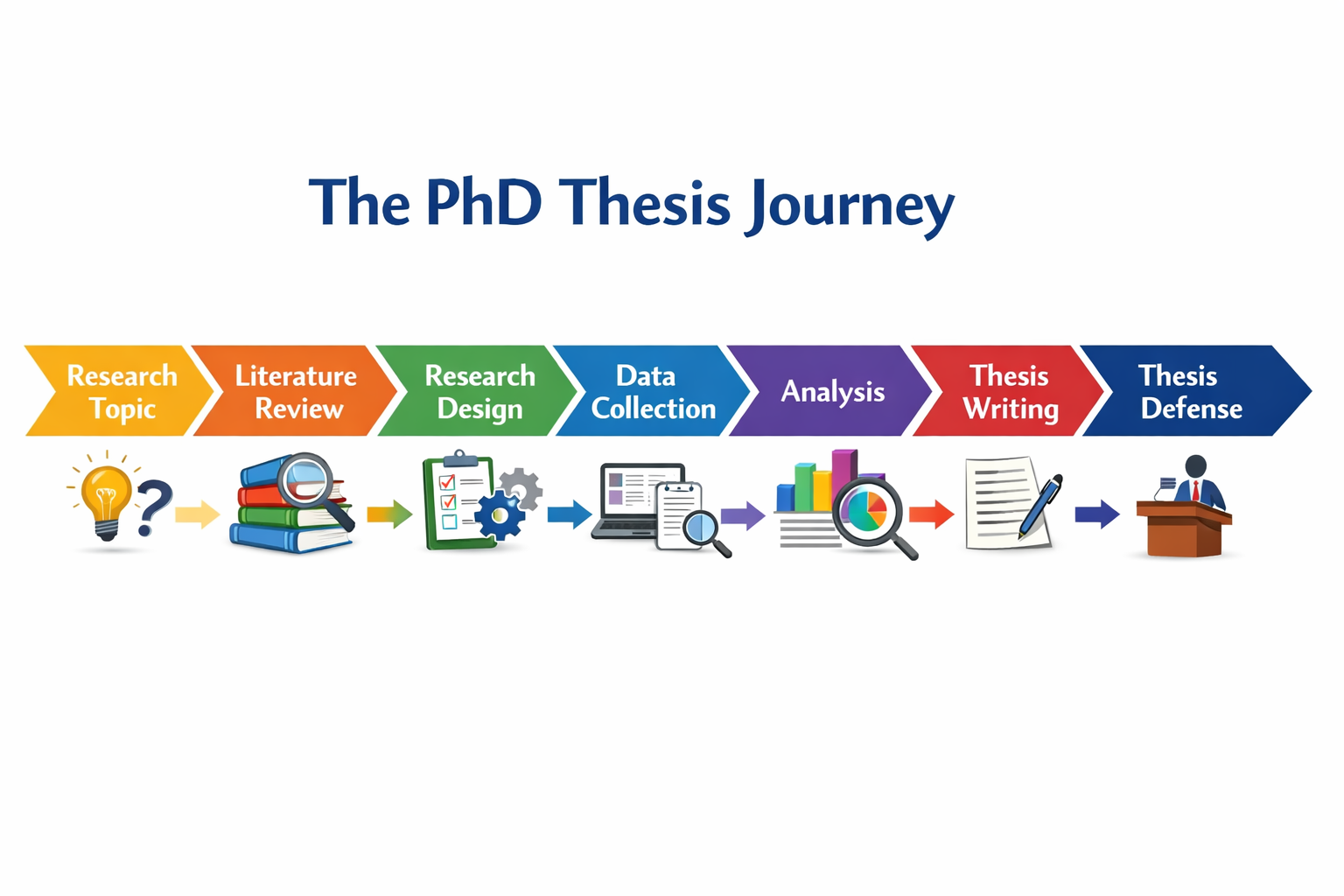
The major stages of PhD thesis development include:
- Identifying a research topic and defining research questions
- Conducting an extensive literature review
- Designing the research methodology
- Collecting and analyzing data
- Writing and revising thesis chapters
- Preparing for final submission and examination
Each stage requires careful planning and academic discipline to ensure that the thesis remains coherent and focused.
Developing a Strong Research Question
A well-defined research question forms the intellectual foundation of a doctoral thesis. Without a clear research question, the thesis may lack direction and analytical focus.
Effective research questions typically:
- Address a specific gap in existing research
- Allow for rigorous investigation and analysis
- Contribute new insights to academic debates
- Remain feasible within the available research timeframe
For example, a general topic such as “digital media and public opinion” may evolve into a more focused research question such as: “How do algorithmic news recommendation systems influence political polarization among online communities?”
A carefully defined research question ensures that the thesis remains analytically coherent throughout the research process.
Conducting a Comprehensive Literature Review
The literature review is one of the most intellectually demanding chapters of a PhD thesis. Rather than summarizing individual sources, the literature review must critically evaluate existing research and identify theoretical or empirical gaps.
A strong literature review accomplishes several objectives:
- Demonstrates familiarity with relevant academic scholarship
- Identifies limitations or gaps in previous research
- Establishes the theoretical framework guiding the study
- Justifies the significance of the research question
Because doctoral research often engages with hundreds of scholarly sources, organizing the literature review effectively is essential for maintaining clarity and analytical depth.
Designing a Rigorous Research Methodology
The methodology chapter explains how the research was conducted and why specific methods were selected. This chapter demonstrates the reliability and validity of the research design.
Different doctoral research projects may employ different methodological approaches depending on the research objectives.
| Method Type | Typical Techniques |
|---|---|
| Qualitative | Interviews, ethnography, case studies |
| Quantitative | Statistical modeling, surveys, experiments |
| Mixed Methods | Combines qualitative and quantitative approaches |
The methodology must clearly justify why the chosen research methods are appropriate for answering the research question.
Maintaining Academic Clarity Across a Long Thesis
A PhD thesis may exceed 80,000 words in many disciplines. Maintaining consistent clarity across such a large document presents significant challenges for doctoral candidates.
Common writing difficulties include:
- Repetition of ideas across chapters
- Unclear transitions between sections
- Overly complex sentences
- Inconsistent terminology or citation style
Structured academic feedback and editing can help improve clarity and ensure that each chapter contributes effectively to the overall research argument.
Common Challenges Faced by PhD Candidates
Doctoral research involves long-term intellectual engagement and can present several challenges for candidates. Understanding these challenges can help students develop strategies for managing them effectively.
Common challenges include:
- Managing large volumes of scholarly literature
- Designing rigorous research methodologies
- Interpreting complex data or research findings
- Maintaining motivation during long research periods
- Preparing for the final thesis defense
Academic guidance and structured research planning can help doctoral candidates address these challenges more effectively.
Using PhD Thesis Help Responsibly
Responsible PhD thesis help focuses on improving research clarity, academic structure, and writing quality without replacing the candidate’s intellectual contribution. Ethical academic support typically involves consultation, editing, and methodological feedback rather than producing original research.
Constructive forms of support may include:
- Guidance on structuring thesis chapters
- Editing and proofreading academic writing
- Advice on literature review organization
- Support with citation formatting and referencing
Such support helps candidates strengthen their research while maintaining full academic ownership of their work.
Successfully Completing a PhD Thesis
Completing a PhD thesis requires intellectual commitment, careful research planning, and sustained academic writing. By developing a clear research question, conducting a rigorous literature review, applying appropriate methodology, and presenting research findings effectively, doctoral candidates can produce theses that contribute meaningfully to their academic fields.
PhD thesis help can provide valuable guidance during this process by helping candidates refine their research organization and improve the clarity of their academic writing. With careful planning and structured support, doctoral candidates can successfully complete their thesis and demonstrate their readiness to contribute to scholarly research.



Comments