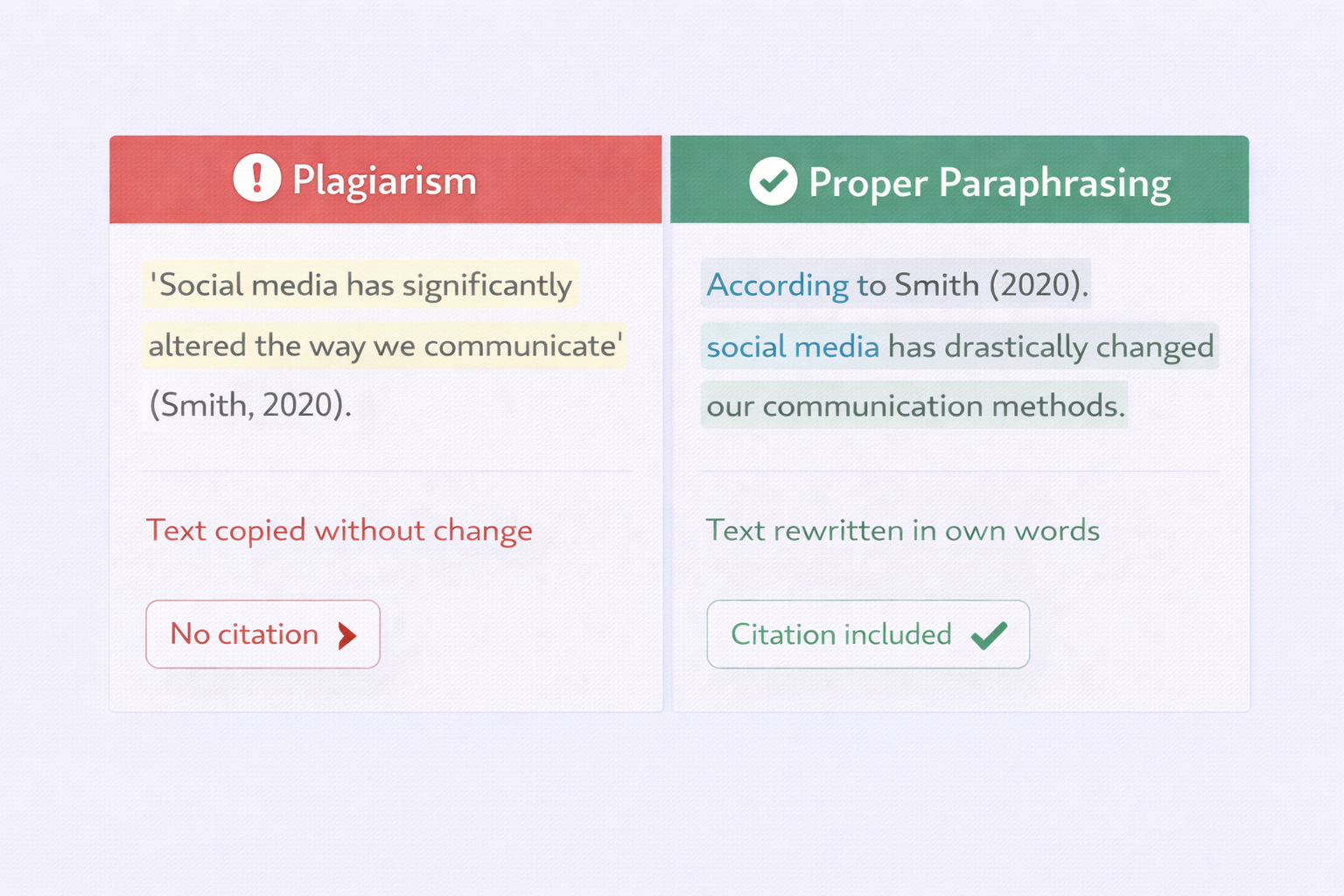
Understanding plagiarism vs paraphrasing explained properly is essential for academic success. Many students unintentionally commit plagiarism because they misunderstand what proper paraphrasing requires. While paraphrasing is a legitimate academic skill, plagiarism is a serious academic offence that can result in penalties, failed assignments, or even expulsion.
Universities expect students to demonstrate originality, critical engagement, and accurate citation. This guide explains the difference between plagiarism and paraphrasing, provides clear examples, highlights common mistakes, and outlines best practices for maintaining academic integrity.
What Is Plagiarism?
Plagiarism occurs when someone presents another person’s ideas, words, or work as their own without proper acknowledgment. It is not limited to copying entire paragraphs; even small sections of text can constitute plagiarism if not cited correctly.
Plagiarism is the use of someone else’s intellectual work without proper attribution.
Plagiarism can be intentional or unintentional. Even accidental plagiarism, such as failing to include a citation after paraphrasing, may still lead to academic consequences.
Common Forms of Plagiarism
Plagiarism appears in various forms, including:
- Direct copying without quotation marks.
- Improper paraphrasing (changing only a few words).
- Using ideas without citation.
- Submitting someone else’s work as your own.
- Self-plagiarism (reusing your own previous work without disclosure).
Recognising these forms helps students avoid unintentional academic misconduct.
What Is Paraphrasing?
Paraphrasing involves restating someone else’s ideas in your own words while preserving the original meaning. Proper paraphrasing requires substantial rewording, structural change, and citation of the source.
Effective paraphrasing requires both rewriting and referencing.
Paraphrasing demonstrates understanding of the material and allows students to integrate scholarly ideas into their arguments without overusing direct quotations.
Plagiarism vs Paraphrasing Explained: Core Differences
The key difference lies in originality and attribution. Paraphrasing is legitimate when properly cited, whereas plagiarism involves presenting borrowed material as original work.
| Aspect | Plagiarism | Paraphrasing |
|---|---|---|
| Use of Source | Copied or slightly modified | Rewritten significantly |
| Citation | Missing or incorrect | Properly cited |
| Academic Integrity | Violation | Acceptable practice |
| Intent | May be deliberate or accidental | Demonstrates understanding |
This distinction is fundamental for ethical academic writing.
Example: Plagiarism vs Proper Paraphrasing
Consider the following original sentence:
“Academic integrity is the foundation of scholarly work and ensures that research is trustworthy and credible.”
Example of plagiarism:
Academic integrity forms the foundation of scholarly work and guarantees that research is credible and trustworthy.
This version changes only a few words and lacks citation. It remains too close to the original structure.
Example of proper paraphrasing:
Maintaining ethical standards in research is essential because it underpins the reliability and legitimacy of academic scholarship (Author, Year).
This version significantly rephrases the idea and includes citation.
Why Proper Paraphrasing Is Academically Valuable
Paraphrasing allows students to integrate multiple scholarly perspectives into their arguments. It demonstrates comprehension and critical engagement rather than simple reproduction of text.
Effective paraphrasing contributes to:
- Stronger argument development.
- Improved academic voice.
- Reduced over-reliance on direct quotations.
- Enhanced analytical depth.
When done correctly, paraphrasing strengthens academic writing.
Common Mistakes in Paraphrasing
Students often make errors when attempting to paraphrase:
- Changing only a few synonyms.
- Keeping the same sentence structure.
- Forgetting to cite the source.
- Over-simplifying complex ideas inaccurately.
Simply replacing words with synonyms does not constitute proper paraphrasing.
True paraphrasing requires deeper cognitive processing of the material.
How to Paraphrase Correctly
To paraphrase effectively, follow a structured approach:
- Read the original text carefully.
- Understand the meaning fully.
- Set the source aside.
- Rewrite the idea in your own words and structure.
- Compare with the original to ensure originality.
- Add appropriate citation.
This method ensures both originality and accuracy.
Referencing and Citation: The Critical Safeguard
Even when paraphrasing properly, citation remains mandatory. Different academic disciplines use different referencing styles, such as APA, Harvard, or MLA. Accurate citation protects students from plagiarism accusations and demonstrates scholarly accountability.
For example, in APA style:
(Smith, 2022)
Referencing ensures intellectual honesty and academic transparency.
Understanding Turnitin and Similarity Reports
Many institutions use plagiarism detection software to assess similarity. These tools do not automatically detect plagiarism; they highlight matching text. Proper paraphrasing combined with correct citation ensures that similarity reports reflect acceptable academic practice rather than misconduct.
Students should focus on writing ethically rather than aiming solely for low similarity percentages.
Mastering Plagiarism vs Paraphrasing Explained for Academic Integrity
Understanding plagiarism vs paraphrasing explained clearly is essential for maintaining academic integrity. Plagiarism involves presenting borrowed material without acknowledgment, while paraphrasing requires significant rewriting combined with proper citation.
By developing strong paraphrasing skills, citing sources accurately, and engaging critically with scholarly material, students can produce original, credible, and ethically sound academic work. Mastery of these principles strengthens both academic performance and long-term scholarly development.


Comments