
One of the earliest and most consequential decisions in any research project is the choice between qualitative, quantitative, or mixed methods research. This decision is not a matter of preference or convenience; it reflects deeper assumptions about knowledge, evidence, and how research questions should be answered. Examiners routinely evaluate whether a student’s chosen research approach aligns logically with the research problem, objectives, and data.
The visual comparison above captures the core distinctions between qualitative, quantitative, and mixed methods research. However, many students struggle to move beyond surface-level definitions. This article provides an academically rigorous explanation of each approach, clarifies when and why each is appropriate, and highlights common mistakes that weaken marks or lead to examiner criticism.

Why research approaches matter in academic assessment
Universities treat research methodology as a marker of intellectual maturity. The choice of qualitative, quantitative, or mixed methods research signals how a student understands evidence, causality, and interpretation. A poorly justified choice suggests weak conceptual grounding, even when data collection is technically competent.
Examiners assess research approaches by asking whether the method fits the question, whether the underlying paradigm is coherent, and whether the student understands the limitations of their choice. Simply stating “this study uses qualitative research” is insufficient; justification and alignment are essential.
Methodological mismatch is one of the most common reasons for low methodology marks.
Qualitative research: exploring meaning, context, and experience
Qualitative research exists to explore how individuals and groups make sense of experiences, processes, and social phenomena. It is rooted in interpretivist and constructivist paradigms, which assume that reality is socially constructed rather than objectively fixed. As a result, qualitative research prioritises depth, context, and meaning over numerical generalisation.
Common qualitative methods include interviews, focus groups, observations, and document analysis. These methods allow researchers to capture nuance, complexity, and perspectives that cannot be reduced to numbers without losing meaning. In assessment, qualitative research is valued for its explanatory power rather than its statistical reach.
What typically goes wrong in qualitative research
A frequent error is treating qualitative research as “easier” or less rigorous than quantitative research. Examiners penalise vague sampling strategies, superficial thematic analysis, and unsubstantiated interpretations. Another common problem is failing to acknowledge subjectivity and reflexivity, which are central to qualitative credibility.
Quantitative research: testing hypotheses and relationships
Quantitative research is designed to test hypotheses, measure variables, and examine relationships using numerical data. It is grounded in positivist or post-positivist paradigms, which assume that reality can be measured objectively through systematic observation and analysis.
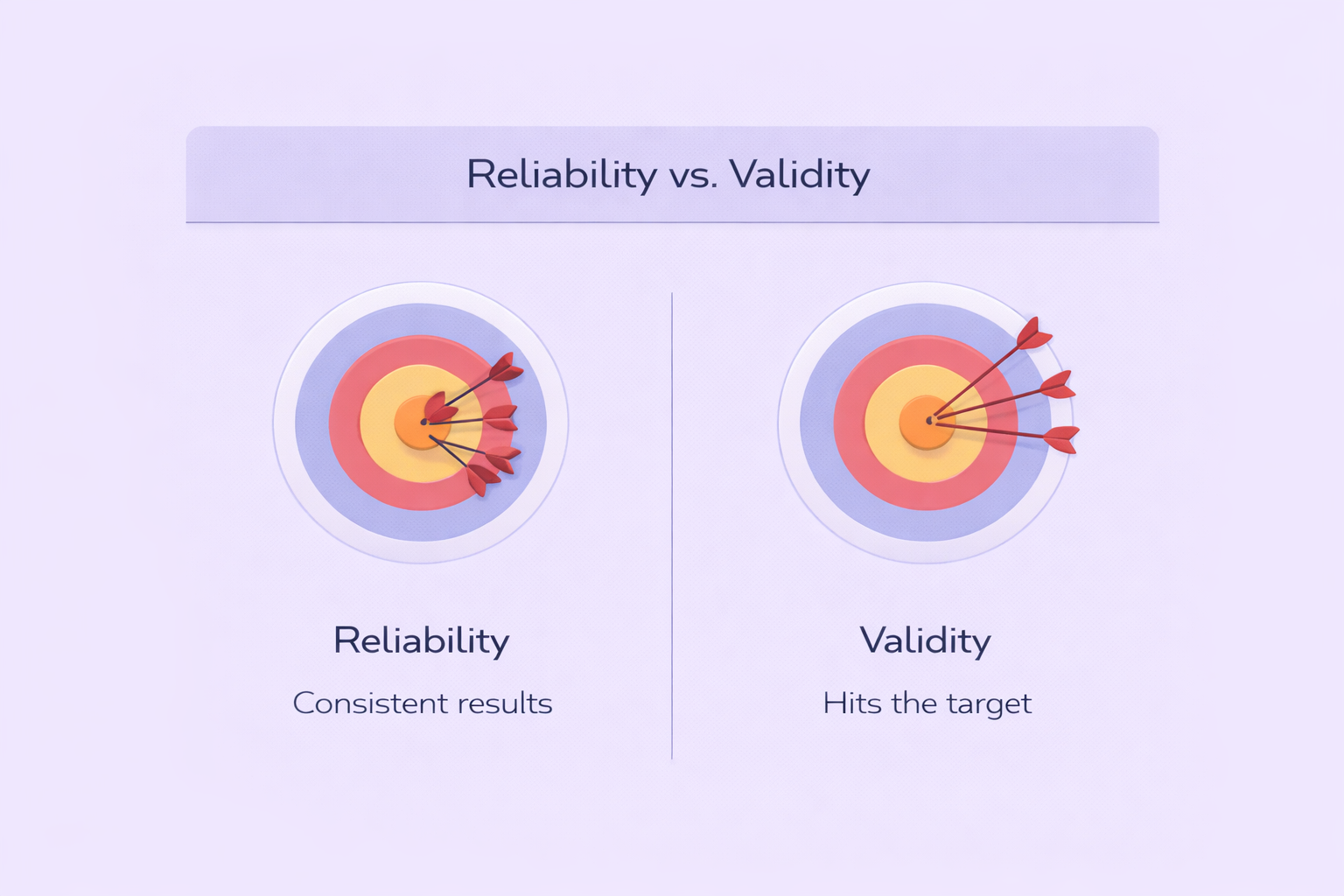
Surveys, experiments, and structured observations are common quantitative methods. Statistical analysis allows researchers to identify patterns, test significance, and make generalisable claims within defined limits. In academic marking, quantitative research is assessed heavily on validity, reliability, and correct application of statistical techniques.
| Dimension | Qualitative research | Quantitative research |
|---|---|---|
| Primary purpose | Explore meanings, experiences, and interpretations | Test hypotheses and examine relationships |
| Type of data | Textual, visual, or observational data | Numerical and measurable data |
| Assessment focus | Depth, coherence, and interpretive rigor | Validity, reliability, and statistical accuracy |
Table 1 shows why these approaches are not interchangeable.
Common pitfalls in quantitative research
Students often misuse statistics by applying tests without checking assumptions or by overinterpreting results. Another frequent issue is weak operationalisation, where abstract concepts are measured poorly. Examiners quickly identify “analysis for the sake of analysis,” which undermines methodological credibility.
Mixed methods research: integrating depth and measurement
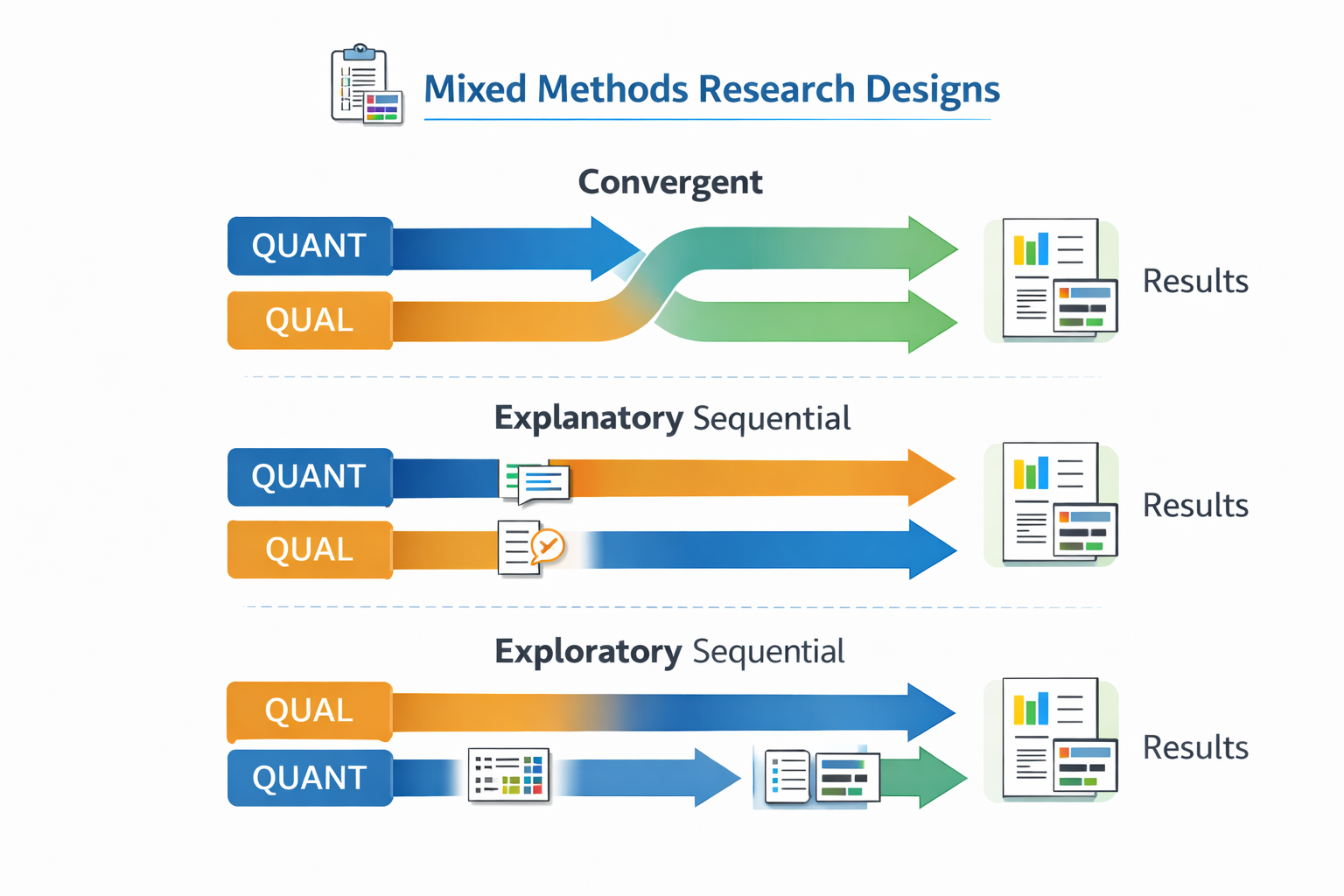
Mixed methods research combines qualitative and quantitative approaches within a single study. It is grounded in pragmatism, which prioritises research questions over strict philosophical allegiance. The aim is not to use “more methods,” but to achieve a more comprehensive understanding of the research problem.
In mixed methods research, qualitative data may explain quantitative findings, or quantitative data may contextualise qualitative insights. When done well, this integration strengthens validity and interpretive richness. When done poorly, it appears fragmented and conceptually confused.
Why mixed methods are academically demanding
Mixed methods research requires students to justify not only each method individually, but also their integration. Examiners expect clear sequencing, explicit rationale, and thoughtful synthesis. Simply collecting interviews and survey data does not constitute mixed methods research.
Many students underestimate the workload and conceptual clarity required, leading to shallow analysis in both strands. This is why mixed methods projects often benefit from structured research support, such as dissertation and research paper guidance, which focuses on coherence rather than data volume.
Choosing the right approach for your research question
The research question should drive the choice of approach, not the other way around. Questions beginning with “how” or “why” often lend themselves to qualitative research, while questions asking “to what extent” or “what is the relationship” are typically quantitative. Mixed methods are appropriate when neither approach alone is sufficient.
Examiners look for explicit alignment between research questions, objectives, methods, and analysis. Misalignment is interpreted as conceptual weakness rather than stylistic error.
How examiners evaluate methodological justification
Methodological justification is evaluated based on clarity, logic, and disciplinary appropriateness. Students are expected to reference methodological literature, explain alternatives they did not choose, and acknowledge limitations honestly.
Language precision is critical. Poorly articulated methodology sections often benefit from academic editing and proofreading, which improves clarity without altering academic ownership.
Integrating methodology into high-scoring writing
High-scoring methodology chapters do more than describe procedures; they demonstrate methodological awareness. This includes understanding epistemological assumptions, ethical considerations, and analytical implications.
Students who treat methodology as a technical requirement rather than an intellectual framework often struggle to defend their work during marking or viva examinations.
Your research approach is part of your argument, not a procedural formality.
Common student misconceptions about research approaches
A persistent misconception is that quantitative research is inherently “stronger” than qualitative research. In reality, strength depends on appropriateness and execution. Another misunderstanding is assuming mixed methods automatically improves quality, when poor integration often weakens coherence.
Addressing these misconceptions explicitly in methodology sections demonstrates academic maturity and earns examiner confidence.
Developing methodological confidence as a researcher
Understanding qualitative, quantitative, and mixed methods research is a developmental process. As students progress academically, they move from applying methods mechanically to justifying them critically.
This shift is central to academic success, particularly at postgraduate level, where independent methodological reasoning is expected.
Making your methodology work for your study
Ultimately, the best research approach is the one that allows you to answer your research question convincingly and ethically. Clear justification, honest limitations, and coherent alignment matter more than methodological complexity.
When students understand this, methodology becomes a strength rather than a source of anxiety.
Comments