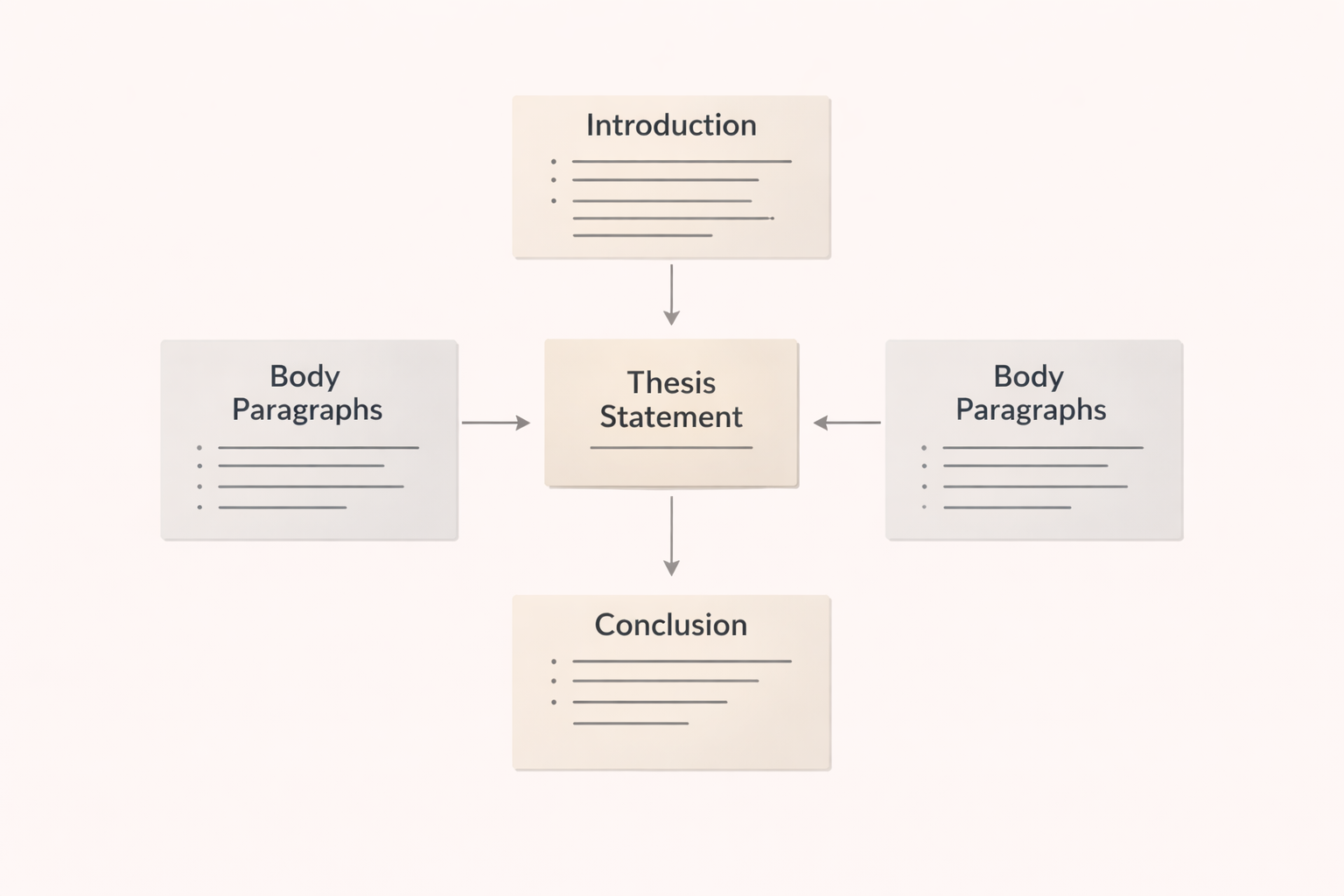
In academic writing, the thesis statement plays a central and non-negotiable role. It is the point at which a student’s ideas become a structured argument rather than a collection of observations. Despite its importance, many students struggle to understand what a thesis statement actually does and how it differs from a topic, opinion, or research question.
Markers often evaluate an essay’s quality within the first few paragraphs, largely based on the clarity and strength of the thesis statement. A weak or unclear thesis creates uncertainty about the purpose of the paper, while a strong thesis establishes authority and direction from the outset.
This article provides a comprehensive academic explanation of the thesis statement, focusing on its function, structure, and role across different types of university assignments.
What a Thesis Statement Is in Academic Writing
A thesis statement is a concise sentence or set of sentences that presents the central argument of an academic paper. It communicates the writer’s position on a specific issue and indicates how that position will be developed.
Unlike a topic sentence, which introduces a paragraph, a thesis statement governs the entire paper. It defines scope, focus, and argumentative direction.
In academic contexts, a thesis must be debatable, specific, and defensible through evidence.
Academic rule: A thesis statement must make a claim that can be supported or challenged, not merely stated as fact.
Why the Thesis Statement Matters to Examiners
Examiners rely on the thesis statement to understand what the essay is attempting to prove or explain. It functions as a contract between the writer and the reader.
A clear thesis allows markers to assess relevance, coherence, and depth of analysis. When a thesis is vague or missing, the essay often appears unfocused, regardless of the quality of research.
Strong theses signal analytical thinking rather than descriptive reporting.
Thesis Statement Versus Topic or Research Question
Students frequently confuse thesis statements with topics or research questions. While related, these elements serve different purposes.
A topic identifies a subject area, such as climate change or social inequality. A research question asks what the paper seeks to investigate.
The thesis statement answers that question by asserting a position.
| Element | Function | Example Purpose |
|---|---|---|
| Topic | Identifies subject area | Defines general focus |
| Research question | Guides investigation | Frames inquiry |
| Thesis statement | Presents argument | Establishes position |
Understanding these distinctions is essential for academic clarity.
Where the Thesis Statement Is Placed
In most academic essays, the thesis statement appears near the end of the introduction. This placement allows the writer to move from general context to a specific claim.
Placing the thesis too early can feel abrupt, while placing it too late may confuse readers about the essay’s purpose.
Although conventions vary slightly by discipline, clarity of placement is always expected.
Characteristics of an Effective Thesis Statement
An effective thesis statement exhibits several key characteristics. These features distinguish strong academic writing from weak or descriptive work.
- Specific focus rather than broad generalisation
- Clear argumentative position
- Relevance to the assignment question
- Capacity for evidence-based support
When these elements are present, the thesis provides a stable foundation for the entire essay.
How the Thesis Statement Shapes Essay Structure
The thesis statement determines how the body of the essay is organised. Each major paragraph should relate directly to defending, explaining, or refining the thesis.
If a paragraph does not clearly connect to the thesis, it weakens structural coherence. This is one of the most common reasons essays lose marks.
Strong essays demonstrate alignment between thesis, topic sentences, and conclusions.
Thesis Statements in Argumentative Writing
In argumentative essays, the thesis statement explicitly states the position being defended. It signals not only what the writer believes, but how the debate will be approached.
Argumentative theses often include a claim and a rationale, indicating the grounds on which the argument rests.
This clarity helps readers anticipate the structure of the argument.
Thesis Statements in Analytical and Expository Essays
In analytical or expository writing, thesis statements may focus less on persuasion and more on explanation or interpretation.
Even in these cases, the thesis must still make a clear claim about meaning, cause, or significance.
Neutral description without interpretation does not meet academic standards.
Developing a Thesis Statement Step by Step
Constructing a thesis statement is an iterative process rather than a single decision. It often evolves as research and analysis deepen.
- Identify the assignment question
- Determine the academic debate or issue
- Formulate a preliminary position
- Refine for clarity and specificity
- Test against available evidence
This process ensures that the thesis remains defensible and relevant.
Common Problems with Thesis Statements
Many thesis statements fail because they are too broad, too obvious, or purely descriptive. Others attempt to cover too many ideas at once.
Another frequent issue is presenting a statement of fact rather than an argument.
Recognising these problems early allows for effective revision.
Critical warning: A thesis that cannot be argued cannot be marked as analytical.
Revising the Thesis During the Writing Process
Thesis statements are not fixed from the first draft. As analysis develops, the thesis often needs refinement.
Revising the thesis ensures alignment between what the essay claims to do and what it actually does.
This practice reflects advanced academic thinking.
Thesis Statements and Conclusions
The conclusion of an essay should return to the thesis statement, not by repeating it verbatim, but by demonstrating how it has been supported.
This reinforces coherence and signals closure to the reader.
A strong conclusion confirms the thesis rather than introducing new claims.
How Markers Evaluate Thesis Quality
Markers assess thesis statements based on clarity, relevance, and analytical depth. A strong thesis simplifies evaluation by making the argument explicit.
Weak theses force markers to infer intent, often resulting in lower grades.
Clear thesis construction is therefore a strategic academic skill.
Final Guidance on Writing Strong Thesis Statements
A thesis statement is more than an introductory sentence; it is the intellectual centre of an academic paper. It shapes structure, guides analysis, and determines coherence.
Students who invest time in developing precise, arguable theses produce stronger, more focused academic writing.
Mastery of thesis statements is foundational to success in higher education.



Comments