Introduction
´Increasing world populations and shrinking farmlands have never necessitated more than the demand of sustainable food production.
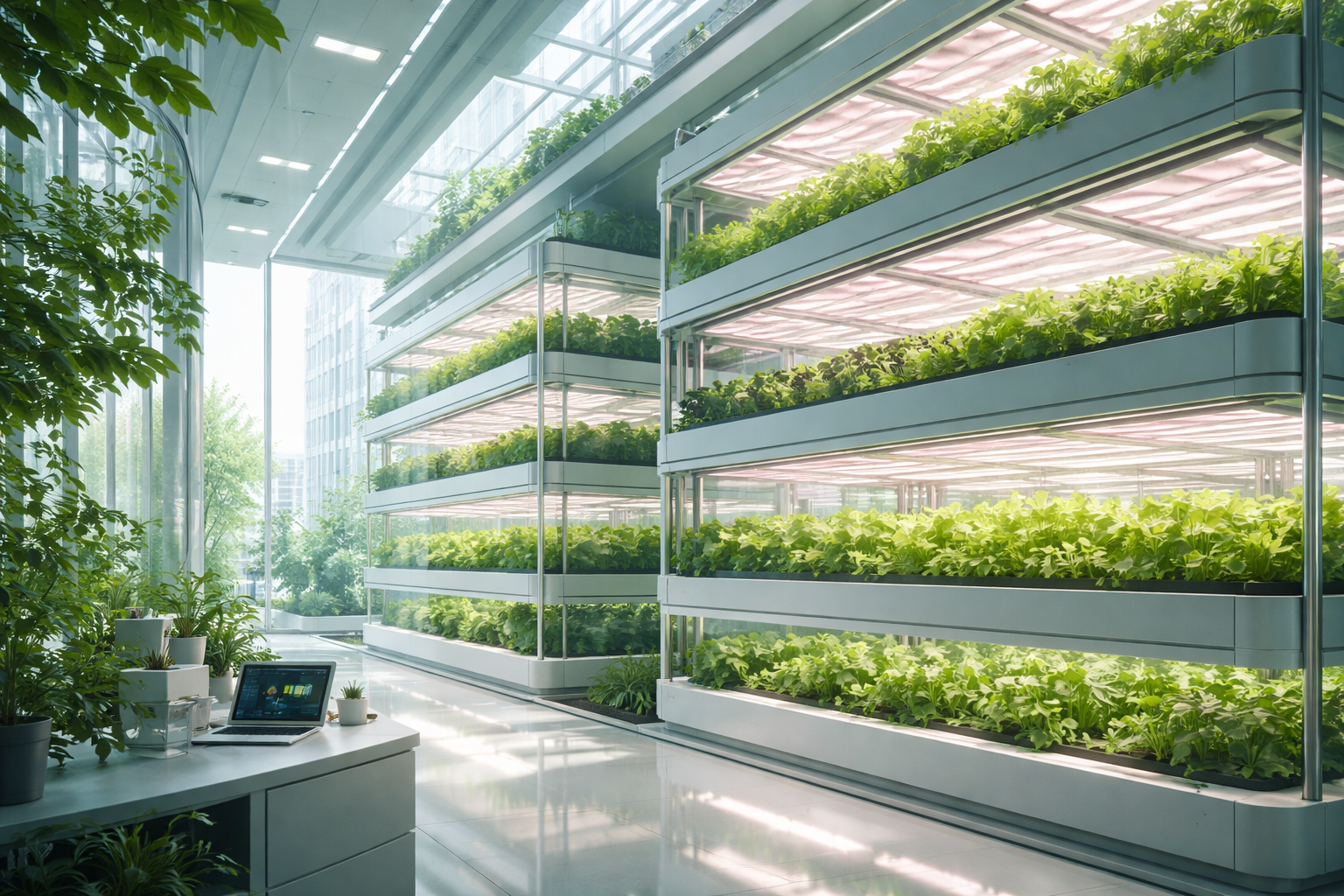
´Vertical farming (production of crops in layers inside and on top of each other under the influence of innovative technologies) is one of the possible solutions.
´The world food requirement is expected to rise by 70% in 2050 ((Mir et al., 2022).
´The urbanization, soil erosion and climatic changes limit traditional farming.
´Vertical farming is done using the hydroponic or aeroponic system with the LED light.
´Allows resource-efficient and local production which is free of pesticides as well.
´It favours sustainability of environment and urban food security.
´This presentation discusses its need, advantages, developments, problems, and its future.

Why Vertical Farming is Needed
´Population Growth: by 2050, the world population will experience over 9.7 billion people (Van Delden et al. 2021).
´Reduction in Arable Land: Urban sprawl and soil erosion have reduced agricultural land in more than 30 percent of the total farm acreage across the planet.
´Climate Change: Unpredictable weather interrupts the conventional farming.
´Water Scarcity: 70 percent of the freshwater is consumed in farming with a significant portion being wasted in fields.
´Urban food gaps: Urban areas bring in to 90 percent of the food supply which adds to carbon footprints.
´Food Security Requirements: Vertical agriculture offers consumption less transportation and spoilage due to the proximity of production to the consumer.

How Vertical Farming Works
´Vertical farming is a substitute to the old farming method which utilized soil, with hydroponic, aeroponic, or aquaponic methods which are more effective at nutrient and water delivery.
´With the CO 2, humidity, and light being controlled, crops could be grown throughout the year.
´LED lighting systems resemble sun rays, which increase photosynthesis effectiveness and make it possible to grow plants in urban areas.
´However, compared to traditional farms, where the U.S feed grain production (20112022) is largely based on corn (around 95 per cent of the output) on vertical farms, leafy greens, herbs and microgreens are produced with a small amount of land (Van Delden et al. 2021).
´Vertical farming limits the reliance on mass cultivation of grain and enhances urban food security as the external harvests decrease and increase.

Advantages of Vertical Farming
´Denser Yields: Grows up to 350 times more on the same area of land than the orthodox farms, and uses urban lands more effectively (Aier et al., 2023).
´Water Efficiency: It consumes as little as 95 percent less water, thus it suits the areas full of drought.
´Less Food Waste: Controlled environment means that there is no overproduction, spoilage, as there are enormous piles of meat and cheese that bring the inefficiency of the traditional system into the limelight.
´Sustainability and Food Security: Vertical agriculture will provide fresh food and local food and is free of pesticides, minimizing storage waste and transportation emissions.
´Energy and Innovation Advantages: Renewable energy and smart automation ensures the reduction of resources consumed in the long run.
´Consumer Health and Safety: Offers cleaner, trace food systems, which indulges the sense of contamination in mass production.

Current Progress and Global Examples
´On-farm Mishandling of Antibiotics.
´Approximately, 81 percent of antibiotics used in the U.S. on animals versus 19 percent on humans causes serious concerns due to antimicrobial resistance and food safety (Gurung et al., 2024).
´Vertical Farming: a Sustainable Alternative.
´Vertical farming will be useful in reducing the reliance on livestock to produce safer, antibiotic-free food and meets world health and sustainability objectives.
´International Development of Vertical Farms.
´More than 200 vertical farms in the world efficiently cultivate herbs and greens on a limited space and lower the environmental impact ().
´U.S. Industry Leaders
´Businesses such as Plenty, Aero farms and Bowery are leading the way in implementing commercial-level innovation, incorporating smart farming technology in achieving a continuous harvest.
´The Support by Governments in Asia and the Middleness.
´Singapore is encouraging vertical farming as a goal of 30% local food by 2030, and Middle Eastern countries utilize it to cover the dry conditions and water shortage.
´Technological and Growth in the Markets.
´The combination of AIs, drones, and robotics improves productivity and monitoring.
´It is projected that the world market will hit 33billion by the year 2032 (Fortune Business Insights, 2024).
Challenges and Limitations
´High Energy Costs
´There is great consumption of electricity in LED and climate control systems.
´Startup Capital
´Initial cost of set up may be as high as 2 million acre.
´Crop Limitations
´The leafy greens are the most appropriate ones; grains and root crops are not viable.
´Technology Dependence
´There is the possibility that any cases of power outages or failure of the system would result in the complete loss of crops.
´Profitability
´Needs the high demand in the market and effective logistics to remain sustainable.
´Environmental Balance
´Should change to renewable sources of energy to lower carbon footprint.

Conclusion - The Future of Food Production
´Vertical farming is a revolutionary change of sustainable agriculture.
´It is in line with UN Sustainable Development Goals (Zero Hunger, Climate Action).Potential to supplement rather than substitute conventional farming regimes.
´It is important that further advances are made in energy conservation and the diversity of crops.
´Vertical farming would provide food security in urban areas with the help of the government and other individuals.
´Smart, local, and sustainable models of food production are the future of food.
References
´Mir, M. S., Naikoo, N. B., Kanth, R. H., Bahar, F. A., Bhat, M. A., Nazir, A., ... & Ahngar, T. A. (2022). Vertical farming: The future of agriculture: A review. The Pharma Innovation Journal, 11(2), 1175-1195.
´Van Delden, S. H., SharathKumar, M., Butturini, M., Graamans, L. J. A., Heuvelink, E., Kacira, M., ... & Marcelis, L. F. M. (2021). Current status and future challenges in implementing and upscaling vertical farming systems. Nature Food, 2(12), 944-956.
´Gurung, L., Rawal, J. S., Puspa, R. C., Joshi, G. R., & Mandal, A. (2024). Vertical farming in urban agriculture: Opportunities, challenges, and future directions. Big Data Agric, 6, 89-95.
´Aier, I., Ariina, M. S., Bier, K., & Awomi, O. S. (2023). Vertical Farming: The Future Food Production System.
Comments