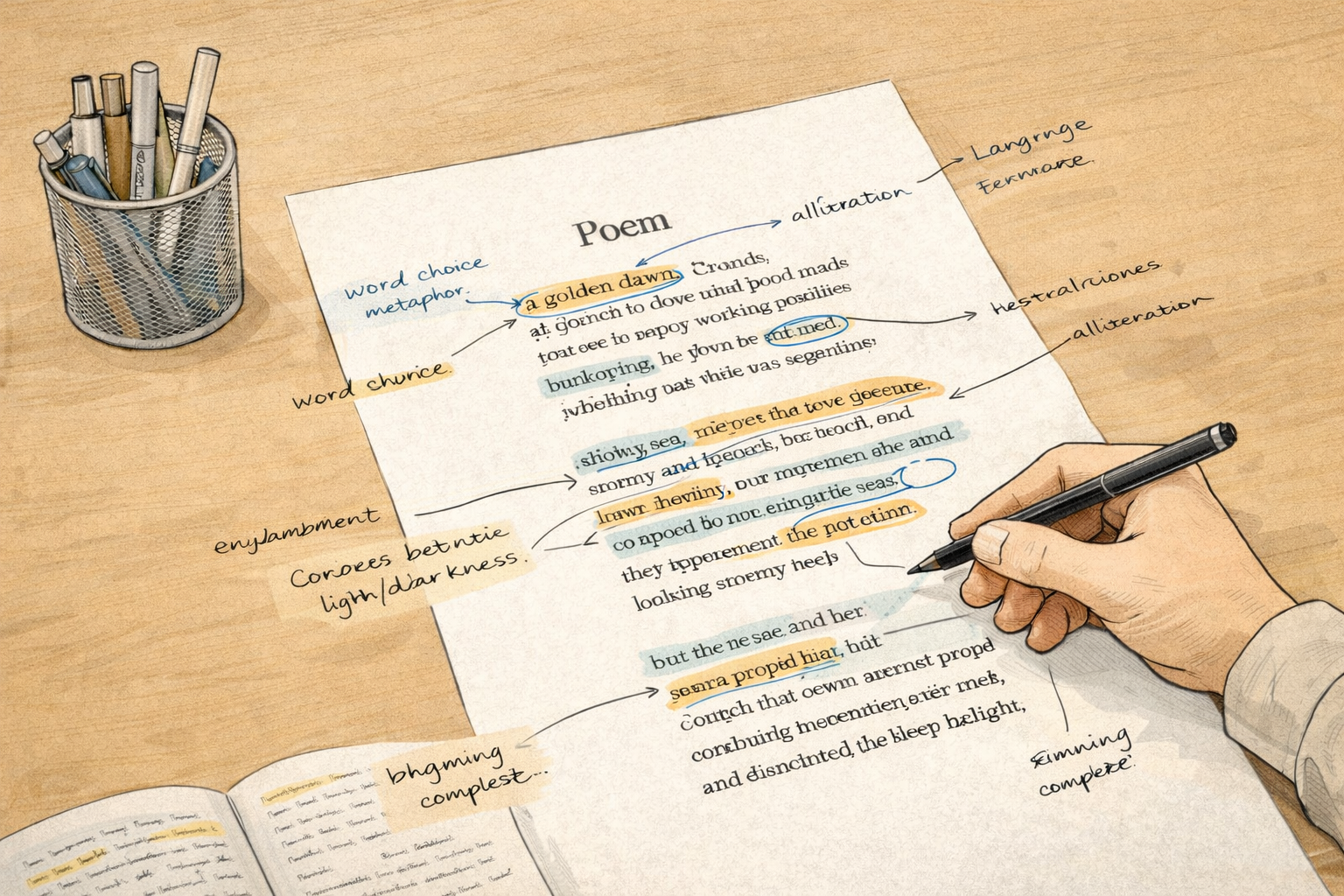
Analysing poetry is one of the most intellectually demanding tasks in literary study. Unlike prose, poetry compresses meaning into sound, structure, imagery, and form, requiring careful attention to how language works at multiple levels simultaneously.
This guide provides a rigorous, student-friendly framework for analysing poetry in academic contexts. It explains what examiners expect, how to structure analysis, and how to move from observation to interpretation in a disciplined and persuasive way.
What It Means to Analyse Poetry Academically
Analysing poetry involves examining how a poem creates meaning through its formal and linguistic choices. Rather than summarising content or offering personal reactions, academic analysis focuses on how meaning is constructed.
At university level, analysis requires close reading, precise terminology, and evidence-based interpretation. Each claim must be grounded in the poem’s language, structure, or form.
Key academic principle: Poetry analysis explains how a poem works, not simply what it is about.
Reading a Poem Closely Before Writing
Effective poetry analysis begins with slow, attentive reading. Students should read a poem multiple times, each time focusing on a different aspect such as sound, imagery, or structure.
Initial confusion is normal and should not be treated as failure. Uncertainty often signals complexity and interpretive depth.
Annotating for Meaning and Technique
Annotation allows students to record observations without immediately forming conclusions. Marking repeated words, shifts in tone, or striking images builds a foundation for analysis.
Annotations should remain descriptive at first, postponing interpretation until patterns become clear.
Identifying the Poem’s Central Concerns
After close reading, students should consider the poem’s central ideas or questions. These may involve identity, power, loss, memory, nature, or social conflict.
Importantly, themes should emerge from textual evidence rather than being imposed from outside knowledge.
Analysing Poetic Language and Diction
Poetic diction refers to the poet’s word choices and their connotations. Even simple vocabulary can carry complex emotional or symbolic weight.
Analysis should consider whether language is abstract or concrete, elevated or conversational, and how this shapes tone.
Figurative Language in Poetry
Metaphor, simile, and symbolism allow poets to express ideas indirectly. These devices often create layered meanings rather than single interpretations.
Academic analysis should explore why a comparison is made and what limitations or tensions it introduces.
Sound and Rhythm in Poetic Analysis
Sound patterns such as alliteration, assonance, and rhyme influence how a poem feels and moves. Rhythm shapes pacing and emotional intensity.
Disruptions in sound or rhythm often signal shifts in meaning and deserve careful attention.
Structural Choices and Their Significance
Poem structure includes stanza arrangement, line length, repetition, and punctuation. These choices guide how readers process meaning.
Structure often mirrors emotional development or thematic progression within the poem.
Enjambment and Line Breaks
Enjambment propels readers forward, while end-stopped lines slow interpretation. Both influence emphasis and suspense.
Analysis should explain how line breaks affect meaning rather than merely noting their presence.
| Analytical Element | Focus | Key Question |
|---|---|---|
| Language | Diction and imagery | What do the word choices suggest? |
| Sound | Rhythm and repetition | How does sound shape mood? |
| Structure | Form and layout | How does structure guide meaning? |
| Tone | Speaker attitude | What stance does the speaker take? |
This table highlights how poetry analysis requires attention to multiple interacting elements rather than isolated techniques.
Tone, Mood, and Voice in Poetry
Tone reflects the speaker’s attitude, while mood describes the emotional effect on the reader. Both are shaped through language, sound, and structure.
Academic analysis should distinguish clearly between tone and mood to avoid conceptual confusion.
Context Without Reducing the Poem
Historical, cultural, or biographical context can inform interpretation but should never replace close reading.
Context is most effective when used to illuminate textual features rather than explain them away.
Common Mistakes When Analysing Poetry
One common error is summarising the poem instead of analysing it. Summary may demonstrate understanding but does not constitute critical engagement.
Another frequent issue is listing poetic devices without explaining their significance.
Examiner warning: Identification without interpretation receives minimal academic credit.
Structuring a Poetry Analysis Essay
Strong essays present a clear argument supported by close textual evidence. Each paragraph should focus on one analytical point.
Quotations should be integrated smoothly and analysed in detail rather than left to “speak for themselves.”
Developing Sophisticated Interpretations
Advanced poetry analysis acknowledges ambiguity and multiple readings. Poems often resist single, fixed meanings.
Academic confidence comes from supporting interpretations with careful reasoning rather than claiming certainty.
Final Guidance on Analysing Poetry Effectively
Analysing poetry is a disciplined process that combines close reading, technical awareness, and interpretive judgement. It requires patience, precision, and intellectual openness.
By focusing on how poems create meaning through language, sound, and structure, students can produce insightful and academically rigorous analyses suitable for high-level assessment.



Comments