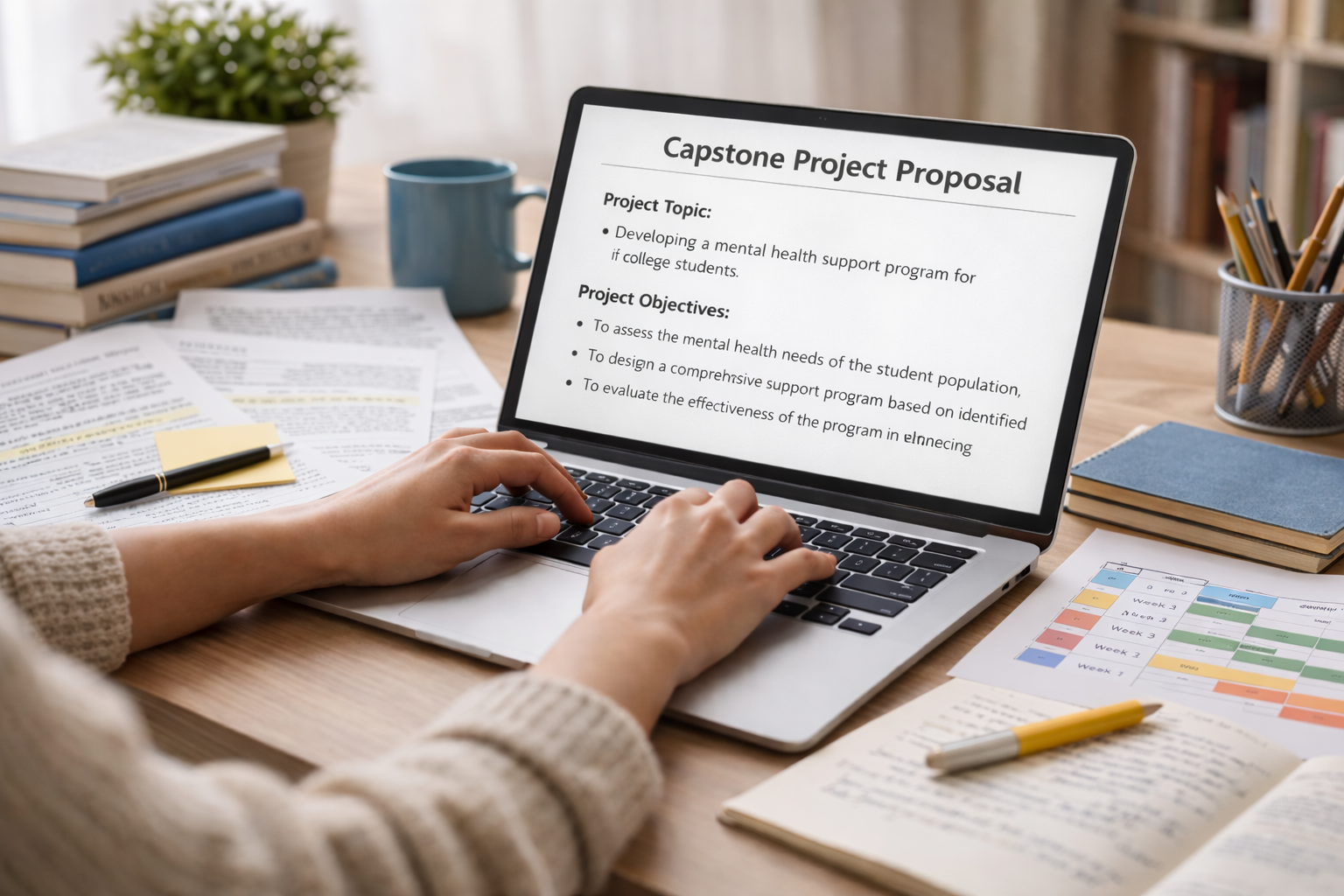
A capstone project proposal is a foundational academic document that outlines what a student intends to research or develop, why the project is important, and how it will be carried out. Before a full capstone project can proceed, universities typically require a formal proposal to assess feasibility, academic value, and methodological soundness.
This article provides a clear capstone project proposal example and explains how each section should be written to meet university standards. It is designed to help students move from a general topic idea to a structured, defensible proposal that can gain supervisor and departmental approval.
What Is a Capstone Project Proposal
A capstone project proposal is a structured plan that presents the intended focus, scope, and approach of a capstone project. Unlike the final capstone paper, the proposal does not present findings; instead, it demonstrates that the project is worthwhile, researchable, and achievable within the available timeframe and resources.
In most programmes, the proposal is assessed formally and may determine whether the student is permitted to proceed. As such, it must show intellectual clarity, awareness of relevant literature, and a realistic research design.
A capstone project proposal demonstrates readiness to conduct independent academic research.
Why Universities Require Capstone Proposals
Universities use capstone proposals to ensure academic quality and to manage risk. By reviewing proposals in advance, supervisors can confirm that research questions are sufficiently focused, ethically appropriate, and aligned with programme learning outcomes.
For students, the proposal functions as a roadmap. A well-developed proposal reduces confusion later in the project, provides a reference point for decision-making, and helps maintain coherence across the final paper.
Standard Structure of a Capstone Project Proposal
While formatting requirements vary across disciplines, most capstone project proposals follow a broadly consistent academic structure. This structure allows reviewers to assess the project’s purpose, relevance, and feasibility efficiently.
| Section | Function |
|---|---|
| Title | Clearly define the project focus |
| Introduction / Background | Explain the context and problem |
| Problem Statement | Identify the specific issue being addressed |
| Research Aim and Objectives | Clarify what the project seeks to achieve |
| Literature Overview | Demonstrate engagement with existing research |
| Methodology | Explain how the project will be conducted |
| Scope and Limitations | Define boundaries of the study |
| Timeline | Show feasibility within the academic period |
| References | List key academic sources |
Title and Background Section
The proposal title should be precise and informative rather than broad or vague. It should indicate the main variables, population, or context of the study. For example, a title such as “Evaluating Cybersecurity Awareness Among Small Business Owners” is clearer than “A Study of Cybersecurity.”
The background section introduces the broader academic or practical context of the project. It explains why the topic matters, outlines relevant trends or challenges, and leads logically into the specific problem being addressed.
Problem Statement and Research Rationale
The problem statement is one of the most critical sections of a capstone project proposal. It defines the exact issue the project will investigate and explains why it deserves academic attention. A strong problem statement is specific, evidence-based, and clearly articulated.
The rationale builds on the problem statement by justifying the project’s value. This may involve highlighting gaps in existing research, unresolved practical challenges, or emerging issues that require systematic investigation.
Research Aim, Objectives, and Questions
The research aim provides a concise statement of the project’s overall purpose. Objectives then break this aim into smaller, achievable components that guide the research process. In some disciplines, these are supplemented by clearly defined research questions or hypotheses.
Objectives should be logically sequenced and realistically achievable within the scope of a capstone project. Overly ambitious objectives are a common reason proposals are rejected or require revision.
Preliminary Literature Review
In a capstone project proposal, the literature review is typically shorter than in the final paper, but it remains essential. Its purpose is to demonstrate familiarity with key theories, models, and findings relevant to the topic.
Rather than summarising sources individually, students should synthesise the literature to show patterns, debates, and gaps. This helps justify the proposed research focus and methodological approach.
Methodology Section
The methodology explains how the proposed research will be conducted. This includes the research design (qualitative, quantitative, or mixed methods), data sources, sampling strategies, and data collection tools.
Importantly, students must explain why these methods are appropriate for addressing the research objectives. Methodological choices should be grounded in academic reasoning rather than convenience.
Examiners look for alignment between research questions, methods, and proposed analysis.
Scope, Limitations, and Ethical Considerations
The scope section defines what the project will and will not cover. This helps manage expectations and demonstrates awareness of practical constraints such as time, access to data, and word limits.
Limitations acknowledge potential weaknesses or constraints in the study, such as small sample sizes or reliance on self-reported data. Where applicable, ethical considerations — including consent, confidentiality, and data protection — should also be addressed.
Proposed Timeline and Feasibility
Many universities require a proposed timeline as part of the capstone project proposal. This may be presented as a brief narrative or table outlining key stages such as literature review, data collection, analysis, and writing.
A realistic timeline reassures supervisors that the project can be completed within the academic term and that the student has planned the workload carefully.
Capstone Project Proposal Example
For example, a business student proposing a capstone project on remote work productivity might outline the growth of remote employment in the background section, identify inconsistent productivity outcomes as the problem, propose survey-based research as the methodology, and set objectives focused on identifying key productivity drivers.
This proposal would demonstrate clarity, relevance, and feasibility — the three core criteria most departments use when approving capstone projects.
Common Reasons Capstone Proposals Are Rejected
Capstone project proposals are often returned for revision due to unclear problem statements, weak justification, or unrealistic scope. Another frequent issue is misalignment between research questions and proposed methods.
To avoid these issues, students should ensure:
- The research problem is clearly defined and evidence-based.
- The proposed methods directly address the research objectives.
- The scope is manageable within the available timeframe.
- The proposal follows departmental formatting and submission guidelines.
Using Feedback to Strengthen the Final Capstone Project
Feedback on a capstone project proposal should be viewed as an opportunity rather than a setback. Supervisor comments often highlight conceptual gaps or methodological concerns that, if addressed early, can significantly improve the final project.
Students who engage actively with proposal feedback typically produce stronger, more coherent capstone papers with fewer revisions required at later stages.
Planning for Capstone Success
A well-written capstone project proposal lays the foundation for a successful final submission. By articulating a clear problem, grounding the project in existing research, and presenting a feasible research plan, students demonstrate academic maturity and readiness for independent inquiry.
Careful planning at the proposal stage ultimately saves time, reduces uncertainty, and increases the likelihood of producing a high-quality capstone project.



Comments