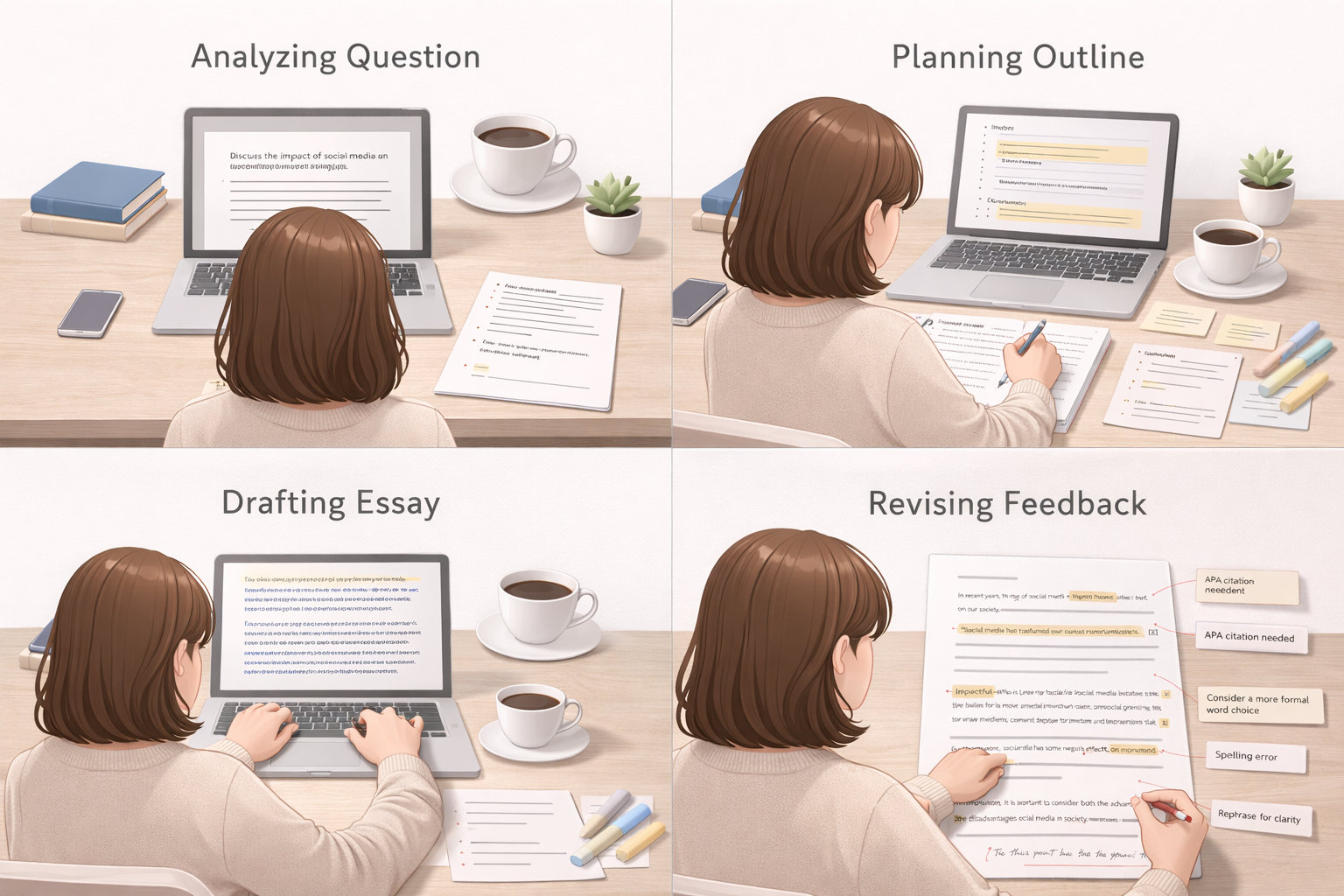
Essay writing is a core academic skill across almost every university discipline, yet it remains one of the most challenging tasks for students. Many essays fail not because students lack knowledge, but because ideas are poorly structured, arguments are unclear, or academic conventions are misunderstood.
An effective essay writing guide must therefore go beyond surface advice. Strong academic essays are built on planning, critical thinking, disciplined structure, and awareness of assessment criteria. This guide explains how essays function academically and how students can consistently produce work that meets university standards.
What an Academic Essay Is and Why It Matters
An academic essay is not a personal opinion piece or a summary of sources. It is a structured argument that responds directly to a specific question using evidence, reasoning, and academic conventions. Essays are used by universities to assess a student’s ability to think critically, synthesise information, and communicate ideas clearly.
Understanding the purpose of an essay helps students write more strategically. Examiners assess how well students engage with the question, develop an argument, and support claims with appropriate evidence. Essays that lack argument or relevance are penalised regardless of how much information they contain.
This makes essay writing a skill of academic communication rather than content reproduction.
Key academic principle: Essays are evaluated on argument quality, not information quantity.
Interpreting the Essay Question Correctly
One of the most critical stages in essay writing is question analysis. Many weak essays fail because students misunderstand what the question requires. Academic questions are carefully worded to signal task type, scope, and expectations.
Instructional terms such as “discuss,” “evaluate,” “compare,” or “analyse” determine how the essay should be structured. Ignoring these terms often results in descriptive writing when analysis is required, which significantly lowers marks.
Effective essay writing begins by breaking the question into key components and identifying what must be argued, not just described.
Planning an Essay Before Writing
Planning is the foundation of strong academic essays. Without a clear plan, essays often lack coherence and drift away from the central argument. Planning forces the writer to decide what the essay will argue and how each section contributes to that argument.
A good essay plan outlines the thesis statement, the main points that support it, and the evidence needed for each point. This prevents repetition, irrelevant paragraphs, and last-minute restructuring.
Although planning may feel time-consuming, it significantly reduces drafting and revision time.
Writing Strong Academic Introductions
The introduction establishes the academic context and prepares the reader for the argument. Effective introductions move from general context to specific focus, guiding the reader logically toward the thesis.
Weak introductions are often too broad or include unnecessary background information. Strong introductions demonstrate control by clearly framing the topic, narrowing the focus, and stating the essay’s purpose.
The introduction should always culminate in a clear thesis statement that directly answers the essay question.
Developing a Clear and Defensible Thesis Statement
The thesis statement is the central claim of the essay. It tells the reader what the essay will argue and provides a reference point for evaluating relevance and coherence.
A strong thesis is specific, arguable, and academically framed. It should take a position rather than announce a topic. Essays without a clear thesis often appear unfocused and descriptive.
| Weak Thesis | Strong Thesis |
|---|---|
| This essay discusses climate change. | This essay argues that climate change policy must prioritise adaptation strategies alongside mitigation to address immediate social impacts. |
| The essay looks at leadership styles. | This essay contends that transformational leadership improves organisational performance more effectively than transactional leadership in knowledge-based firms. |
A well-constructed thesis gives direction to every paragraph that follows.
Structuring Body Paragraphs Effectively
Body paragraphs are where arguments are developed and supported. Each paragraph should focus on one main idea that contributes directly to the thesis. When paragraphs attempt to cover multiple ideas, clarity and coherence are lost.
Strong paragraphs follow a logical pattern: a topic sentence introduces the point, evidence supports it, and analysis explains its relevance. Paragraphs should conclude by linking back to the central argument.
This structure helps examiners follow the reasoning and assess the quality of analysis.
Common Paragraph-Level Mistakes
- Missing or vague topic sentences
- Evidence presented without explanation
- Over-summarising sources
- Weak links to the essay question
Avoiding these mistakes significantly improves academic clarity.
Using Evidence and Sources Critically
Academic essays rely on evidence, but evidence alone does not guarantee quality. Examiners look for how sources are used, not how many are included. Evidence must be integrated into the argument and critically interpreted.
Critical use of sources involves explaining why a source is relevant, how it supports the argument, and what its limitations may be. Quoting without analysis weakens academic authority.
Strong essays balance evidence with original reasoning.
Critical warning: Evidence that is not analysed does not strengthen an argument.
Maintaining Academic Tone and Style
Academic tone reflects precision, objectivity, and discipline. Informal language, emotional expressions, and unsupported claims undermine credibility. Essays should use cautious, measured language appropriate to scholarly communication.
Consistency in tense, terminology, and register helps maintain clarity. Claims should be supported and appropriately qualified, avoiding overgeneralisation.
Clear academic style allows ideas to be evaluated on their merit rather than their presentation.
Revising and Editing Academic Essays
Revision is an essential stage of essay writing, not an optional one. Effective revision focuses on argument structure, coherence, and relevance rather than surface-level errors alone.
During revision, students should assess whether each paragraph contributes to the thesis and whether the argument develops logically. Structural problems are easier to fix at this stage than after submission.
Editing for grammar and referencing should occur only after structural issues are resolved.
Frequent Essay Writing Errors and Their Consequences
Understanding common errors helps students avoid unnecessary loss of marks. These issues appear consistently in examiner feedback.
| Error | Academic Consequence |
|---|---|
| Lack of clear argument | Essay appears descriptive and unfocused |
| Poor paragraph structure | Reduced coherence and clarity |
| Ignoring the essay question | Loss of relevance marks |
| Inconsistent referencing | Credibility and academic integrity concerns |
Most of these problems can be prevented through planning and careful revision.
Ending Essays with Academic Control
Effective conclusions synthesise key arguments rather than repeat them. They reinforce the thesis and highlight the significance of the discussion within the academic context.
Conclusions should not introduce new evidence or ideas. Instead, they provide closure and demonstrate control over the argument developed throughout the essay.
A strong conclusion leaves the examiner with a clear sense of coherence and purpose.
Applying This Essay Writing Guide in Practice
This essay writing guide emphasises strategy, structure, and academic reasoning over shortcuts. Applying these principles consistently improves writing quality across disciplines and assessment types.
When students understand why academic conventions exist and how essays are assessed, writing becomes more purposeful and less stressful.
Strong essays are the result of clear thinking, disciplined structure, and critical engagement with ideas.


Comments