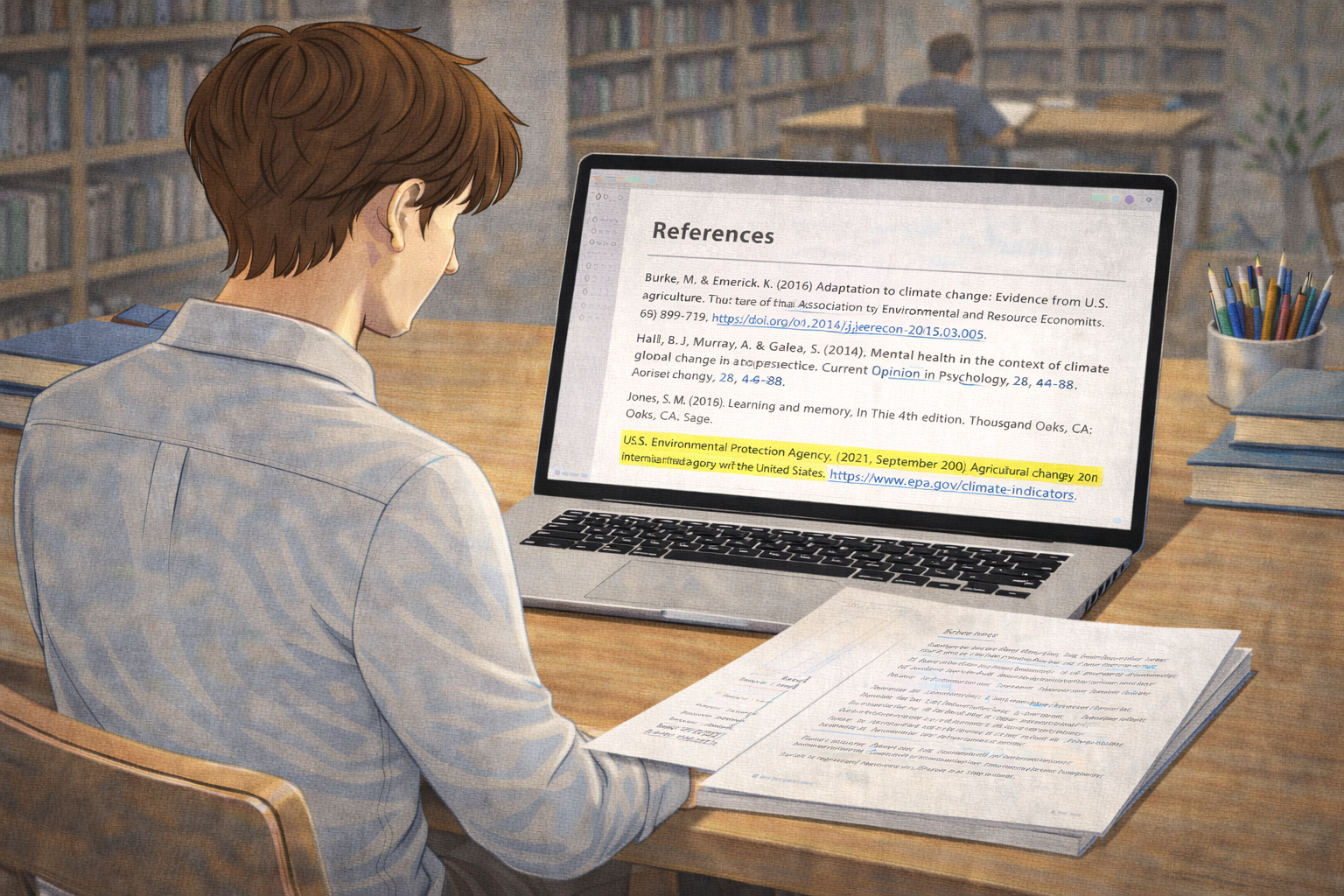
Online sources are now a routine part of university research, particularly in disciplines such as business, psychology, education, health sciences, and social sciences. However, citing websites correctly remains one of the most common referencing challenges students face when using APA 7th edition.
Unlike books and journal articles, websites often lack clear authorship, stable publication dates, or consistent formatting. These variations can lead to incorrect references, mismatched in-text citations, and avoidable loss of marks. Understanding how to cite a website in APA 7 is therefore essential for academic accuracy and integrity.
This guide explains APA 7 website citation rules in a structured, practical way, using assignment-ready examples that reflect real university marking criteria.
What APA 7 Requires When Citing a Website
APA 7 treats websites as online works and applies the same core reference components used for other sources, with flexibility to account for missing information. The goal is clarity and traceability rather than rigid formatting.
An APA 7 website reference generally includes the author, publication date, title of the webpage, website name, and URL. Not all elements will appear in every case, but the order remains consistent.
APA principle: Include as much information as needed to help the reader locate the source, but do not invent missing details.
This principle explains why APA discourages guessing authors or adding retrieval dates unless required.
Basic Format: How to Cite a Website in APA 7
The standard APA 7 reference format for a webpage is shown below. This structure applies to most academic assignments.
Author, A. A. (Year, Month Day). Title of webpage. Website Name. URL
Each element serves a specific purpose, and incorrect ordering or punctuation can result in referencing penalties.
APA 7 Website Citation Examples
The table below presents common website citation scenarios students encounter in university assignments.
| Scenario | APA 7 Reference Example |
|---|---|
| Website with author and date | Smith, J. (2022, March 15). Climate change and policy responses. Global Policy Institute. https://www.gpi.org/climate-policy |
| Website with no individual author | World Health Organization. (2023). Mental health in emergencies. https://www.who.int/mental_health |
| Website with no date | American Psychological Association. (n.d.). APA style guidelines. https://apastyle.apa.org |
These examples reflect examiner-approved APA 7 formatting and are suitable for direct use in academic work.
How to Cite a Website with No Author in APA 7
Many academic and institutional websites do not list individual authors. In APA 7, the organisation responsible for the content becomes the author.
Example:
United Nations. (2021). Sustainable development goals report. https://www.un.org/sustainabledevelopment
If both the author and website name are the same, the website name is omitted to avoid repetition.
Examiner warning: Do not use “Anonymous” unless the source explicitly lists the author that way.
How to Cite a Website with No Date
Webpages frequently change, and publication dates are sometimes unavailable. APA 7 allows the use of “n.d.” (no date) in such cases.
Example:
National Institute of Mental Health. (n.d.). Anxiety disorders. https://www.nimh.nih.gov/anxiety
Using “n.d.” signals transparency and avoids the academic misconduct risk associated with guessing dates.
In-Text Citations for Websites in APA 7
Every website reference must correspond to at least one in-text citation. APA 7 uses the author–date system, even for online sources.
Parenthetical citation:
(Smith, 2022)
Narrative citation:
Smith (2022) explains that climate policy responses vary significantly by region.
For organisational authors, use the organisation name in both reference list and in-text citations.
When to Include a Retrieval Date
APA 7 generally does not require retrieval dates. However, they are necessary when the content is designed to change over time, such as dashboards or live statistics.
Example with retrieval date:
World Bank. (n.d.). Global economic indicators. Retrieved April 10, 2024, from https://data.worldbank.org
Including retrieval dates when unnecessary is considered poor APA practice.
Common APA 7 Website Citation Mistakes
Students often lose marks for avoidable APA website citation errors. The most frequent include:
- Capitalising webpage titles incorrectly
- Using italics on website names instead of page titles
- Including “Retrieved from” when not required
- Breaking URLs with line spaces or punctuation
These errors signal weak attention to detail and can undermine an otherwise strong academic argument.
Why Accurate Website Citation Matters in University Assignments
Website sources are sometimes viewed sceptically by examiners due to concerns about credibility. Correct APA 7 citation helps demonstrate that online materials are used responsibly and critically.
Accurate referencing also protects against plagiarism allegations and allows markers to verify sources efficiently. In many marking rubrics, referencing accuracy contributes directly to the final grade.
Final Guidance on Citing Websites in APA 7
Learning how to cite a website in APA 7 is an essential academic skill, particularly as digital sources become more prominent in university research. By applying the rules and examples outlined in this guide, students can reference websites with confidence and precision.
Consistency, transparency, and adherence to APA 7 principles are more important than memorising templates. When applied correctly, APA website citations strengthen both academic credibility and overall assignment quality.


Comments