Learning how to cite secondary sources in APA 7 is essential for maintaining academic integrity, particularly when working with complex literature reviews or historical texts. In university-level writing, students are often required to consult original research. However, there are situations where the primary source is unavailable, inaccessible, or out of print. In such cases, a secondary citation becomes necessary.
Many students misunderstand secondary citations and either reference them incorrectly or overuse them. Because APA 7 places strong emphasis on consulting original works whenever possible, secondary citations should be used carefully and strategically. This guide explains when they are appropriate, how to format them correctly, and how to avoid losing marks.
What Is a Secondary Source in APA 7?
A secondary source occurs when you cite an author’s idea, theory, or data that you found quoted or discussed in another author’s work. In other words, you are not reading the original source directly but are relying on someone else's interpretation of it.
For example, imagine Author A (published in 1995) developed an influential theory. You cannot access Author A’s original book, but Author B (published in 2022) discusses and quotes that theory. If you rely on Author B’s explanation of Author A, you are using a secondary source.
APA 7 recommends using secondary citations only when the original source cannot be obtained.
Whenever possible, you should locate and read the primary source yourself.
When Should You Use a Secondary Citation?
Secondary citations are acceptable under specific circumstances:
- The original source is out of print or historically inaccessible.
- You cannot obtain the source through academic databases.
- The original text is in another language and unavailable in translation.
However, they should not be used simply for convenience. Examiners often view excessive secondary citations as a sign of weak research depth.
How to Cite Secondary Sources in APA 7 In-Text
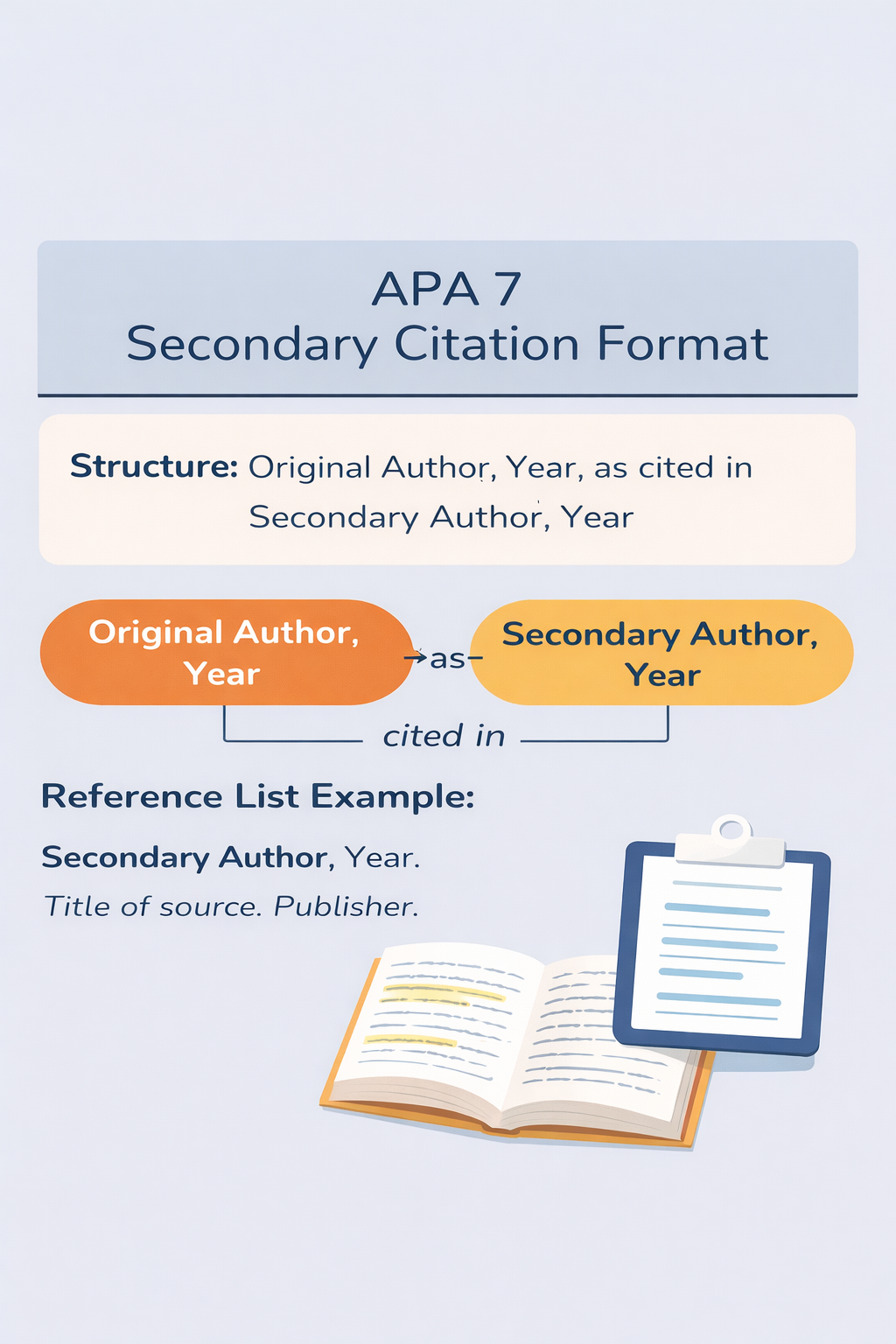
APA 7 uses a clear “as cited in” structure for secondary citations. The format is:
(Original Author, Year, as cited in Secondary Author, Year)
Example:
(Freud, 1900, as cited in Smith, 2021)
In narrative form, this would appear as:
Freud (1900, as cited in Smith, 2021) argued that dreams reflect unconscious desires.
Notice that both authors appear in the in-text citation, but only one appears in the reference list. This is a common point of confusion.
What Goes in the Reference List?
In APA 7, you only include the source you actually read in your reference list — that is, the secondary source.
If you accessed Freud’s theory through Smith’s 2021 article, only Smith (2021) appears in the references.
| Element | Included in In-Text Citation | Included in Reference List |
|---|---|---|
| Original Author (Freud, 1900) | Yes | No |
| Secondary Author (Smith, 2021) | Yes | Yes |
This rule ensures transparency about the source you directly consulted.
Common Mistakes When Citing Secondary Sources
Students frequently make errors that can lead to marking penalties. The most common issues include:
- Listing both the original and secondary source in the reference list.
- Failing to include “as cited in” in the in-text citation.
- Using secondary citations when the original source is easily accessible.
- Misplacing dates or formatting punctuation incorrectly.
Remember that APA formatting is precise. Even small structural errors can affect grading in research-heavy assignments.
How Secondary Citations Affect Academic Credibility
Using secondary citations is not inherently wrong, but it signals that your engagement with the literature may be indirect. In dissertations and postgraduate research, overreliance on secondary citations may reduce perceived depth of scholarship.
Strong academic writing demonstrates critical engagement with primary sources whenever possible. Secondary citations should supplement your research, not replace comprehensive literature review practices.
How to Cite Secondary Sources in APA 7 Correctly and Confidently
To summarise, citing secondary sources in APA 7 requires careful attention to structure and intention. Use the “Original Author, Year, as cited in Secondary Author, Year” format in-text, and include only the secondary source in your reference list.
Always attempt to locate the original source before relying on a secondary citation. If it is genuinely unavailable, follow APA rules precisely to maintain academic transparency and credibility. Mastering this technique strengthens your research integrity and ensures compliance with APA 7 guidelines.

Comments