Knowing how to cite an image in APA 7 is essential for maintaining academic integrity, especially in essays, research papers, presentations, and dissertations that include visual material. Students often use photographs, charts, paintings, infographics, screenshots, or diagrams without properly referencing them, which can result in unintentional plagiarism.
APA 7th edition provides clear but slightly different rules depending on whether you are reproducing an image, adapting it, or simply referring to it within your text. This guide explains each scenario in detail, including reference list entries, in-text citations, and figure notes. By the end, you will understand how to cite images accurately and confidently in APA style.
When Do You Need to Cite an Image in APA 7?
You must cite an image in APA 7 whenever the visual material is not your original creation. This includes images downloaded from websites, photographs taken by someone else, artwork, published graphs, diagrams, maps, screenshots, and figures from journal articles or textbooks.
Even if the image is publicly available online, it still requires citation. Copyright and academic integrity rules apply regardless of how easy the image was to access.
If you did not create the image yourself, you must cite it.
Failure to do so can be treated as plagiarism in many universities.
Basic APA 7 Reference Format for an Online Image
The general reference format for an image found online is:
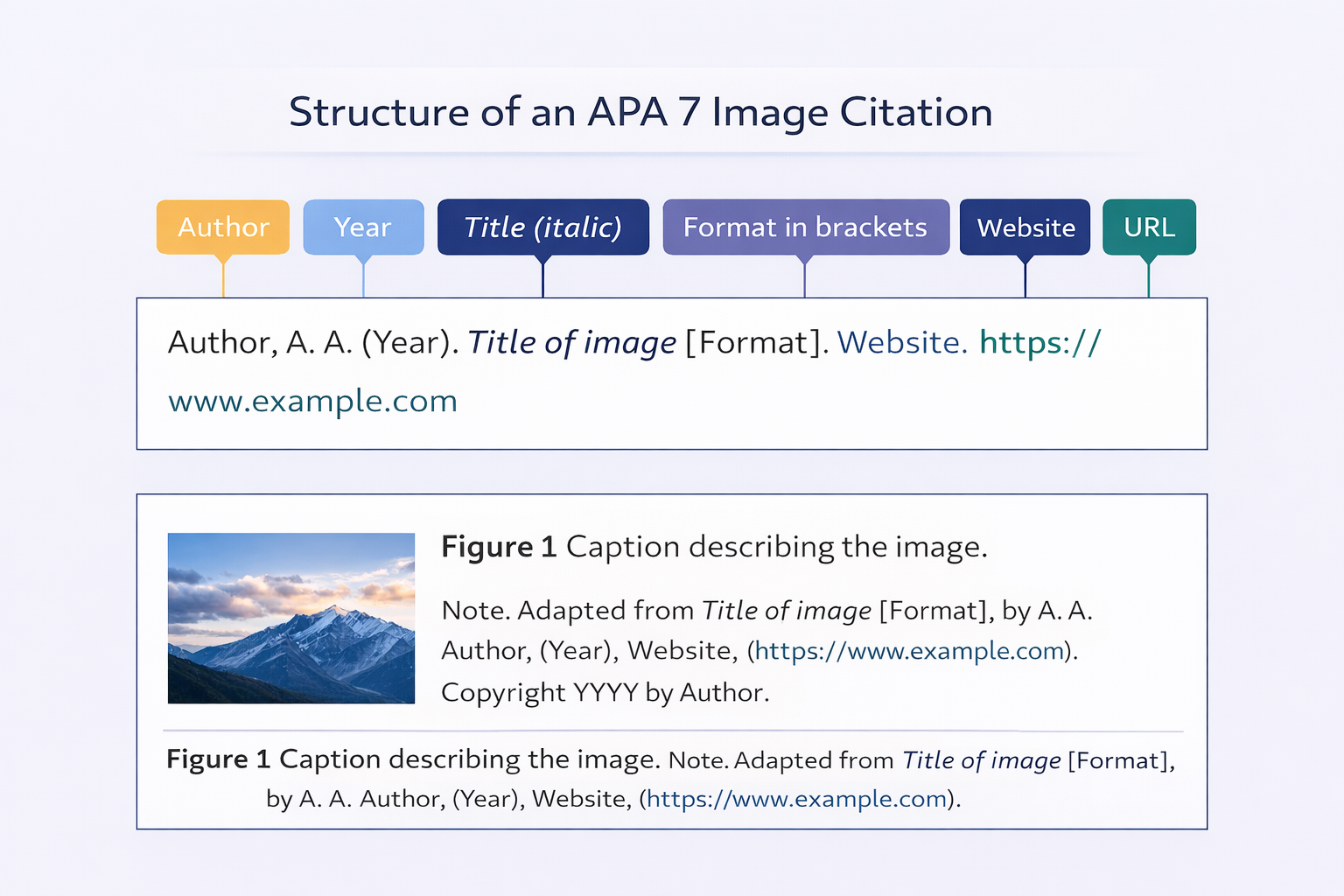
Author, A. A. (Year). Title of image [Description of format]. Website Name. URL
The description in square brackets identifies the type of image, such as [Photograph], [Painting], [Infographic], or [Map]. Unlike some other sources, APA 7 does not require an access date unless the content is designed to change over time.
| Element | Example |
|---|---|
| Author | Smith, J. |
| Year | (2021) |
| Title (Italicised) | Urban skyline at sunset |
| Format Description | [Photograph] |
| Website Name | Unsplash |
| URL | https://unsplash.com/... |
This structure ensures that readers can identify the creator, date, and source clearly.
Example: Citing a Photograph from a Website
Smith, J. (2021). Urban skyline at sunset [Photograph]. Unsplash. https://unsplash.com/...
In-text citation:
(Smith, 2021)
If you mention the photographer in your sentence:
Smith (2021) captures the urban skyline during golden hour.
How to Cite an Image with No Individual Author
If no individual author is listed, use the organisation as the author. If neither is available, move the title to the author position.
Example with organisational author:
National Geographic (2020). Coral reef ecosystem [Photograph]. https://www.nationalgeographic.com/...
In-text citation:
(National Geographic, 2020)
How to Cite an Image from a Book or Journal
If the image appears within a textbook or journal article, you cite the source where the image appears, not the image separately. The reference follows standard book or journal formatting, and you include figure details in your caption.
For example, if the image appears in a textbook:
Brown, L. (2019). Introduction to environmental science. Pearson.
Your in-text citation would refer to the book:
(Brown, 2019)
The figure caption would acknowledge the source, as explained below.
How to Format Figures in APA 7
When you include an image in your assignment, APA 7 requires a figure number and title placed above the image, followed by a note below it.
The structure is:
- Figure number (bold)
- Title (italicised)
- Image
- Note. Source information
Example of a figure note:
Note. From Urban skyline at sunset [Photograph], by J. Smith, 2021, Unsplash (https://unsplash.com/...). Copyright 2021 by J. Smith.
If the image is adapted rather than reproduced exactly, write “Adapted from” instead of “From.”
Reproducing vs Adapting an Image
APA distinguishes between reproducing an image exactly and adapting it. Reproducing means using it unchanged. Adapting means modifying it, such as altering labels, colours, or cropping sections.
| Action | Figure Note Wording |
|---|---|
| Exact copy | From “Title,” by Author, Year, Website/Publisher |
| Modified image | Adapted from “Title,” by Author, Year, Website/Publisher |
Using the correct wording ensures transparency about how the image was used.
How to Cite Stock Images and Creative Commons Images
Many students assume stock images or Creative Commons images do not require citation. This is incorrect. Even if an image is free to use, academic citation is still required.
Check the licensing information carefully. If attribution is required under the licence, follow those requirements alongside APA formatting.
Common Mistakes When Citing an Image in APA 7
- Omitting the format description in square brackets.
- Forgetting to italicise the image title.
- Citing only the website instead of the creator.
- Placing figure captions incorrectly.
- Not distinguishing between adapted and reproduced images.
These mistakes can reduce marks in research projects, dissertations, and visual assignments.
Mastering How to Cite an Image in APA 7
Learning how to cite an image in APA 7 requires understanding three key elements: the reference list entry, the in-text citation, and the figure note format. Each plays a distinct role in acknowledging intellectual property and maintaining academic credibility.
Whether you are citing a photograph, artwork, infographic, map, or diagram, always identify the creator, publication year, image title, format type, and source URL. If the image appears in a published book or journal, cite the original source appropriately and format the figure according to APA 7 guidelines.
By applying these structured rules consistently, you ensure that your academic work is ethically sound, professionally presented, and fully compliant with APA 7 standards.
Comments