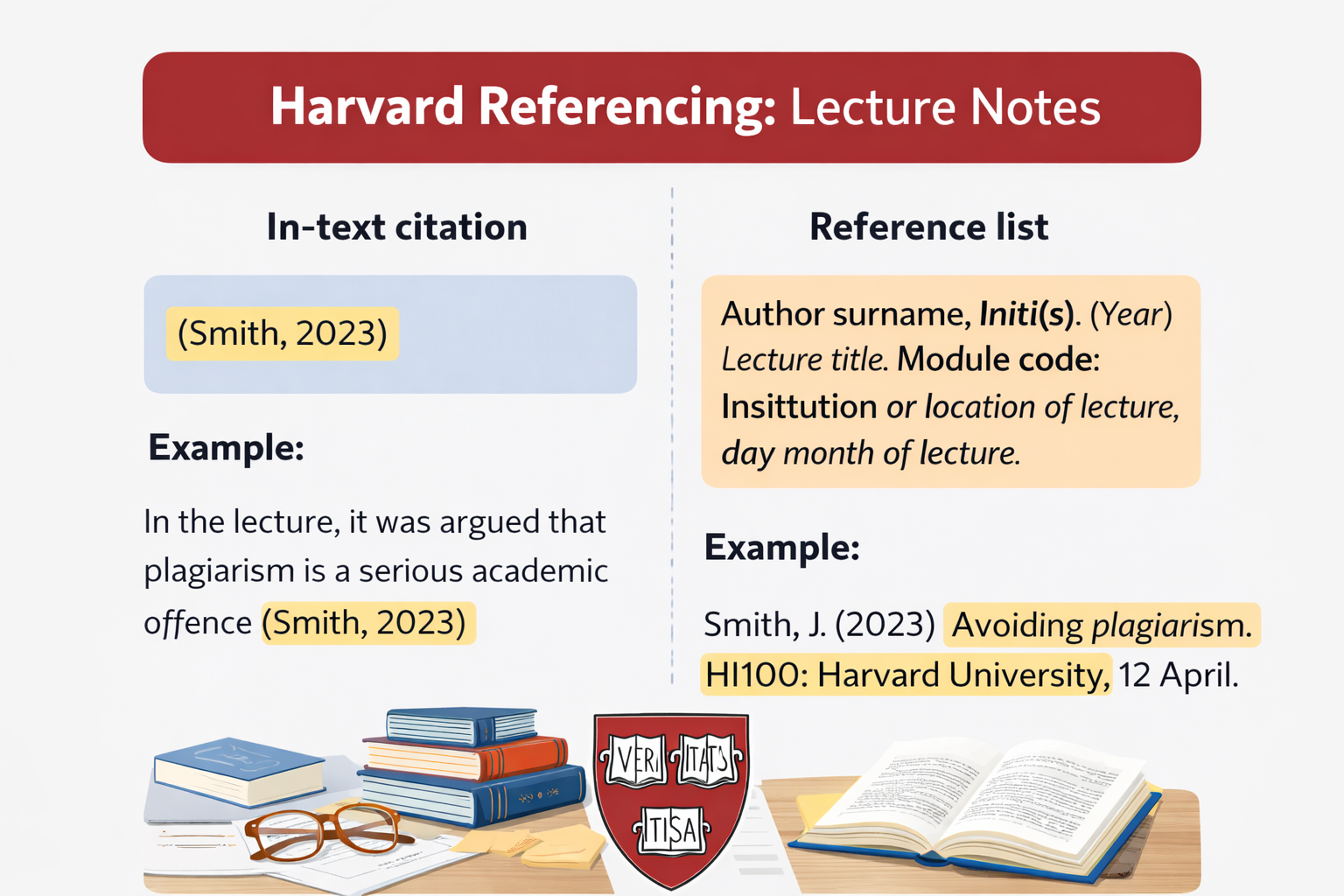
Understanding how to reference lecture notes in Harvard style is essential for university students, particularly in coursework that draws heavily on module content. While lecture slides, seminar notes, and recorded presentations are valuable learning tools, they must be cited correctly to maintain academic integrity and avoid plagiarism. Many students are unsure whether lecture notes are even allowed as sources, and if they are, how to format them properly.
Harvard referencing is an author–date system, meaning citations must clearly identify the creator and the year of publication or delivery. However, lecture materials present unique challenges because they are often unpublished, institution-specific, and sometimes inaccessible to external readers. This guide explains when you can reference lecture notes, how to cite them correctly in Harvard style, and what examiners expect.
Can You Reference Lecture Notes in Harvard Style?
Before learning how to reference lecture notes in Harvard style, it is important to understand when they are appropriate to use. In many universities, lecture notes are considered supplementary material rather than peer-reviewed academic sources. This means they should not replace textbooks, journal articles, or official reports in research-heavy assignments.
However, referencing lecture notes is acceptable when:
- You are referring to specific content delivered by your lecturer.
- The assignment explicitly asks you to engage with lecture material.
- The lecture includes original explanations not found in published texts.
Lecture notes should support your argument, not serve as your primary academic evidence.
Examiners generally expect independent research beyond lecture slides.
How to Reference Lecture Notes in Harvard Style (In-Text Citation)
Harvard referencing requires in-text citations in the format (Author, Year). For lecture notes, the “author” is typically the lecturer who created or delivered the material.
Basic in-text format:
(Lecturer Surname, Year)
Example:
(Thompson, 2023)
If you mention the lecturer in the sentence:
Thompson (2023) argues that globalisation has reshaped contemporary labour markets.
The year refers to the year the lecture was delivered or published on the learning platform.
How to Reference Lecture Slides or Notes in the Reference List
The reference list entry depends on whether the lecture notes are available online via a learning platform (e.g., Moodle, Blackboard) or unpublished.
Format for Online Lecture Notes (Accessible via Learning Platform)
General format:
Lecturer Surname, Initial(s). (Year) Title of lecture. Module code: Module title. [Lecture notes] Name of University. Available at: URL (Accessed: Day Month Year).
Example:
Thompson, J. (2023) Globalisation and labour markets. SOC202: Global Sociology. [Lecture slides] University of Manchester. Available at: https://moodle.manchester.ac.uk (Accessed: 12 January 2024).
Format for Unpublished Lecture Notes
If the lecture notes are not publicly accessible and only available to students:
Lecturer Surname, Initial(s). (Year) Title of lecture. Module code: Module title. [Unpublished lecture notes]. Name of University.
Example:
Thompson, J. (2023) Globalisation and labour markets. SOC202: Global Sociology. [Unpublished lecture notes]. University of Manchester.
| Type of Lecture Material | Include URL? | Include Access Date? |
|---|---|---|
| Online (Learning Platform) | Yes | Yes |
| Unpublished/Internal Only | No | No |
This distinction ensures transparency about source accessibility.
Referencing Recorded Lectures in Harvard Style
If you are referencing a recorded lecture video provided by your lecturer, you should treat it similarly to an online lecture. Include the format descriptor such as “[Video recording]”.
Example:
Thompson, J. (2023) Globalisation and labour markets. SOC202: Global Sociology. [Video recording] University of Manchester. Available at: https://moodle.manchester.ac.uk (Accessed: 12 January 2024).
This clarifies the medium of delivery and avoids ambiguity.
Common Mistakes When Referencing Lecture Notes in Harvard Style
Students often lose marks due to avoidable formatting errors. The most common issues include:
- Omitting the module title or module code.
- Forgetting to include “[Lecture slides]” or “[Unpublished lecture notes]”.
- Listing lecture notes without including the university name.
- Using lecture notes as the only source in research essays.
Remember that Harvard referencing requires consistency. Small punctuation or formatting errors can reduce marks in assignments where referencing accuracy is assessed.
Should Lecture Notes Appear Frequently in Academic Essays?
While referencing lecture notes in Harvard style is acceptable, they should not dominate your reference list. Academic essays are expected to demonstrate engagement with peer-reviewed journal articles, books, and credible reports. Lecture notes summarise material but often do not provide full theoretical debates or empirical evidence.
Using lecture notes strategically — for example, to clarify a concept introduced in class — can strengthen your work. However, always support those concepts with independent academic sources.
How to Reference Lecture Notes in Harvard Style with Confidence
To reference lecture notes in Harvard style correctly, identify the lecturer as the author, use the year of delivery, clearly label the material type, and include institutional details. Include URLs and access dates only if the material is available online. Ensure consistency between in-text citations and the reference list.
Most importantly, use lecture notes as supporting material rather than primary evidence. Accurate Harvard referencing demonstrates academic integrity, clarity, and professionalism — qualities that examiners consistently reward.

Comments