Understanding how to write in-text citations with multiple authors is a fundamental academic skill at university level. As research increasingly involves collaboration, students frequently encounter sources written by two, three, or even dozens of authors. Correctly citing these works is essential for maintaining academic integrity, demonstrating scholarly engagement, and meeting formatting requirements in different referencing styles.
However, citation rules vary depending on the style guide used, the number of authors involved, and whether the citation appears in narrative or parenthetical form. Many students lose marks not because of weak arguments, but because of small citation errors. This guide explains how to write in-text citations with multiple authors clearly and accurately across major referencing systems.
Why Accurate Multi-Author Citations Matter
Academic writing depends on transparency. Readers must be able to trace ideas back to their original sources. When multiple authors are involved, citation formatting ensures that credit is distributed appropriately while maintaining clarity in your writing.
Incorrect in-text citation formatting can result in lost marks or accusations of poor academic practice.
Accurate citation also reflects attention to detail. Examiners often treat referencing accuracy as an indicator of overall academic discipline. Mastering multi-author citation rules therefore strengthens both credibility and presentation.
General Principles Before Applying Style-Specific Rules
Although citation styles differ, several universal principles apply when learning how to write in-text citations with multiple authors:
- List authors in the order they appear in the original publication.
- Use consistent punctuation and conjunctions (e.g., “and” vs “&”) according to the style guide.
- Apply abbreviation rules correctly when there are three or more authors.
- Ensure every in-text citation has a matching reference list entry.
These foundational rules prevent structural inconsistencies in academic writing.
APA Style: Writing In-Text Citations with Multiple Authors
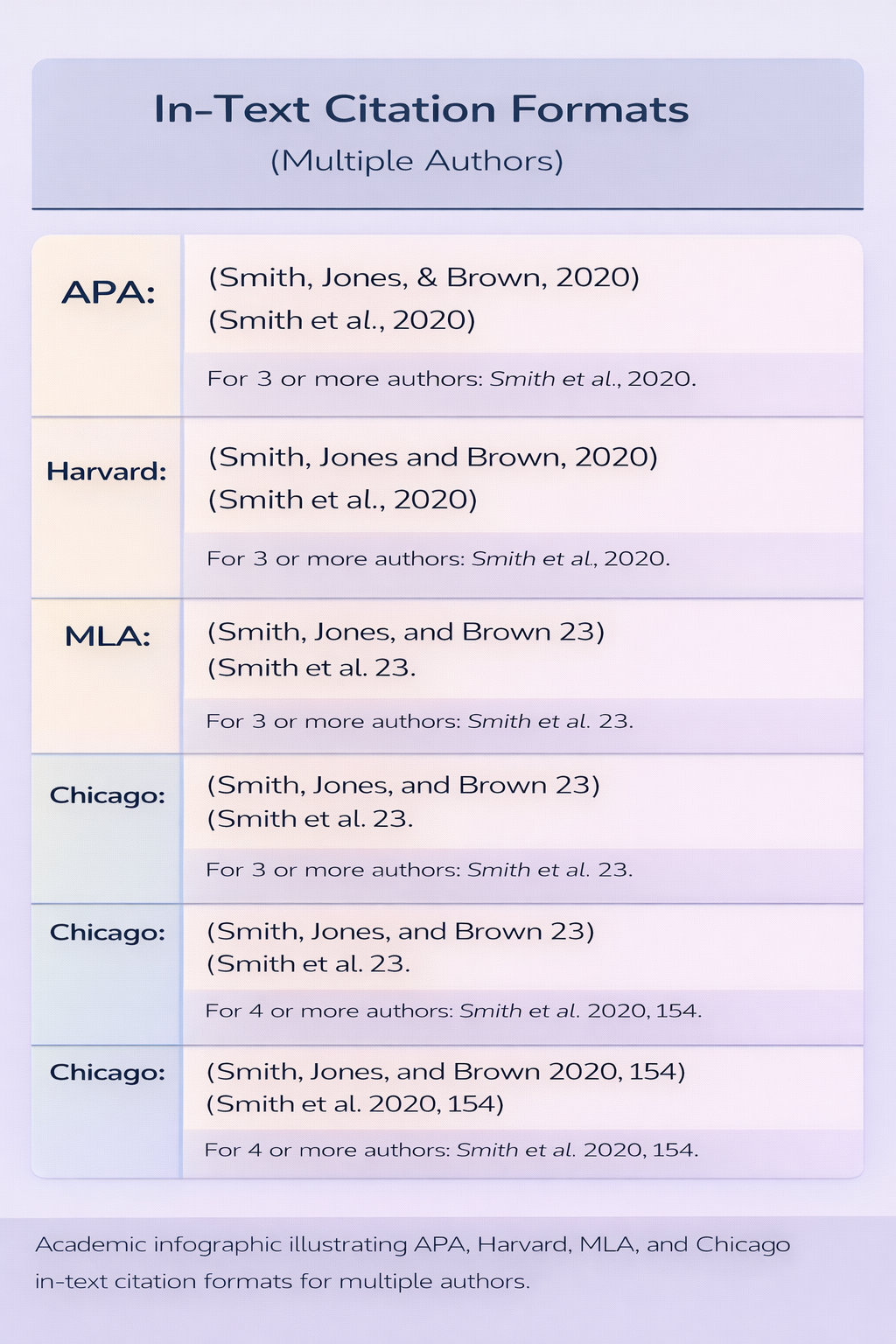
APA (7th edition) is widely used in social sciences, psychology, business, and education. Its rules for multiple authors depend on how many authors a source has.
| Number of Authors | Narrative Citation | Parenthetical Citation |
|---|---|---|
| Two Authors | Smith and Jones (2022) | (Smith & Jones, 2022) |
| Three or More Authors | Smith et al. (2022) | (Smith et al., 2022) |
In APA 7th edition, sources with three or more authors are shortened to the first author followed by “et al.” from the very first citation. This simplifies formatting and improves readability.
Example in context:
Collaborative learning improves critical thinking outcomes (Smith et al., 2022). This finding aligns with earlier research suggesting peer interaction enhances retention rates.
Harvard Style: Multi-Author In-Text Citations
Harvard referencing varies slightly between institutions, but general principles remain consistent. Typically:
- Two authors: cite both names.
- Three or more authors: use the first author followed by “et al.”
Example:
Two authors: (Brown and Taylor, 2021)
Three or more authors: (Brown et al., 2021)
Always consult your university’s specific Harvard guide, as formatting may differ slightly in punctuation or spacing.
MLA Style: In-Text Citations with Multiple Authors
MLA style, commonly used in humanities disciplines, emphasises author names and page numbers rather than publication year.
| Number of Authors | Format |
|---|---|
| Two Authors | (Smith and Jones 45) |
| Three or More Authors | (Smith et al. 45) |
Notice that MLA does not use commas between author names and page numbers, and it does not include the publication year in the in-text citation.
Chicago Style: Notes and Author-Date Variations
Chicago style has two systems: Notes and Bibliography, and Author-Date. For the Author-Date system, multiple authors are cited similarly to APA.
Two authors example:
(Smith and Johnson 2020, 78)
Three or more authors example:
(Smith et al. 2020, 78)
The Notes and Bibliography system uses footnotes rather than parenthetical citations, which changes formatting requirements significantly.
Narrative vs Parenthetical Citations
When learning how to write in-text citations with multiple authors, it is important to distinguish between narrative and parenthetical citation formats.
Narrative citation: The authors’ names appear within the sentence.
Smith and Brown (2021) argue that educational equity requires policy reform.
Parenthetical citation: The citation appears at the end of the sentence.
Educational equity requires significant policy reform (Smith & Brown, 2021).
Both formats are acceptable when used correctly, but consistency throughout the essay is essential.
Common Mistakes in Multi-Author Citations
- Using “et al.” incorrectly for two-author sources.
- Failing to include all required authors in reference lists.
- Mixing “and” and “&” incorrectly in APA.
- Inconsistent punctuation between citations.
- Forgetting page numbers when directly quoting.
Always check whether your citation style requires an ampersand (&) or the word “and” depending on placement.
Attention to these details prevents formatting penalties.
How to Handle Sources with Many Authors (10+ Authors)
Some research articles include extensive author lists. APA 7th edition allows the use of “et al.” in in-text citations for three or more authors. However, in the reference list, up to 20 authors may need to be listed before abbreviation rules apply.
Always verify your style manual’s specific requirements, particularly for high-author-count journal articles.
Direct Quotations with Multiple Authors
When quoting directly from a source with multiple authors, you must include page numbers (or paragraph numbers for online sources without pagination).
Example (APA):
“Inclusive classrooms improve social outcomes for all students” (Garcia et al., 2021, p. 112).
This demonstrates complete and accurate citation formatting.
Mastering How to Write In-Text Citations with Multiple Authors
Learning how to write in-text citations with multiple authors requires careful attention to detail, consistency, and adherence to style guidelines. Whether using APA, Harvard, MLA, or Chicago style, the core principles remain consistent: cite authors in correct order, apply abbreviation rules properly, and match in-text citations to reference entries.
Strong academic writing is not only about argument quality but also about precision. By mastering multi-author citation rules, students enhance credibility, avoid plagiarism risks, and present their research with confidence and professionalism.
Comments