Understanding how to cite tables and figures in Harvard referencing is essential for producing academically rigorous coursework. Whether you are writing a business report, dissertation, laboratory report, or research essay, visual data such as charts, graphs, maps, and statistical tables must be properly acknowledged.
Students often focus on referencing books and journal articles but overlook the correct citation of visual materials. However, tables and figures represent intellectual property just as much as written content. Failure to cite them accurately can result in plagiarism penalties, reduced marks, or requests for resubmission.
This guide explains, step by step, how to cite tables and figures in Harvard referencing, including formatting captions, writing in-text citations, and constructing full reference list entries.
What Counts as a Table or Figure in Harvard Referencing?
In academic writing, a table typically presents data in rows and columns, such as statistical results, financial comparisons, or survey summaries. A figure includes visual materials such as graphs, charts, photographs, maps, diagrams, and illustrations.
Although Harvard referencing styles can vary slightly between universities, the fundamental principle remains consistent: you must acknowledge the original source whenever you reproduce or adapt a table or figure.
If the data or image is not originally created by you, it must be cited.
This applies even if you have modified the material.
How to Label Tables and Figures in Harvard Style
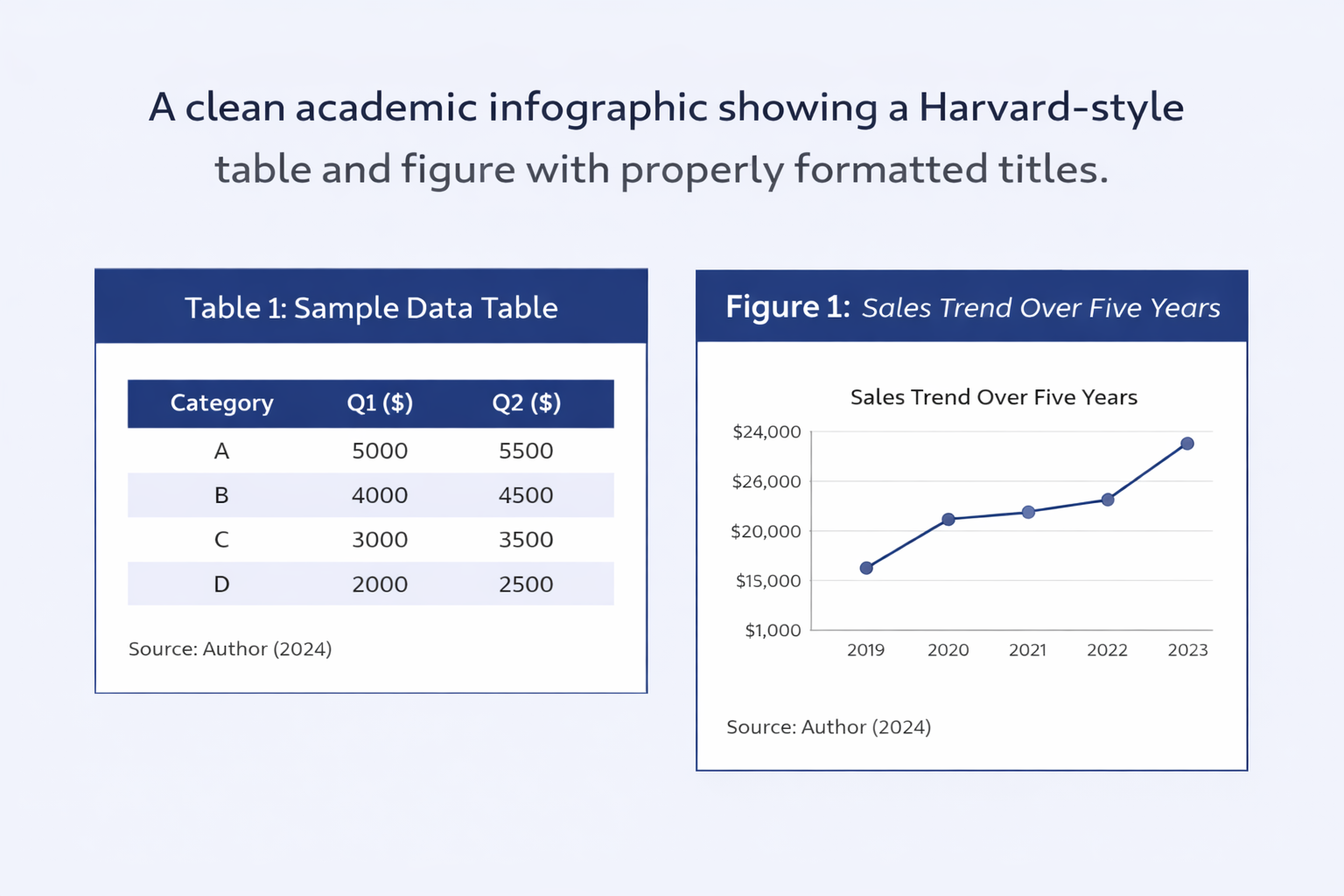
When inserting tables and figures into your work, they must be clearly numbered and titled. Tables and figures are numbered separately (e.g., Table 1, Table 2; Figure 1, Figure 2).
The standard structure includes:
- Number (Table 1 or Figure 1)
- Clear, descriptive title
- The table or image itself
- Source information below
For example:
Table 1: UK Inflation Rates 2018–2023
| Year | Inflation Rate (%) |
|---|---|
| 2018 | 2.5 |
| 2019 | 1.8 |
| 2020 | 0.9 |
Source: Office for National Statistics (2023)
The source line appears directly beneath the table or figure.
How to Cite a Table or Figure Reproduced Exactly
If you copy a table or figure exactly as it appears in the original source, you must provide a full source statement beneath it and include the complete reference in your reference list.
Example source line:
Source: Smith (2022)
Corresponding reference list entry:
Smith, J. (2022) Global economic trends. London: Routledge.
You should also refer to the table or figure within the body of your text, for example:
As shown in Table 1 (Smith, 2022), inflation declined significantly after 2019.
How to Cite an Adapted Table or Figure
If you modify a table or figure — for example by changing formatting, combining data, or altering labels — you must indicate that the material has been adapted.
The source line should read:
Source: Adapted from Smith (2022)
| Type of Use | Source Statement |
|---|---|
| Exact copy | Source: Smith (2022) |
| Modified version | Source: Adapted from Smith (2022) |
This distinction is important because it clarifies whether the content is directly reproduced or partially reworked.
How to Cite Tables and Figures from Online Reports
Many students use tables and figures from government publications, NGO reports, and statistical databases. In such cases, you cite the organisation as the author.
Example source beneath the figure:
Source: World Health Organization (2021)
Reference list entry:
World Health Organization (2021) Global health statistics 2021. Available at: https://www.who.int/... (Accessed: 10 January 2025).
Always check whether your institution requires an access date for online sources, as some Harvard variants do.
How to Refer to Tables and Figures in the Main Text
You should always refer to tables and figures within your discussion rather than inserting them without explanation. This demonstrates analytical engagement rather than decorative use.
- Correct: As illustrated in Figure 2 (Brown, 2021), renewable energy output increased steadily.
- Incorrect: See figure below.
Harvard referencing requires the author-date format in parentheses when referring to the original source.
Common Mistakes When Citing Tables and Figures in Harvard Referencing
Students frequently lose marks due to avoidable formatting errors. The most common issues include:
- Failing to include a source line beneath the table or figure.
- Not distinguishing between adapted and reproduced material.
- Providing a source line but omitting the full reference entry.
- Using inconsistent numbering (e.g., restarting numbering each page).
- Placing tables or figures without referencing them in the text.
These errors weaken academic presentation and may raise integrity concerns.
Mastering How to Cite Tables and Figures in Harvard Referencing
Learning how to cite tables and figures in Harvard referencing is about consistency and clarity. Every visual element must be numbered, titled, referenced in the text, and accompanied by a clear source statement.
If the table or figure is reproduced exactly, state the original author and year. If it is adapted, explicitly indicate that it has been modified. Finally, ensure the full source appears in your reference list in correct Harvard format.
When applied correctly, these practices demonstrate academic professionalism, strengthen the credibility of your work, and ensure full compliance with university marking criteria.

Comments