Learning how to write discussion section in research is one of the most important academic skills students must develop. While the results section presents findings objectively, the discussion section explains what those findings mean. It connects data to theory, evaluates implications, addresses limitations, and demonstrates scholarly insight. A strong discussion section often determines whether a research paper feels descriptive or intellectually compelling.
Many students struggle because they are unsure how to move from reporting numbers to interpreting meaning. They either repeat results without analysis or introduce entirely new arguments unrelated to their data. This guide provides a structured, step-by-step explanation of how to write a discussion section in research, ensuring clarity, coherence, and academic depth.
The Purpose of the Discussion Section
The discussion section interprets findings in relation to the research questions and existing literature. It answers the fundamental question: What do these results mean? Unlike the results section, the discussion requires analytical reasoning, theoretical engagement, and critical evaluation.
The discussion section interprets findings, connects them to theory, and explains their broader significance.
A strong discussion demonstrates that the researcher understands both the data and the scholarly context in which the research sits. It moves from specific findings to broader implications.
Overall Structure of a Strong Discussion Section
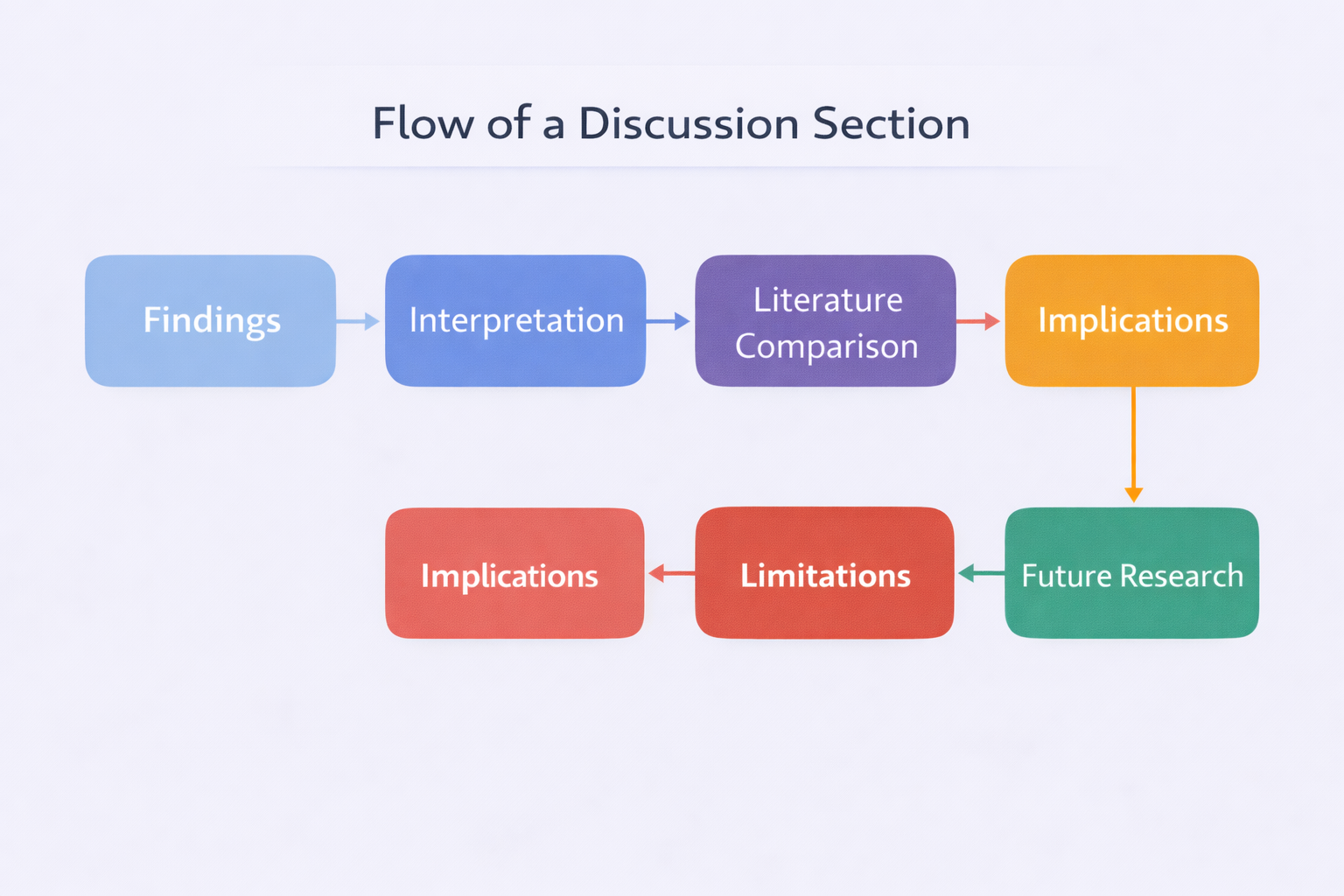
Although structures vary by discipline, most high-quality discussion sections follow a logical progression. This structure ensures clarity and prevents repetition of earlier sections.
| Section Component | Purpose |
|---|---|
| Summary of Key Findings | Briefly restate main results |
| Interpretation of Results | Explain what findings mean |
| Comparison with Literature | Link findings to previous studies |
| Theoretical or Practical Implications | Explain significance |
| Limitations | Acknowledge weaknesses |
| Recommendations for Future Research | Suggest further investigation |
This progression ensures that the discussion builds logically from findings to broader academic contribution.
Step 1: Start with a Focused Summary of Key Findings
The discussion should begin with a concise summary of the most important results. This is not a repetition of statistics but a restatement of the main patterns observed. The purpose is to remind readers of the central outcomes before interpreting them.
For example:
The findings revealed a significant positive relationship between study hours and academic performance, while social media usage showed no significant association with grades.
This opening paragraph anchors the discussion in the study’s objectives.
Step 2: Interpret the Meaning of the Findings
Interpretation is the heart of the discussion section. Students must explain why findings occurred and what they suggest about the research topic. Interpretation should be grounded in evidence, not speculation.
Do not introduce new data in the discussion section.
For example, if a relationship between study hours and grades is found, the discussion might explore theories of self-regulated learning or time management. This demonstrates analytical depth rather than mere description.
Step 3: Connect Findings to Existing Literature
A strong discussion section situates findings within existing research. Students should compare their results with previous studies, highlighting agreement, contradiction, or extension of knowledge.
- Do findings support existing theories?
- Do they challenge previous conclusions?
- Do they extend knowledge to new contexts?
Engaging with literature demonstrates scholarly maturity and reinforces the academic relevance of the study.
Step 4: Discuss Theoretical and Practical Implications
The discussion should move beyond comparison to consider broader implications. Theoretical implications explain how findings contribute to conceptual understanding. Practical implications explain real-world applications.
For example, if research shows that mentoring improves academic engagement, the discussion might suggest implementing structured mentoring programs in educational institutions.
This section demonstrates the broader value of the research beyond its immediate findings.
Step 5: Acknowledge Limitations Transparently
No research study is perfect. Addressing limitations strengthens credibility rather than weakening it. Limitations might relate to sample size, measurement tools, research design, or external validity.
| Limitation Type | Example |
|---|---|
| Sample Limitation | Small or homogeneous participant group |
| Methodological Limitation | Self-reported survey data |
| Design Limitation | Cross-sectional rather than longitudinal design |
Discussing limitations should be balanced—acknowledge weaknesses without undermining the study’s contribution.
Step 6: Offer Recommendations for Future Research
Future research suggestions should logically follow from the study’s findings and limitations. This demonstrates forward-thinking academic engagement.
For example, if a study used a small sample, future research might involve larger, more diverse populations. If results were inconclusive, further investigation may refine measurement tools.
Common Mistakes in Discussion Sections
Students frequently make avoidable errors when writing discussion sections:
- Repeating results without interpretation.
- Introducing entirely new arguments unrelated to findings.
- Overstating conclusions beyond the data.
- Ignoring contradictory evidence.
- Failing to connect to literature.
Avoiding these errors significantly strengthens academic quality.
Maintaining Logical Flow and Cohesion
The discussion section should follow a clear narrative progression. Each paragraph should build on the previous one. Avoid abrupt topic shifts. Transitional phrases help maintain coherence and ensure the argument develops logically.
Strong academic discussions move from specific findings to broader theoretical and practical implications in a controlled and structured manner.
Mastering How to Write Discussion Section in Research for Academic Excellence
Understanding how to write discussion section in research transforms a paper from descriptive reporting into scholarly analysis. The discussion interprets findings, connects them to theory, evaluates implications, acknowledges limitations, and suggests future research.
By structuring the section logically, maintaining analytical depth, and grounding interpretations in evidence, students can produce discussion sections that demonstrate academic maturity and intellectual contribution. Mastery of discussion writing strengthens dissertations, research papers, and overall scholarly communication skills.



Comments