Writing the results section is one of the most technical parts of an academic research paper. Many students struggle with how to write results section APA correctly because it requires precision, objectivity, and strict adherence to formatting standards. Unlike the introduction or discussion, the results section is not about interpretation—it is about presenting findings clearly and accurately.
This guide explains how to write a results section in APA format step by step. It clarifies structure, statistical reporting, table formatting, and common errors that cost students marks. Whether you are preparing a psychology paper, dissertation, or quantitative assignment, understanding APA results writing is essential for academic credibility.
Purpose of the Results Section in APA
The primary purpose of the results section is to present the findings of your study objectively. This includes descriptive statistics, inferential statistics, and outcomes related to your research questions or hypotheses. The results section should not include interpretation—that belongs in the discussion section.
The results section reports what was found, not what it means.
APA style emphasises clarity, precision, and statistical transparency. Every reported statistic must directly relate to a research question or hypothesis.
Overall Structure of an APA Results Section
A well-organised results section typically follows a logical sequence aligned with the research questions. The most common structure includes:
- Restatement of the analysis purpose.
- Descriptive statistics.
- Assumption testing (if applicable).
- Inferential statistical results.
- Tables and figures (if necessary).
This structure ensures clarity and methodological coherence.
Reporting Descriptive Statistics in APA
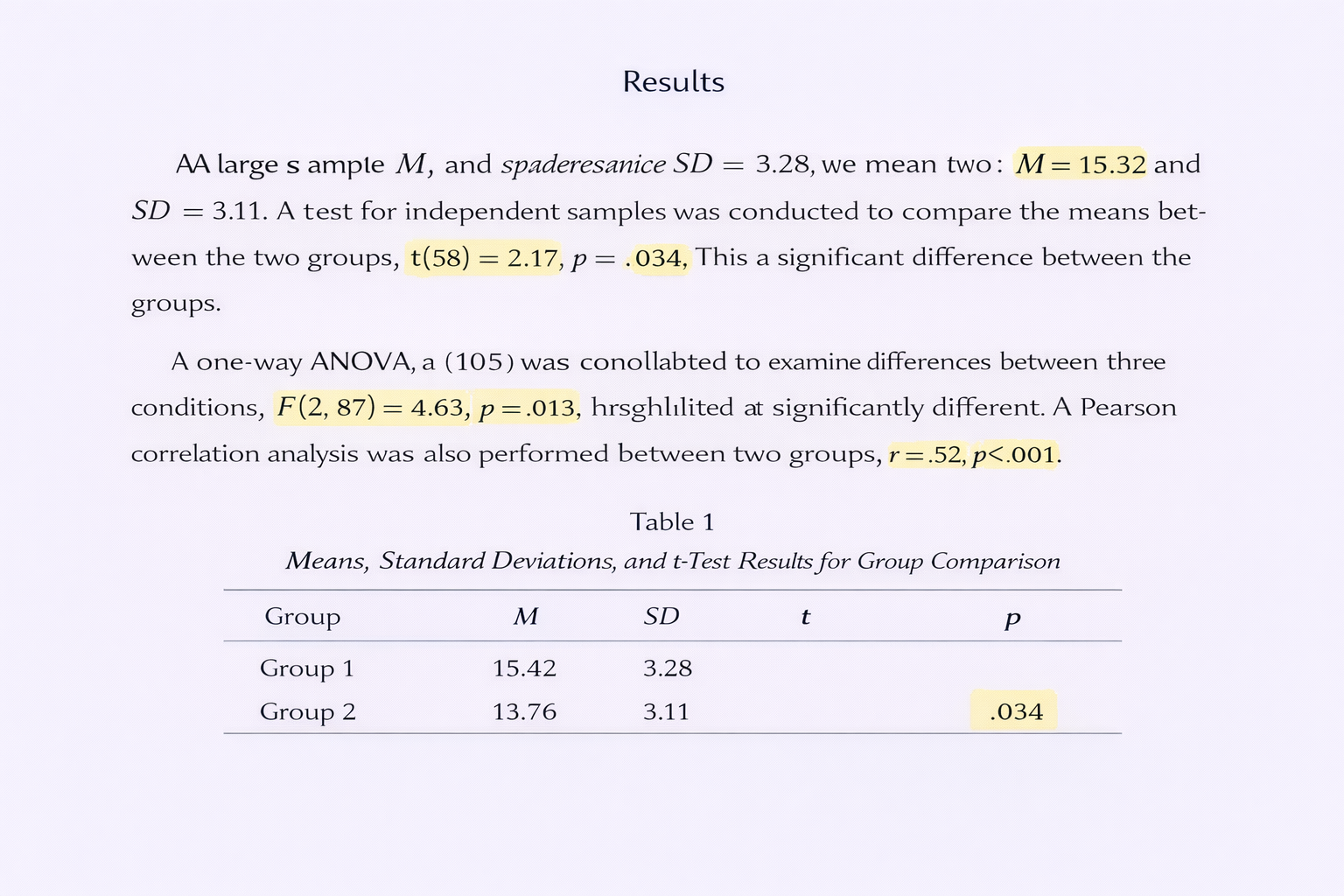
Descriptive statistics provide a summary of the data. These include means, standard deviations, frequencies, and percentages. In APA format, statistical symbols such as M (mean) and SD (standard deviation) should be italicised.
Example:
Participants reported moderate levels of stress (M = 3.45, SD = 0.87).
Descriptive results should logically precede inferential statistics, giving readers context before hypothesis testing.
Reporting Inferential Statistics in APA
Inferential statistics test hypotheses and determine whether observed differences are statistically significant. APA requires specific formatting for each type of statistical test.
| Test Type | APA Reporting Example |
|---|---|
| T-Test | t(28) = 2.45, p = .021 |
| ANOVA | F(2, 57) = 4.32, p = .018 |
| Correlation | r(45) = .52, p < .001 |
| Regression | B = 1.23, SE = 0.45, p = .007 |
Each test statistic must include degrees of freedom and p-values. If effect sizes are available, they should also be reported.
Including Effect Sizes in APA Results
APA strongly encourages reporting effect sizes alongside p-values. Effect sizes provide information about practical significance, not just statistical significance.
- Cohen’s d for t-tests
- Eta squared (η²) for ANOVA
- R² for regression
For example:
The difference between groups was significant, t(48) = 2.65, p = .011, d = 0.74.
Reporting only p-values without effect sizes is considered incomplete in APA style.
How to Format Tables in APA Style
Tables should be used when they enhance clarity rather than repeat information already described in text. APA tables must include a table number and title above the table, with notes below if necessary.
| Group | M | SD |
|---|---|---|
| Control | 75.32 | 8.45 |
| Experimental | 82.14 | 7.12 |
When tables are included, the text should reference them (e.g., “see Table 2”). However, do not repeat every number from the table in the text.
Reporting Assumption Testing
If statistical tests require assumptions (e.g., normality, homogeneity of variance), these should be briefly reported. For example:
Levene’s test indicated that the assumption of homogeneity of variance was met, F(1, 48) = 0.87, p = .356.
Assumption testing strengthens methodological transparency and demonstrates statistical competence.
Common Mistakes in APA Results Sections
Students frequently lose marks due to avoidable errors in results writing:
- Interpreting findings instead of simply reporting them.
- Copying raw SPSS tables without formatting.
- Failing to include degrees of freedom.
- Reporting p-values incorrectly (e.g., p = .000 instead of p < .001).
- Overusing tables unnecessarily.
Avoiding these errors ensures clarity, professionalism, and adherence to APA standards.
Integrating Results with Research Questions
Results should be organised according to research questions or hypotheses. Each paragraph should clearly state which hypothesis is being tested and whether it was supported.
For example:
Hypothesis 1 predicted a positive relationship between study hours and GPA. A Pearson correlation analysis confirmed this prediction, r(52) = .41, p = .003.
This structured alignment enhances readability and academic coherence.
Maintaining Objectivity in the Results Section
The tone of the results section must remain neutral and objective. Avoid subjective language such as “surprisingly” or “interestingly.” Interpretation and implications should be reserved for the discussion section.
The results section presents data objectively; interpretation belongs in the discussion.
This separation demonstrates academic discipline and adherence to APA structure.
Mastering How to Write Results Section APA for Academic Success
Understanding how to write results section APA correctly ensures clarity, credibility, and academic professionalism. A strong results section presents descriptive and inferential statistics clearly, reports effect sizes, checks assumptions, and adheres strictly to APA formatting guidelines.
By organising findings logically, formatting statistics correctly, and maintaining objectivity, students can significantly improve the quality of their research papers and dissertations. Mastery of APA results writing not only enhances grades but also strengthens long-term research competence and scholarly communication skills.


Comments