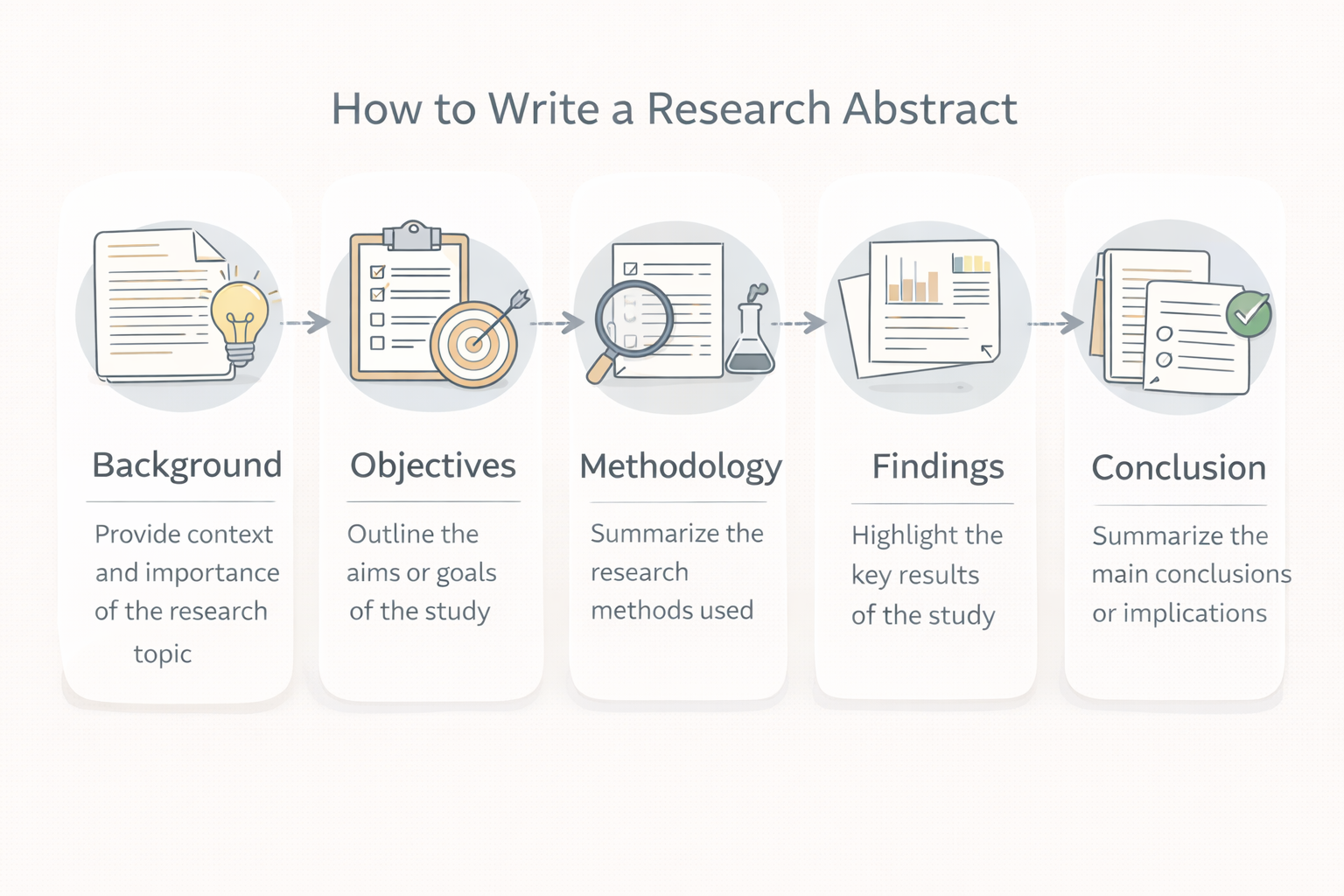
An abstract is not a summary written for convenience; it is a tightly structured academic text that performs a distinct evaluative function. In many university settings, the abstract is read before any other section and is often used by examiners to form an initial judgement about the coherence, originality, and methodological soundness of a study. Despite this importance, abstracts are frequently misunderstood and underdeveloped.
The image accompanying this article outlines a five-part structure for abstract writing: background, objectives, methodology, findings, and conclusion. This article expands that structure into a rigorous academic guide, explaining not only what to include, but why each element exists, how it affects assessment, and where students commonly lose marks.
 ]
]
Why the Abstract Carries Disproportionate Academic Weight
The abstract functions as a gatekeeping text in academic communication. For journal articles, it determines whether reviewers proceed to the full manuscript. In coursework and dissertations, it signals to examiners whether the research demonstrates clarity of purpose, alignment between sections, and intellectual control. A weak abstract often leads to harsher scrutiny of the entire paper.
Academically, the abstract exists to compress a complex research process into a logically complete narrative. This compression test tests a student’s ability to distinguish between essential and non-essential information. When abstracts become descriptive, vague, or overly promotional, they fail this test and undermine perceived research quality.
Understanding the abstract as an analytical artefact rather than a summary is therefore essential to high-level academic writing.
Examiner expectation: A strong abstract demonstrates conceptual clarity, methodological alignment, and awareness of academic purpose within a very limited word count.
Establishing Context Through a Focused Background
The background sentence or sentences of an abstract introduce the academic context in which the research is situated. This is not a place for general statements or textbook definitions. Instead, the background should identify a specific scholarly issue, debate, or problem that justifies the study’s existence.
Academically effective backgrounds are narrow rather than broad. They show disciplinary awareness by positioning the research within a recognisable field or conversation. Overly generic backgrounds suggest superficial engagement with the literature and often indicate that the research question itself lacks precision.
Students commonly lose marks here by mistaking relevance for importance. An abstract background should explain why the topic matters academically, not why it matters personally or socially.
Stating Clear and Assessable Research Objectives
The objective statement defines the intellectual task of the research. It answers the question: what exactly does this study aim to do? Strong objectives are explicit, concise, and aligned with the research questions and methodology.
From an assessment perspective, objectives function as evaluative benchmarks. Examiners use them to judge whether the methods, analysis, and conclusions are appropriate and sufficient. Vague objectives make it impossible to assess success, weakening the entire paper.
Effective abstracts usually state the objective in one sentence, using precise academic verbs such as “examine,” “analyse,” “investigate,” or “evaluate.”
| Weak Objective | Strong Objective |
|---|---|
| This study looks at social media use among students. | This study examines the relationship between social media use and academic performance among undergraduate students. |
| The research aims to understand leadership. | The research analyses how transformational leadership practices influence employee motivation in SMEs. |
Summarising Methodology Without Technical Overload
The methodology component of an abstract demonstrates research credibility. Its purpose is not to provide procedural detail, but to signal that the research design is appropriate, systematic, and aligned with the stated objectives.
Academically, this section reassures the reader that conclusions are grounded in evidence rather than opinion. It should identify the research approach, data source, and analytical strategy at a high level, without introducing jargon or unnecessary statistics.
Common errors include omitting methodology entirely, overloading the abstract with technical detail, or describing methods that do not clearly address the research objective.
Critical warning: If the methodology in the abstract does not logically support the objective, the entire study appears conceptually flawed.
Presenting Findings as Academic Contributions
Findings in an abstract should be presented as outcomes, not as raw data. This means summarising patterns, relationships, or key results rather than listing numerical values or procedural outputs.
From an examiner’s perspective, this section demonstrates whether the student understands the significance of their own results. Abstracts that merely state that “results are discussed” or “findings are presented” fail to meet academic expectations.
Strong abstracts identify what was discovered and why it matters within the research context established earlier.
Explaining Significance and Direction in the Conclusion
The concluding element of an abstract explains why the findings matter. This may involve theoretical implications, practical applications, or directions for future research, depending on discipline and assignment level.
Academically, this section signals contribution. It distinguishes studies that replicate existing knowledge from those that extend, challenge, or refine it. Even at undergraduate level, some indication of significance is expected.
Students often misuse this section by repeating results or making exaggerated claims. Effective conclusions remain proportionate, evidence-based, and aligned with the scope of the study.
Integrating Keywords for Discoverability and Precision
Keywords are not decorative metadata; they are functional academic tools. They support indexing, searchability, and thematic clarity. Selecting appropriate keywords requires conceptual precision rather than repetition of title words.
Well-chosen keywords reflect the core constructs, methods, and context of the study. Poor keyword selection often signals weak conceptualisation or misunderstanding of disciplinary language.
Most institutions expect between five and seven keywords, ordered by relevance.
Common Abstract Mistakes That Reduce Academic Marks
Across disciplines, certain abstract errors recur consistently. These include writing the abstract before completing the paper, using promotional language, introducing citations, and exceeding word limits.
Such mistakes suggest a lack of academic discipline rather than a lack of intelligence. Examiners typically interpret them as indicators of weak research training.
A disciplined abstract reflects planning, revision, and conceptual control.
| Error | Academic Consequence |
|---|---|
| Vague objectives | Unclear assessment criteria |
| No findings stated | Perceived lack of contribution |
| Overly general background | Weak disciplinary positioning |
Writing the Abstract as the Final, Not First, Step
One of the most important academic practices is writing the abstract last. Only after completing the full paper can a student accurately represent objectives, methods, and findings.
Revising the abstract after completing the discussion often reveals inconsistencies or conceptual gaps elsewhere in the paper. In this sense, the abstract also functions as a diagnostic tool.
Students who treat the abstract as a final act of synthesis consistently produce stronger, more coherent research papers.
Abstract Writing as a Measure of Academic Maturity
The ability to write a strong abstract reflects more than writing skill. It demonstrates analytical prioritisation, disciplinary awareness, and intellectual self-control.
At higher levels of study, abstract quality often distinguishes competent work from excellent work. It is one of the clearest indicators of readiness for advanced research.
Mastering abstract writing is therefore not optional; it is foundational to academic success.

Comments