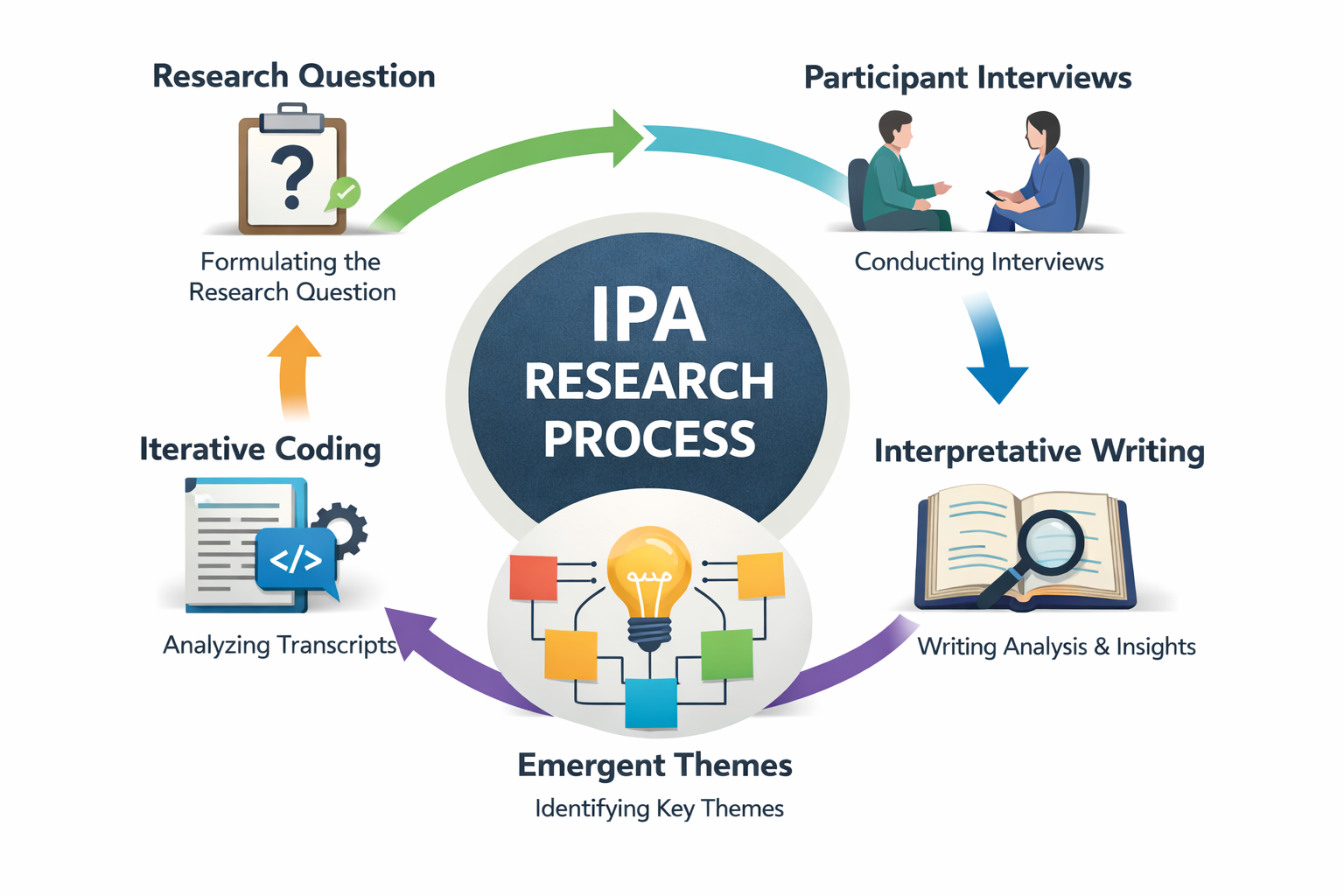
Interpretative Phenomenological Analysis (IPA) is a qualitative research methodology designed to help researchers deeply understand how individuals perceive and make sense of their personal experiences. IPA is rooted in phenomenology and hermeneutics, and it emphasises capturing lived experience with rich, contextualised meaning rather than producing broad generalisations. This makes IPA particularly useful for student researchers in psychology, sociology, health sciences, education, and related fields investigating meaning-making within real-life contexts. IPA represents a rigorous pathway for producing detailed, credible research findings grounded in participants’ subjective perspectives.
Philosophical Foundations of IPA
At its core, IPA emerges from two philosophical traditions: phenomenology, concerned with the essence of experience, and hermeneutics, the theory of interpretation. Phenomenology aims to explore how phenomena are experienced by individuals without reducing those experiences to pre-existing categories or theories. Hermeneutics adds an interpretative layer, acknowledging that both participant and researcher contribute meaning and understanding to the narrative data. IPA therefore recognises that researchers must engage in active interpretation — making sense of participants’ attempts to make sense of their own lived experiences.
This double hermeneutic stance is central to understanding IPA’s epistemological commitments: first, to treat experience as meaningful, and second, to reflect on interpretation as a deliberate analytical act. Researchers using IPA do not aim to test hypotheses; instead, they seek to illuminate how individuals interpret significant events in their lives within their unique contexts, situating those interpretations within psychological and social frameworks.
When and Why to Use IPA in Student Research
IPA is most appropriate when the research aim is to explore the depth and complexity of individual experience, especially in situations of personal significance. For example, students might use IPA to understand how first-generation university students experience academic transition, how individuals cope with chronic illness, or how trauma shapes sense-making processes. These topics are hard to quantify and require nuanced qualitative inquiry.
Unlike quantitative methods that prioritise breadth and generalisability, IPA prioritises depth and idiographic analysis. It is ideally used when sample sizes are small — often between 5 and 25 participants — to allow exceptionally close engagement with individual accounts. This small sample focus enables students to conduct intensive analysis, drawing rich explanatory insights that showcase not just what was said, but how participants give meaning to their experiences.
Designing an IPA Study
Designing an IPA study involves several key steps: formulating research questions, selecting participants, collecting data, and analysing detailed narrative accounts. Each step is guided by IPA’s emphasis on experiential meaning and interpretative depth.
Crafting Research Questions
IPA research questions should focus on understanding the lived experience and the sense-making processes around that experience. Good IPA questions often begin with phrases like “How do individuals experience…?” or “What meanings do participants attach to…?” rather than seeking statistical comparison or measurable outcomes. These questions drive explorative engagement rather than hypothesis testing.
Sampling and Participants
IPA relies on purposive sampling: participants are selected because they share the experience under study. Homogeneity is important; for example, an IPA study on coping with academic failure may include only postgraduate students who have failed major assessments. This controlled sampling enhances the quality of interpretative richness in the data. IPA does not require large samples — in fact, too many participants can dilute the depth of analysis.
Data Collection Methods
Semi-structured interviews are the cornerstone of IPA data collection. These interviews provide enough structure to address the research questions but allow flexibility for participants to express their perspectives in their own words. Interviews typically last 45–90 minutes, and they are audio-recorded and transcribed verbatim to preserve the authenticity of participants’ narratives. Observation or reflective diaries can supplement interviews but rarely replace them in IPA.
Conducting IPA Data Analysis
IPA analysis is iterative and interpretative. It involves several analytical stages that move from close engagement with the text to thematic abstraction and interpretative description. These stages can be organised into a sequential analytic framework to support students’ methodological rigour.
- Reading and re-reading: Immersion in each transcript to fully understand its narrative contours.
- Initial noting: Annotating the transcript with descriptive, linguistic, and conceptual observations.
- Developing emergent themes: Identifying interpretative themes that capture patterns across notes.
- Cross-case analysis: Comparing themes across participants to construct a coherent thematic map.
- Writing up: Producing analytic text that grounds interpretations in verbatim accounts while explaining meaning and relevance.
This structured process ensures that IPA findings reflect both the particularities of individual experience and broader interpretative insights. Students should ground every emergent theme in explicit evidence from the data to maintain credibility and transparency in reporting.
IPA vs. Other Qualitative Methods
IPA shares some features with other qualitative traditions, but it is distinct in its focus and analytical commitments. For example, thematic analysis is broadly used to find patterns in qualitative data but does not necessarily emphasise the subtle interpretative interplay between participant and researcher. Grounded theory seeks theory building, whereas IPA prioritises meaning without necessarily generating new theory. Narrative analysis focuses on life stories in sequence, while IPA centres on experiential meaning making without requiring a narrative arc. This difference highlights IPA’s specialised niche within qualitative research.
| Method | Primary Aim | Sample Focus | Interpretative Depth |
|---|---|---|---|
| IPA | Understand lived experience and sense-making | Small, homogeneous | High |
| Thematic Analysis | Identify patterns across data | Flexible | Moderate |
| Grounded Theory | Generate theory grounded in data | Moderate to large | Variable |
| Narrative Analysis | Explore stories as structured texts | Case-by-case focus | Contextual |
This table clarifies how IPA’s hermeneutic and idiographic commitments differentiate it from others: it is not merely thematic or narrative but deeply interpretative of human experience and meaning. Each comparison helps students choose an approach aligned with their research aims.
Reporting IPA Findings in Academic Assignments
When writing up IPA findings, students should present analytic themes with clear linkage to participant excerpts. Good practice includes contextual explanation of themes, discussion of interpretative insights, and reflection on the researcher’s positionality. Transparent reporting ensures that academic readers can follow how interpretations emerged from the data. IPA write-ups often include rich quotations, integrated analytic commentary, and illustrative extracts to support interpretations.
Closing Guidance: Maximising Academic Impact with IPA
IPA offers students a powerful methodology for deeply exploring subjective experience with methodological integrity. Its strengths lie in interpretative depth, idiographic richness, and phenomenological insight. Students using IPA should remain attentive to analytic rigour, ethical research conduct, and transparent reporting to maximise the academic credibility of their findings. Practised carefully, IPA can transform raw narrative data into meaningful academic insights that resonate with lived human experience.
Comments