
Many university students generate good ideas but lose marks because those ideas are poorly organised. Lecturers do not assess essays based on effort or creativity alone; they assess how clearly ideas are structured, connected, and developed.
Organising essay ideas is therefore not a cosmetic task carried out after writing. It is an intellectual process that shapes argument strength, paragraph flow, and overall coherence long before the final draft is produced.
This article explains how to organise essay ideas using academically accepted methods, ensuring clarity, logical progression, and alignment with university marking criteria.
What Organising Essay Ideas Means in Academic Writing
Organising essay ideas refers to the deliberate arrangement of concepts, arguments, and evidence into a logical structure that readers can easily follow. It is not simply about ordering paragraphs but about creating a coherent line of reasoning.
In academic contexts, organisation reflects critical thinking. A well-organised essay demonstrates that the writer understands relationships between ideas rather than presenting disconnected points.
Effective organisation ensures that each paragraph contributes meaningfully to the overall argument.
Academic rule: An idea has value in an essay only when its purpose and position are clear.
Why Organisation Is Central to High-Scoring Essays
University marking rubrics consistently prioritise structure, coherence, and logical flow. Even strong evidence can lose impact if it appears in the wrong place or without clear linkage.
Organised essays reduce cognitive load for the reader, allowing examiners to focus on analysis rather than deciphering meaning.
Students who master idea organisation write more efficiently and revise more effectively.
From Brainstorming to Organisation: Making the Shift
Brainstorming produces raw material, while organisation refines that material into an argument. Many students struggle because they move directly from brainstorming to drafting without organising ideas.
This jump often results in repetition, weak transitions, and unclear arguments.
Organisation is the stage where ideas are evaluated, grouped, and sequenced.
Filtering Ideas for Relevance
Not all brainstormed ideas deserve inclusion.
Students should remove ideas that do not directly answer the essay question or contribute to analysis.
This filtering strengthens focus and prevents unnecessary digressions.
Identifying Core Argument Threads
Once irrelevant ideas are removed, remaining ideas should be examined for patterns.
Ideas that support similar claims are grouped together.
These groups often become main body sections.
Common Organisational Patterns in Academic Essays
Academic essays typically follow recognised organisational patterns. Understanding these patterns helps students position ideas effectively.
Logical Progression Structure
This structure moves from foundational concepts to more complex analysis.
It is commonly used in theoretical or explanatory essays.
Each section builds upon the previous one.
Cause-and-Effect Structure
Ideas are organised to show relationships between causes and outcomes.
This structure is common in social sciences and applied disciplines.
Clear sequencing is essential to avoid confusion.
Comparative Structure
Ideas are arranged to highlight similarities and differences.
This structure works well for comparative essays and evaluations.
Balance between sections is critical.
Using Paragraph Function to Organise Ideas
Paragraphs are the primary organisational units of an essay.
Each paragraph should perform a clear function within the argument.
Understanding paragraph roles prevents overcrowding and repetition.
Topic Sentences as Organisational Anchors
Topic sentences signal the purpose of each paragraph.
They guide both the writer and the reader.
Well-crafted topic sentences improve overall coherence.
Supporting Evidence Placement
Evidence should appear immediately after the claim it supports.
Misplaced evidence weakens clarity and impact.
Organisation ensures evidence is always contextualised.
Organising Ideas Before Writing: Practical Techniques
Several practical techniques help students organise ideas before drafting.
These techniques reduce revision time and improve clarity.
They are especially useful under time constraints.
Outline-Based Organisation
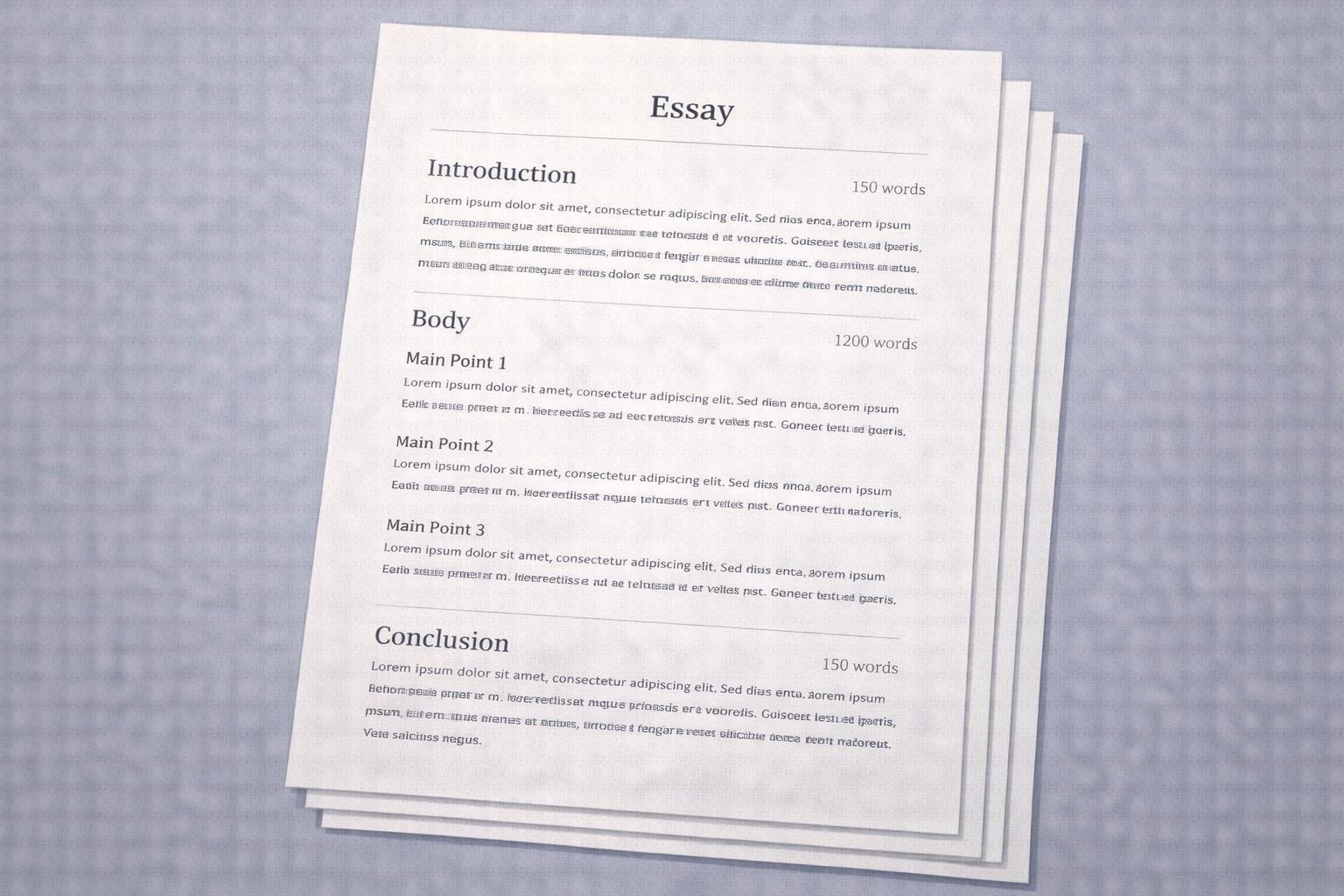
Creating an outline forces students to commit to an order.
Outlines reveal gaps in logic before writing begins.
They are particularly effective for longer assignments.
Reverse Outlining for Idea Checking
Reverse outlining involves listing the main idea of each planned paragraph.
This technique highlights redundancy and imbalance.
It is useful both before and after drafting.
Table: Organising Essay Ideas by Function
The table below illustrates how ideas can be organised based on their academic function.
| Idea Type | Purpose in Essay | Typical Placement |
|---|---|---|
| Background concept | Establish context | Early body sections |
| Main argument | Advance central claim | Core body paragraphs |
| Counterargument | Demonstrate critical engagement | Mid-to-late body |
| Synthesis insight | Integrate discussion | Final sections |
This functional approach ensures that ideas are not only ordered but purposefully placed.
Transitions and Coherence Between Ideas
Organisation extends beyond paragraph order to include transitions.
Transitions explain how ideas relate, preventing abrupt shifts.
Effective transitions strengthen argumentative flow.
Conceptual Transitions
Conceptual transitions link ideas logically rather than stylistically.
They clarify relationships such as contrast, progression, or causation.
This approach is preferred in academic writing.
Discipline-Specific Considerations in Organising Ideas
Different academic disciplines prioritise different organisational principles.
Understanding these expectations improves alignment with marking criteria.
For example, humanities essays emphasise interpretive flow, while scientific writing prioritises methodological order.
When Organising Essay Ideas Requires Academic Support
Some assignments require advanced organisational skills.
Students often seek guidance through academic essay writing support when structure becomes complex.
Large projects such as theses benefit from early organisational planning in dissertation writing.
Once ideas are organised and drafted, clarity can be enhanced through editing and proofreading services.
Final Guidance on Organising Essay Ideas
Organising essay ideas is a foundational academic skill that directly affects clarity, coherence, and analytical strength.
Students who organise ideas deliberately write more persuasive, logical, and academically credible essays.
By treating organisation as an intellectual process rather than a formatting task, students consistently improve their university writing outcomes.

Comments