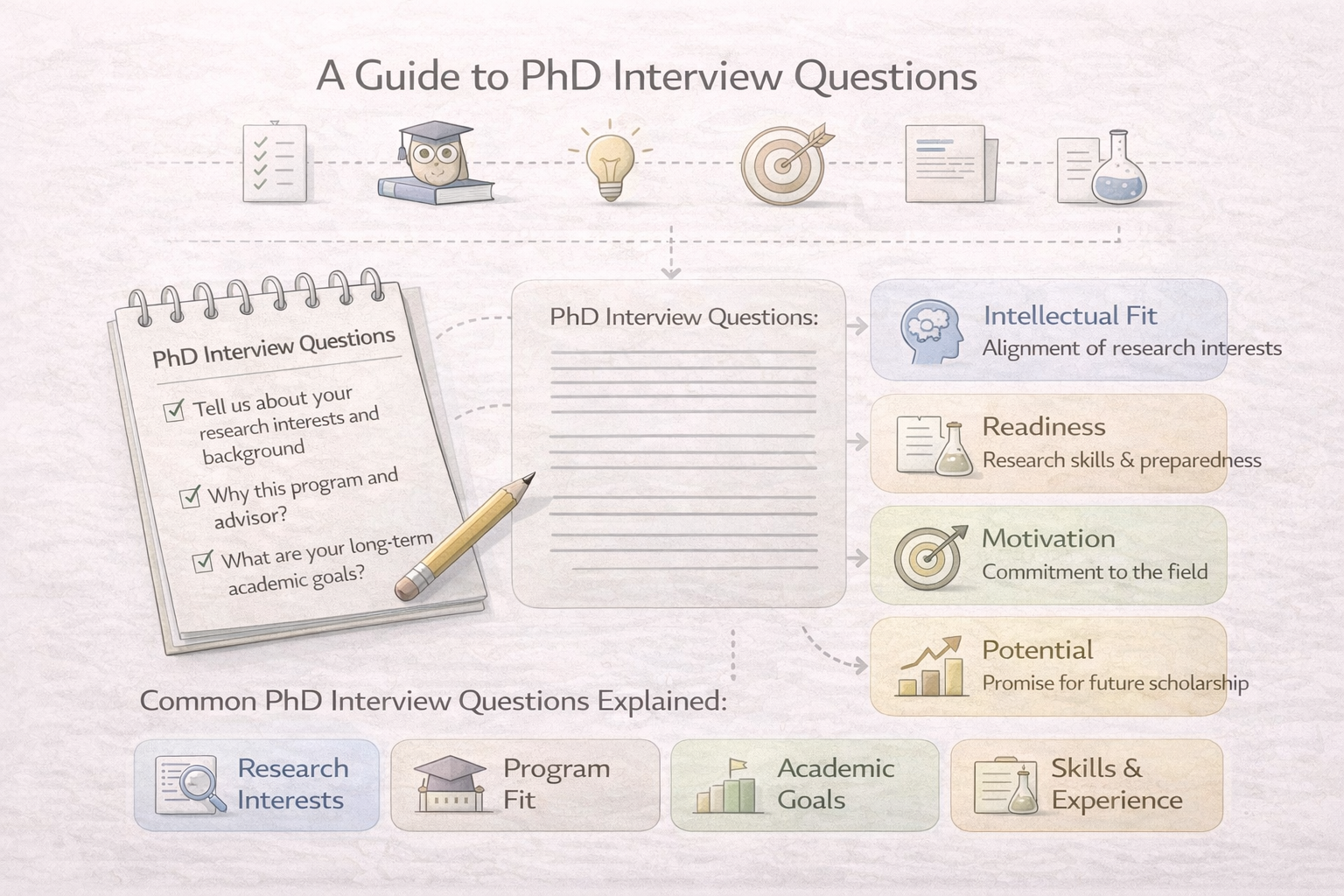
A PhD interview is not an exam and not a casual conversation. It is a structured academic evaluation designed to assess whether you are intellectually prepared, research-ready, and institutionally aligned for doctoral study. Many strong candidates fail not because their ideas are weak, but because they misunderstand what interview questions are actually testing. The PhD interview cheat sheet shown above captures the most common themes, but each question carries deeper academic expectations that must be addressed explicitly.
This guide unpacks every major PhD interview question area and explains how panels interpret your answers. It shows how to move beyond generic enthusiasm toward evidence-based, discipline-aware responses that demonstrate research maturity. The focus is not on scripting answers, but on building responses that show readiness for independent research, supervision, and long-term scholarly contribution.

What PhD interview panels are really evaluating
Doctoral interview panels are assessing three interlinked dimensions. First, research capability: whether you can formulate questions, justify methods, and think critically about evidence. Second, academic fit: whether your interests align with available supervision, departmental strengths, and institutional priorities. Third, doctoral resilience: whether you can handle uncertainty, setbacks, and long-term intellectual work.
Unlike undergraduate or taught postgraduate interviews, PhD interviews are forward-looking. Panels are not only asking whether you can complete a doctorate, but whether investing supervision time, funding, and resources in you is academically justified. This is why answers must be specific, grounded in research practice, and framed in disciplinary terms rather than personal motivation alone.
PhD interviews reward evidence of research thinking, not enthusiasm unsupported by academic reasoning.
Why do you want to pursue a PhD?
This question tests intellectual motivation, not ambition. Panels want to see that your decision is grounded in sustained research curiosity rather than vague career aspirations or external pressure. Strong answers demonstrate a clear trajectory: how prior study, projects, or professional experiences led you to specific research problems that now require doctoral-level investigation.
Weak answers focus on prestige, job security, or generic love of learning. Strong answers articulate how a PhD is the necessary next step to answer questions that cannot be resolved at master’s level. You should also show awareness of what a PhD actually involves: extended independent research, uncertainty, and delayed gratification. This signals informed commitment rather than idealised expectations.
What is your research proposal or research interest?
This is the intellectual core of the interview. Panels are not expecting a finished thesis plan, but they do expect conceptual clarity. Your answer should articulate the research problem, its academic significance, and why it matters within your field—ideally in two to three focused minutes. The emphasis is on coherence, not completeness.
Common mistakes include overloading detail, listing multiple unrelated interests, or failing to justify why the topic matters academically. Strong candidates explain the gap their research addresses, reference the type of literature or debates involved, and show preliminary thinking about methods. Alignment is critical: panels listen carefully for how well your interests fit existing supervisory expertise and departmental strengths.
Tell us about your previous research experience
This question assesses preparedness for independent research. Panels want evidence that you understand the research process, not just that you have completed assignments. Strong answers focus on one or two substantial projects and explain your role, methodological choices, and key outcomes.
You should highlight what you learned about research design, data collection, analysis, and academic writing. Discussing challenges is encouraged, provided you frame them analytically—what went wrong, why it mattered, and how you adapted. Avoid simply listing tasks; instead, show reflective understanding of research decisions and limitations.
Why this university, department, or supervisor?
This question tests academic fit and preparation. Panels expect you to have researched the department and potential supervisors in detail. Generic praise of rankings or facilities is insufficient. Instead, you should connect your research interests directly to specific scholars, research groups, labs, or methodological strengths.
Strong answers demonstrate that you understand how doctoral training works at that institution: supervisory models, resources, and research culture. This reassures panels that you are not applying indiscriminately and that your project is realistically supportable within the department.
| Weak response pattern | What it signals to the panel | Strong response alternative |
|---|---|---|
| Mentions rankings or location only | Superficial research and poor academic fit | Links specific faculty expertise and research groups to the proposed project |
| Generic praise of resources | Lack of departmental understanding | Identifies relevant labs, archives, datasets, or methodological support |
| No reference to supervisors | Unclear supervision feasibility | Explains why particular supervisors are academically appropriate |
Table 1 illustrates how the same question can either weaken or strengthen your candidacy depending on how specifically you answer it.
What relevant skills do you bring?
This question evaluates whether you have the practical and intellectual tools needed for doctoral work. Panels are interested in both technical skills (data analysis, programming, laboratory techniques, archival research) and transferable research skills (critical reading, academic writing, project management).
Effective answers emphasise relevance. Rather than listing every skill you possess, select those directly applicable to your proposed research. Provide brief examples showing how you have used these skills in research contexts. This demonstrates readiness and reduces perceived training burden for supervisors.
How do you handle research setbacks?
Doctoral research is defined by uncertainty. This question tests resilience, adaptability, and problem-solving. Panels expect you to acknowledge that setbacks are normal and to demonstrate a reflective, analytical approach to difficulty.
Strong answers describe a specific challenge—failed experiments, inaccessible data, negative results—and explain how you diagnosed the problem, adjusted your approach, and extracted learning value. Avoid framing setbacks as purely emotional experiences; instead, show how you respond intellectually and methodologically.
Resilience in a PhD context is demonstrated through analytical adaptation, not personal toughness alone.
What are your long-term academic or career goals?
This question assesses whether your expectations align with doctoral training realities. Panels are not judging ambition, but coherence. Strong answers show understanding of academic career pathways while acknowledging uncertainty and alternative trajectories.
You should explain how PhD training supports your goals—whether academic, industry, policy, or applied research—without presenting the doctorate as a guaranteed outcome. This reassures panels that you view the PhD as research training rather than a credential shortcut.
Do you have any questions for us?
This is not a formality. The questions you ask reveal your level of preparation and seriousness. Strong candidates ask about research culture, supervision practices, training opportunities, funding structures, or progression milestones.
Avoid questions that could easily be answered on the website or that focus only on personal convenience. Instead, ask questions that show long-term thinking about research quality, collaboration, and professional development.
Common PhD interview mistakes that weaken strong candidates
Many capable applicants underperform due to avoidable errors. These include over-general answers, excessive jargon without clarity, defensiveness when discussing limitations, and failure to link answers back to the proposed research. Another common issue is treating the interview as a performance rather than an academic discussion.
Preparation should focus on refining reasoning, not memorising scripts. Practising answers aloud, anticipating follow-up questions, and reviewing your proposal critically will improve confidence and coherence. If you need structured academic support when refining proposals or preparing doctoral materials, services such as Dissertations and Research Papers and Academic Editing and Proofreading can help strengthen clarity and alignment before interviews.
A confident framework for PhD interview success
The PhD interview cheat sheet works because it reflects how academics think: significance, alignment, method, resilience, and clarity. When your answers demonstrate these qualities consistently, panels see you not as a student seeking approval, but as a developing researcher capable of joining an academic community.
Approach the interview as a scholarly conversation grounded in evidence and reflection. If you can explain why your research matters, how you will pursue it responsibly, and how you respond to uncertainty, you are already speaking the language of doctoral study.



Comments