
Plagiarism penalties at university are far more serious than many students initially realise. While plagiarism is often discussed in abstract terms, its real-world consequences can directly affect grades, progression, funding, and even future career prospects. Universities treat plagiarism as a breach of academic integrity because it undermines the fairness and credibility of assessment.
Understanding how plagiarism penalties work is therefore essential for every student. This article explains how universities define and investigate plagiarism, the range of penalties applied, and how students can avoid disciplinary outcomes through responsible academic practice.
Why Universities Impose Strict Plagiarism Penalties
Universities are custodians of academic standards. Degrees are awarded on the assumption that submitted work reflects a student’s own intellectual effort, supported transparently by credible sources. When plagiarism occurs, that assumption collapses.
Plagiarism penalties exist not simply to punish, but to protect the integrity of qualifications and ensure fairness among students. Without consistent enforcement, honest students would be disadvantaged, and institutional credibility would suffer.
Academic principle: Plagiarism is treated as misconduct because it misrepresents authorship, not because it produces “similar” text.
How Universities Define Plagiarism
Most universities define plagiarism broadly, covering both intentional and unintentional misuse of sources. This means that claiming ignorance or poor referencing skills does not automatically exempt a student from penalties.
Institutional definitions typically include copying text, close paraphrasing, using ideas without citation, submitting purchased or ghostwritten work, and recycling previous assignments without approval.
Intent vs Outcome in Plagiarism Cases
While intent may influence the severity of penalties, universities primarily assess the outcome: whether submitted work misrepresents originality. Even accidental plagiarism can still trigger formal academic misconduct procedures.
This is why universities emphasise prevention and training, alongside enforcement.
How Plagiarism Is Detected at University
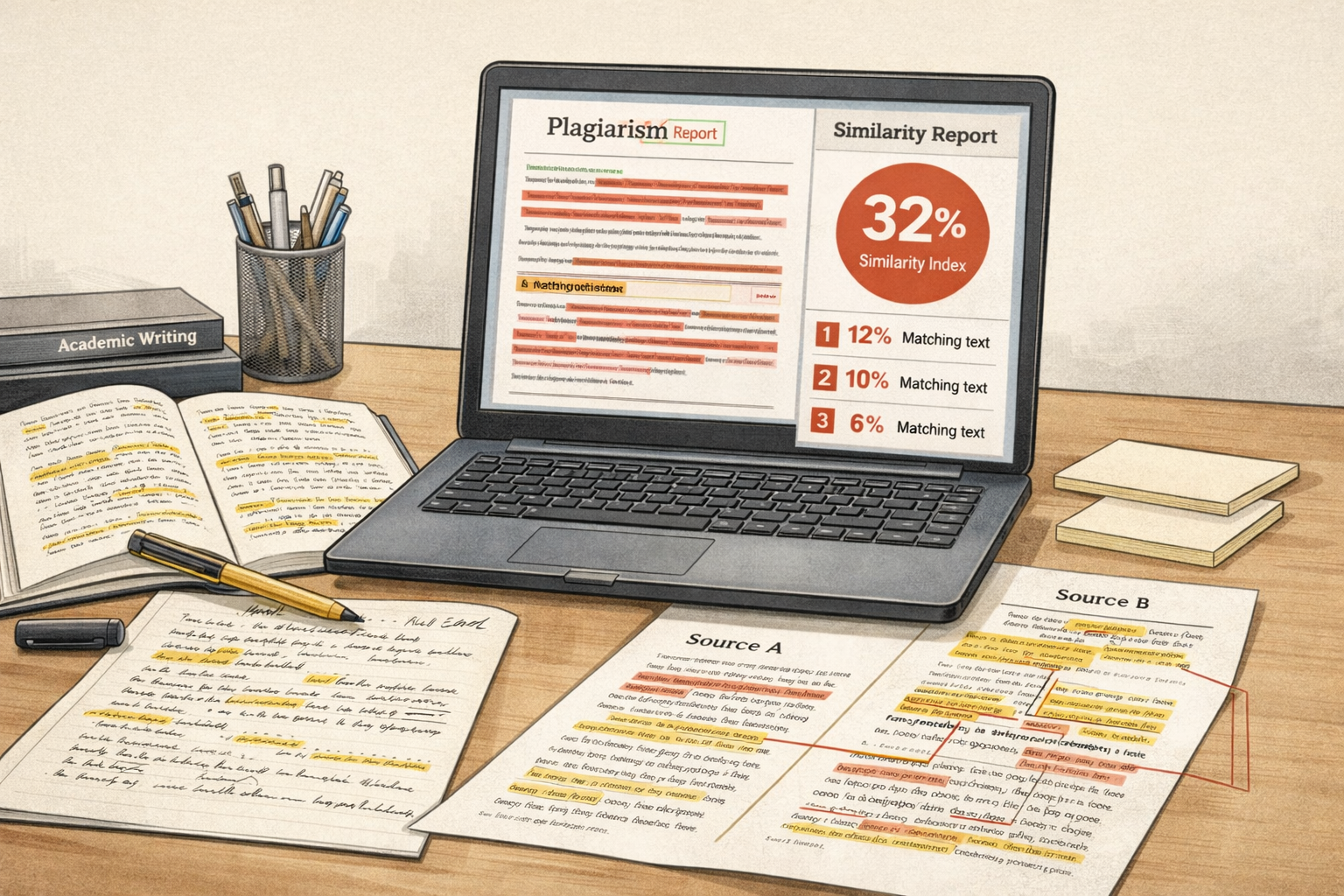
Plagiarism is most commonly identified through similarity detection software combined with academic review. Software highlights overlapping text, but academic staff interpret the findings.
Markers assess whether similarities reflect acceptable academic practice, such as properly cited quotations, or problematic source dependency.
Levels of Plagiarism Penalties at University
Plagiarism penalties are typically applied on a tiered basis. Universities distinguish between minor, moderate, and major offences, with escalating consequences.
The student’s level of study, previous history, and the proportion of plagiarised material all influence outcomes.
| Offence Level | Common Characteristics | Typical Penalty |
|---|---|---|
| Minor | Poor citation, limited overlap | Mark reduction or resubmission |
| Moderate | Substantial unattributed paraphrasing | Failing grade for assessment |
| Major | Large-scale copying or contract cheating | Fail module or suspension |
| Severe | Repeat offences or deliberate fraud | Expulsion or degree termination |
This escalation framework ensures proportionality while maintaining strict academic standards.
Penalties for First-Year vs Final-Year Students
Universities often take a more educative approach with first-year students, recognising that they are still adjusting to academic conventions. Penalties may focus on warnings, capped marks, or compulsory resubmission.
By contrast, final-year and postgraduate students are held to higher standards. Plagiarism at advanced levels is more likely to result in failing grades or programme termination.
Long-Term Consequences Beyond Marks
Plagiarism penalties extend beyond individual assessments. Academic misconduct records may affect progression, scholarships, and professional accreditation.
In some cases, plagiarism findings must be disclosed when applying for postgraduate study or regulated professions.
Critical warning: A plagiarism finding can follow a student beyond graduation, even if the immediate penalty seems minor.
The Academic Misconduct Investigation Process
When plagiarism is suspected, universities follow formal procedures. Students are usually notified, provided with evidence, and given an opportunity to respond.
Panels or academic officers then determine whether misconduct occurred and apply penalties according to institutional regulations.
Your Rights During a Plagiarism Investigation
Students are entitled to procedural fairness. This includes access to evidence, the right to submit a written explanation, and the right to appeal under defined grounds.
However, appeals focus on process, not disagreement with academic judgment.
How Students Can Reduce the Risk of Plagiarism Penalties
Preventing plagiarism is far easier than defending against misconduct allegations. Students who adopt strong academic habits dramatically reduce their exposure to penalties.
Seeking structured academic support, such as editing and proofreading services, can help ensure accurate referencing and clear paraphrasing before submission.
Practical Prevention Strategies
The following practices significantly lower plagiarism risk across all disciplines.
- Plan assignments early to avoid rushed writing
- Take notes in your own words
- Cite all sources consistently
- Use quotations sparingly and correctly
- Review similarity reports critically
These steps align with university expectations and academic best practice.
Plagiarism Penalties in Dissertations and Major Projects
Plagiarism in dissertations carries particularly severe consequences due to the weight of the assessment. A failed dissertation may delay graduation or terminate a degree.
Many students therefore seek structured guidance, such as dissertation writing support, to manage sources ethically and maintain originality.
Why “Low Similarity” Does Not Guarantee Safety
Some students mistakenly believe that achieving a low similarity percentage ensures immunity from penalties. This is a misconception.
Universities assess plagiarism qualitatively. Poor paraphrasing, structural imitation, or uncited ideas can still result in penalties even with modest similarity scores.
Academic Integrity as Risk Management
Understanding plagiarism penalties is not about fear; it is about informed academic decision-making. Ethical writing protects both grades and reputation.
Students who view academic integrity as a core skill, rather than an administrative rule, are far less likely to face disciplinary outcomes.
Protecting Your Academic Future
Plagiarism penalties at university can escalate quickly, but they are also largely preventable. Knowledge, planning, and ethical writing habits remain the strongest safeguards.
By engaging critically with sources, citing transparently, and seeking support where needed, students can complete their studies with confidence and integrity.

Comments