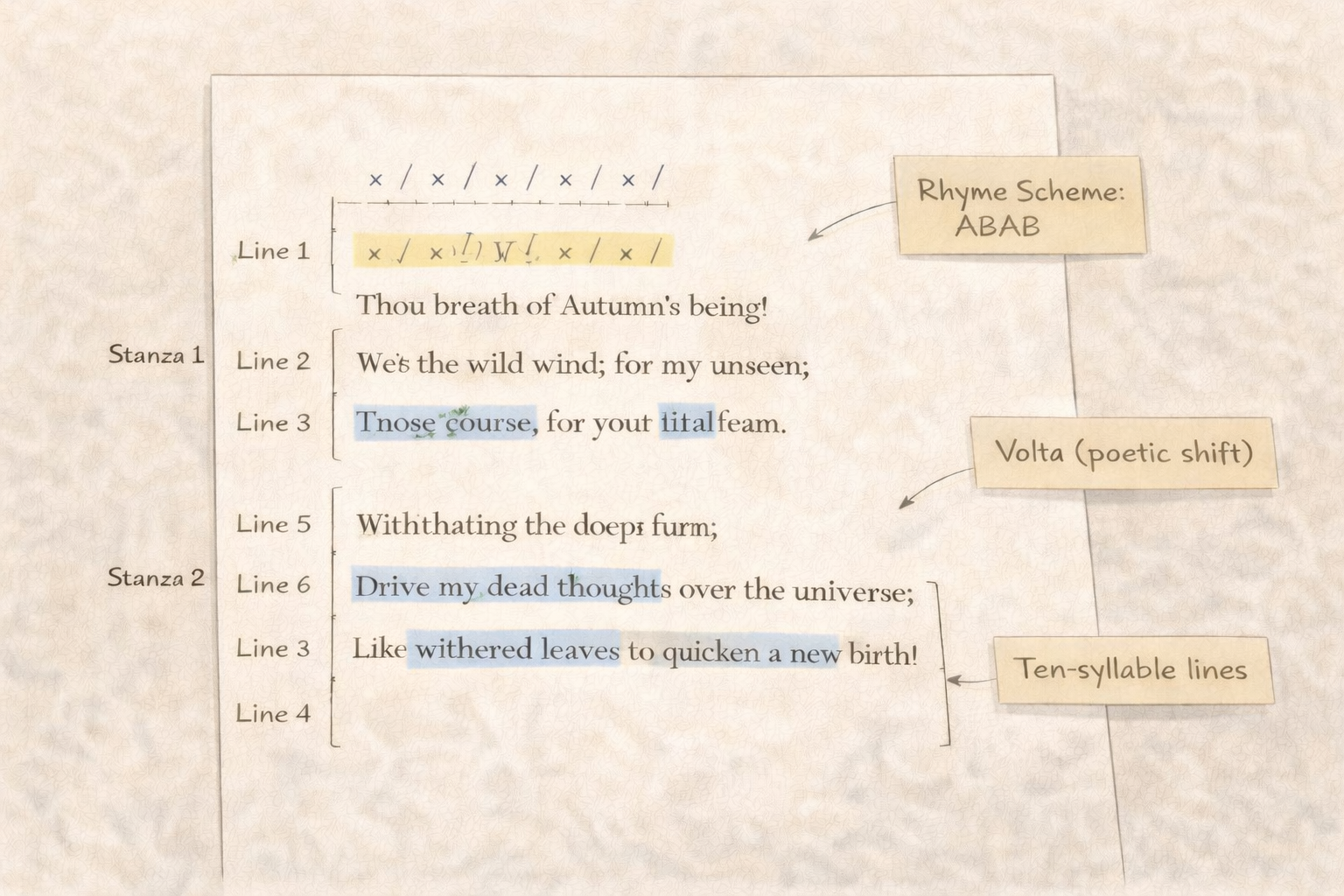
Poem structure is one of the most important yet frequently misunderstood aspects of poetry analysis. While readers often focus on imagery or themes, structure determines how a poem unfolds, where emphasis falls, and how meaning develops across lines and stanzas.
This guide explains poem structure in a rigorous academic context. It clarifies key structural elements, shows how structure influences interpretation, and demonstrates how students should analyse poetic form in essays, exams, and coursework.
What Poem Structure Means in Academic Study
In literary studies, poem structure refers to the organised arrangement of a poem’s parts, including lines, stanzas, rhythm, and overall layout. Structure governs how a poem progresses and how readers experience its ideas.
Academic analysis treats structure as a meaning-making device rather than a decorative feature. A poem’s form often reinforces, complicates, or challenges its themes, making structural awareness essential for high-level interpretation.
Academic rule: Poem structure must always be analysed in relation to meaning, not described in isolation.
Lines and Line Breaks as Structural Tools
The line is the basic unit of poetic structure. Line length, enjambment, and end-stopping shape how language flows and how readers process ideas.
Enjambment, where a sentence continues across a line break, can create tension, momentum, or ambiguity. End-stopped lines, by contrast, provide closure and emphasis. Analytical essays should explain why a poet chooses one approach over the other.
Stanza Patterns and Visual Organisation
Stanzas group lines into meaningful units, functioning similarly to paragraphs in prose. Stanza length, symmetry, and repetition all contribute to interpretation.
Regular stanza patterns may suggest control, balance, or tradition, while irregular or fragmented stanzas often signal disruption or emotional instability. Visual structure on the page is therefore analytically significant.
Fixed Forms and Their Structural Implications
Some poems follow established forms such as sonnets, villanelles, or sestinas. These forms impose structural constraints that shape meaning and reader expectations.
Academic analysis should identify the form and explain how the poet works within or against its rules. Deviations from expected structure often carry interpretive weight.
| Form | Key Structural Traits | Analytical Focus |
|---|---|---|
| Sonnet | 14 lines, structured argument | Turn (volta) and resolution |
| Villanelle | Refrains and repetition | Obsession, cyclical meaning |
| Free verse | No fixed pattern | Organic or thematic structure |
This comparison highlights how structure guides interpretation, but each poem must be analysed individually rather than mechanically classified.
Free Verse and Organic Structure
Free verse poetry lacks a fixed formal pattern, but it is not unstructured. Instead, its organisation emerges from thematic, emotional, or rhetorical movement.
Students should analyse how free verse poems create coherence through repetition, pacing, or visual spacing. Apparent irregularity often reflects deliberate artistic choice.
Rhythm and Meter as Structural Elements
Rhythm refers to the pattern of stressed and unstressed syllables, while meter describes a regular rhythmic scheme. Together, they shape the musical quality of a poem.
Changes in rhythm or meter frequently signal shifts in mood, perspective, or tension. Academic analysis should explain how these variations support interpretation.
Rhyme Schemes and Sound Structure
Rhyme contributes to structure by linking lines and reinforcing patterns. Regular rhyme schemes can create harmony or predictability, while irregular schemes may introduce instability.
Sound structure should be analysed alongside meaning. For example, harsh or dissonant sounds may reinforce themes of conflict or discomfort.
Structural Progression and Argument
Many poems develop ideas progressively, moving through stages of reflection, conflict, or resolution. Structure often mirrors this intellectual or emotional journey.
Effective literary analysis traces how the poem’s structure guides readers from one stage to the next, rather than treating each stanza as an isolated unit.
Beginnings and Endings in Poetic Structure
The opening and closing of a poem are structurally significant. Beginnings establish tone and direction, while endings often provide closure or deliberate ambiguity.
Academic essays should examine how endings resolve, complicate, or resist the expectations set up earlier in the poem.
Examiner warning: Avoid describing structure without explaining its interpretive impact.
Structural Repetition and Emphasis
Repetition of lines, phrases, or stanza patterns can create emphasis and reinforce key ideas. Structural repetition often signals emotional intensity or thematic fixation.
Analysis should explore why repetition occurs where it does and how it shapes reader response.
Comparing Structure Across Poems
In comparative essays, structural analysis allows students to explore how different poets organise meaning differently. Contrasting forms can reveal differing artistic priorities or ideological positions.
Such comparisons must remain precise and text-focused, avoiding vague claims about “style” without evidence.
Integrating Structural Analysis into Essays
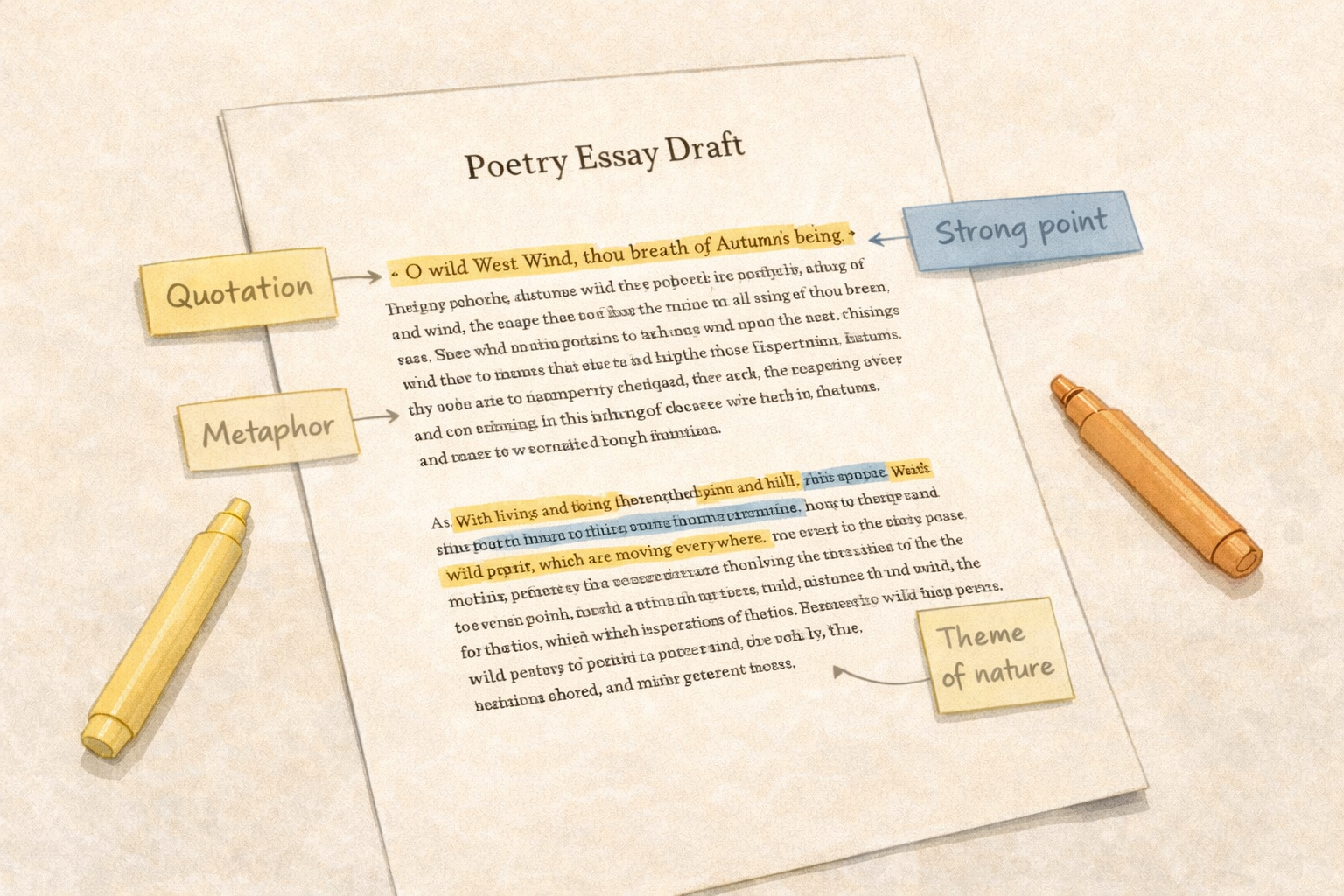
Strong academic writing integrates structural analysis into a broader argument rather than isolating it in a single paragraph. Structure should support claims about theme, voice, or meaning.
Each analytical point should link structural observation to interpretation, maintaining coherence throughout the essay.
Common Mistakes When Analysing Poem Structure
A frequent error is listing structural features without interpretation. Simply identifying rhyme or stanza length does not constitute analysis.
Another common mistake is assuming free verse has no structure. All poems possess organisation that must be examined critically.
Academic Style and Precision in Structural Analysis
When discussing poem structure, students should use precise terminology and avoid impressionistic language. Clear definitions strengthen academic credibility.
Analytical claims should always be supported by textual evidence and explained fully.
Final Guidance on Analysing Poem Structure
Poem structure is fundamental to poetic meaning and must be treated as an active component of interpretation. Careful attention to form, rhythm, and organisation enables deeper, more persuasive analysis.
By approaching structure analytically rather than descriptively, students can produce confident, high-quality academic work in poetry studies.
Comments