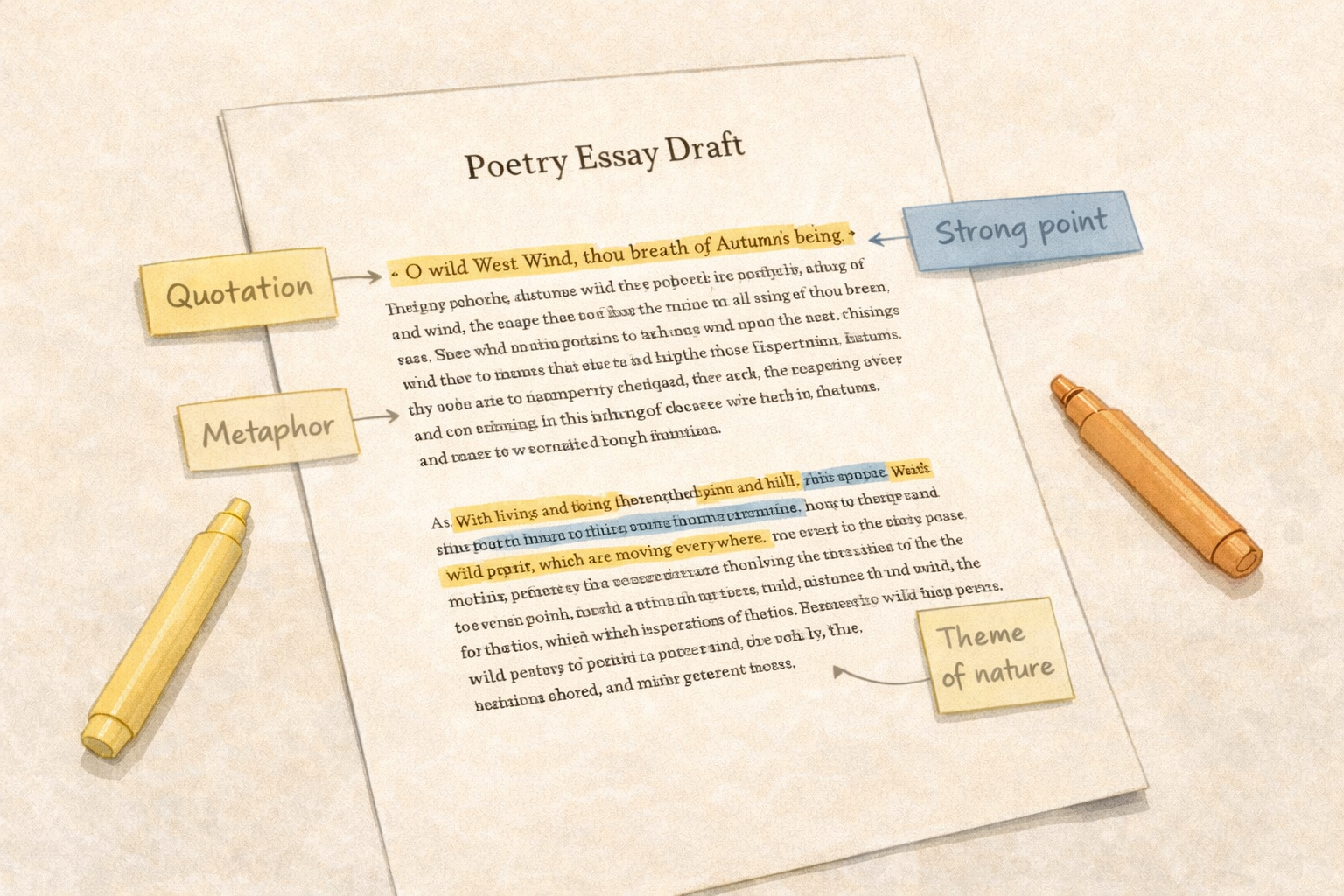
Poetry essay examples are one of the most effective learning tools for students studying literature. They demonstrate how analytical ideas are translated into structured academic arguments, showing the balance between close reading, interpretation, and formal essay writing.
Many students struggle with poetry essays because poems are compact, layered, and linguistically dense. Examining well-constructed poetry essay examples clarifies what academic analysis looks like in practice and how examiners assess quality.
What a Poetry Essay Is Expected to Demonstrate
A poetry essay is not a summary of a poem’s content. Instead, it is an analytical argument that explains how poetic techniques create meaning, effect, or tension within the text.
Strong poetry essay examples consistently show close engagement with language, form, and structure while maintaining a clear central argument.
Key principle: A poetry essay must explain how meaning is produced, not simply what the poem is about.
Why Studying Poetry Essay Examples Matters
Poetry essays are often assessed differently from prose or drama essays. Examiners expect precision, concision, and sustained attention to textual detail.
Reading high-quality poetry essay examples helps students internalise academic tone, paragraph structure, and evidence-based reasoning.
Common Types of Poetry Essays
Poetry essays vary depending on the assignment brief. Understanding the type of essay required is essential before analysing examples.
Each essay type prioritises different analytical skills, even though all rely on close reading.
Single-Poem Analysis Essays
This essay focuses on one poem and explores how its language and form develop a central idea or tension.
High-quality examples demonstrate depth rather than breadth, analysing fewer features in greater detail.
Comparative Poetry Essays
Comparative essays analyse two or more poems in relation to a shared theme, technique, or context.
Strong examples integrate comparison throughout the essay rather than discussing poems separately.
Thematic Poetry Essays
These essays explore how multiple poems engage with a shared theme such as identity, nature, or conflict.
Effective examples maintain focus by using poems selectively to support a coherent argument.
Typical Structure in Strong Poetry Essay Examples
Although poetry essays vary, strong examples tend to follow a clear academic structure that guides the reader logically.
This structure supports analytical clarity and ensures ideas develop progressively.
| Section | Purpose | Key Features |
|---|---|---|
| Introduction | Establish argument | Clear thesis, focused scope |
| Body paragraphs | Develop analysis | Close reading, quotations, explanation |
| Conclusion | Synthesise insights | No new ideas, conceptual closure |
This structure appears consistently across high-mark poetry essay examples.
Introduction Examples in Poetry Essays
Strong poetry essay introductions contextualise the poem briefly and present a clear analytical argument.
They avoid vague statements about poetry and instead focus on the specific poem or poems under discussion.
Body Paragraph Examples: What Examiners Look For
Body paragraphs in strong poetry essay examples are tightly structured around analytical claims.
Each paragraph typically follows a pattern of claim, evidence, close analysis, and interpretive explanation.
Using Quotations Effectively
High-quality examples use short, precise quotations embedded within sentences.
Every quotation is followed by explanation that links language choice to meaning or effect.
Examiner warning: Quoting poetry without analysing the quoted language results in low marks.
Close Reading in Poetry Essay Examples
Close reading is the defining feature of strong poetry essays. Examples demonstrate careful attention to diction, imagery, sound, and structure.
Rather than listing techniques, effective essays explain how these elements interact within the poem.
Analytical Depth vs Description
Weak poetry essays tend to describe what happens in the poem. Strong examples move beyond description to interpretation.
They explain why specific choices matter and how they contribute to broader meaning.
Handling Poetic Devices in Essays
Poetry essay examples show that poetic devices should never be discussed in isolation.
Instead, devices such as metaphor, enjambment, or alliteration are analysed in relation to the poem’s argument or emotional trajectory.
Comparative Essay Examples: Integration Over Separation
In comparative poetry essays, strong examples integrate poems within the same paragraph.
This approach demonstrates analytical sophistication and avoids repetitive structure.
Common Weaknesses Revealed by Poor Poetry Essay Examples
Examining weaker examples is equally instructive. These essays often lack focus, depth, or textual precision.
Understanding common errors helps students avoid repeating them.
| Problem | Why It Fails | Effective Alternative |
|---|---|---|
| Over-summary | Shows comprehension only | Focus on language and form |
| Technique listing | Lacks interpretation | Explain functional impact |
| Loose structure | Weakens argument | Clear analytical progression |
This comparison highlights what distinguishes high-quality poetry essay examples.
Academic Tone in Poetry Essay Examples
Strong examples maintain a formal, analytical tone without becoming inaccessible.
They avoid personal anecdotes and unsupported opinion, relying instead on evidence-based reasoning.
Using Context Appropriately in Poetry Essays
While poetry essays prioritise close reading, some examples integrate historical or literary context sparingly.
Context is used to illuminate textual choices rather than replace analysis.
Revision Strategies Based on Poetry Essay Examples
Studying examples during revision helps students refine their own writing.
Comparing draft paragraphs to strong models reveals gaps in explanation, structure, or focus.
Final Guidance on Learning from Poetry Essay Examples
Poetry essay examples are most useful when studied analytically rather than copied.
By focusing on argument structure, close reading techniques, and academic clarity, students can transfer these skills to any poetry assignment.



Comments