
Creating a strong thesis begins with a well-structured outline. Before any detailed writing takes place, students must organise their ideas, research, and arguments into a clear framework. Reviewing a high-quality thesis outline example is one of the most effective ways to understand how to structure a thesis logically and ensure coherence from the beginning.
Many students struggle with thesis writing not because of a lack of knowledge, but because of poor organisation. Without a clear outline, arguments become fragmented, sections lose focus, and the overall thesis lacks direction. This guide provides a comprehensive thesis outline example along with practical guidance to help students plan, structure, and execute their work effectively.
What Is a Thesis Outline and Why It Is Essential
A thesis outline is a structured plan that organises the main sections and arguments of your research before writing begins. It serves as a roadmap, guiding the development of your thesis and ensuring that each part contributes to the overall argument.
Using a thesis outline helps students maintain focus, avoid repetition, and ensure logical progression. It also simplifies the writing process by breaking a complex project into manageable sections.
A thesis outline is not optional—it is a foundational tool that determines the clarity and coherence of your entire thesis.
By developing a clear outline, students can approach thesis writing with greater confidence and efficiency.
Key Components of a Standard Thesis Outline
Before reviewing a thesis outline example, it is important to understand the standard components that most academic theses include. These components provide a consistent structure that aligns with examiner expectations.
| Section | Purpose | Key Content |
|---|---|---|
| Introduction | Introduce research topic | Background, objectives, research question |
| Literature Review | Analyse existing research | Theories, debates, research gaps |
| Methodology | Explain research approach | Design, data collection, analysis |
| Results | Present findings | Data and observations |
| Discussion | Interpret findings | Analysis and implications |
| Conclusion | Summarise research | Key findings and recommendations |
Understanding these components ensures that your outline follows a logical academic structure.
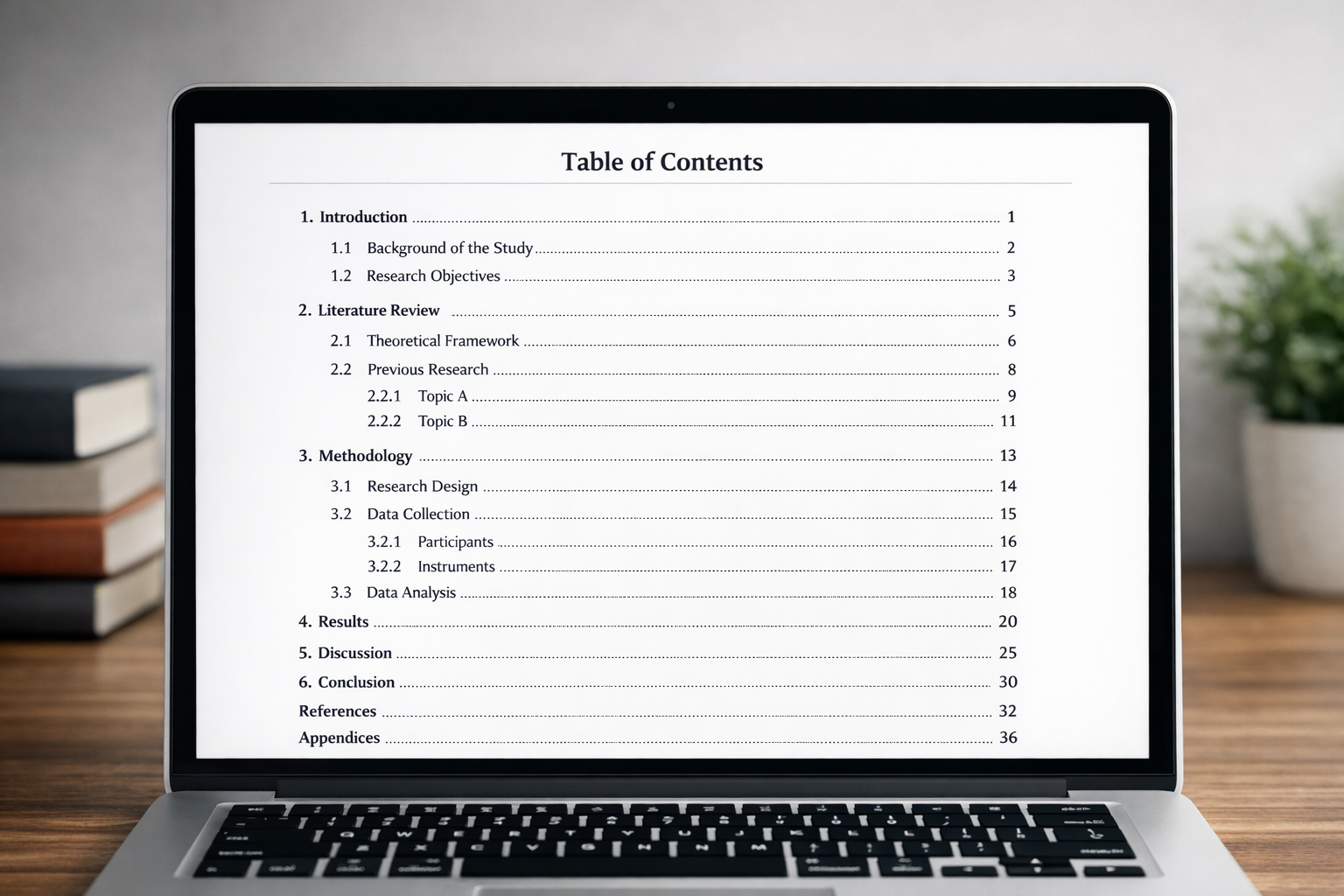
Thesis Outline Example (Detailed Structure)
The following thesis outline example demonstrates how a research project can be organised into clear sections and subsections. This example is suitable for a typical university-level thesis.
1. Introduction
1.1 Background of the Study
1.2 Research Problem
1.3 Research Objectives
1.4 Research Questions
1.5 Significance of the Study
2. Literature Review
2.1 Theoretical Framework
2.2 Review of Key Studies
2.3 Research Gaps
3. Methodology
3.1 Research Design
3.2 Data Collection Methods
3.3 Sampling Strategy
3.4 Data Analysis Techniques
4. Results
4.1 Presentation of Data
4.2 Key Findings
5. Discussion
5.1 Interpretation of Results
5.2 Comparison with Literature
5.3 Implications
6. Conclusion
6.1 Summary of Findings
6.2 Limitations
6.3 Recommendations
This thesis outline example demonstrates how each section builds logically on the previous one, creating a coherent structure that supports academic argumentation.
How to Create Your Own Thesis Outline Step by Step
Developing your own outline requires a systematic approach. Rather than copying a generic structure, students should adapt the outline to their specific research topic and objectives.
Step-by-Step Process for Building an Outline
- Define your research question and objectives
- Identify key themes from your literature review
- Determine the most appropriate methodology
- Organise sections in a logical sequence
- Break each section into subsections
This process ensures that your outline is tailored to your research and provides a clear framework for writing.
Students who need structured guidance can explore dissertation writing support, which provides examples of well-organised academic structures.
Common Mistakes When Creating a Thesis Outline
Even with a clear understanding of structure, students often make mistakes when developing their outlines. These issues can affect the clarity and effectiveness of the final thesis.
Common mistakes include:
- Creating overly vague or broad sections
- Including too many unnecessary subsections
- Failing to align the outline with the research question
- Ignoring logical progression between sections
- Not updating the outline as research evolves
Avoiding these mistakes ensures that your outline remains clear, focused, and adaptable.
An outline should guide your thesis—not restrict it. Be prepared to refine it as your research develops.
Refining and Improving Your Thesis Outline
Once your initial outline is complete, refinement is essential. This involves reviewing the structure, ensuring logical flow, and confirming that each section contributes to the research objective.
One effective strategy is to review your outline from the perspective of an examiner. Ask whether the structure is clear, whether the progression makes sense, and whether each section adds value to the argument.
Students can also benefit from academic editing services, which help refine structure and improve clarity before writing begins.
Refining your outline ensures that your thesis will be well-organised and academically strong.
Using a Thesis Outline Example to Strengthen Your Writing Process
A well-developed thesis outline example provides a clear framework that simplifies the writing process and improves the overall quality of your work. By organising your ideas in advance, you can focus on developing strong arguments and maintaining coherence throughout your thesis.
The outline is not just a planning tool; it is a foundation for academic success. It ensures that your thesis remains focused, structured, and aligned with your research objectives.
By applying the strategies outlined in this guide, students can create effective outlines that support high-quality academic writing. With a clear plan in place, the process of writing a thesis becomes more manageable, efficient, and ultimately more successful.


Comments