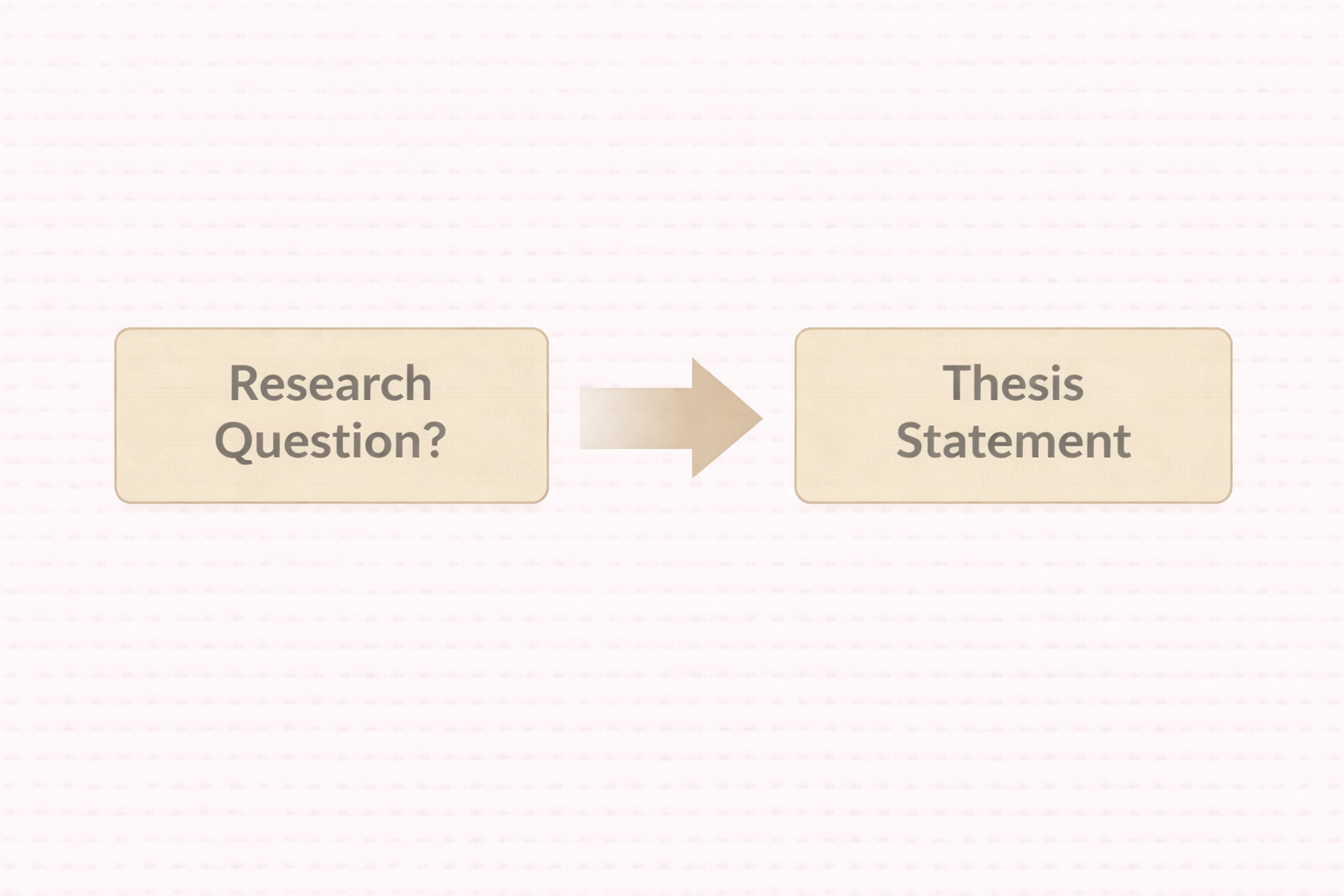
One of the most persistent sources of confusion in university writing is the distinction between a thesis statement and a research question. Although both appear early in academic papers and serve framing functions, they perform fundamentally different intellectual roles. Misunderstanding this distinction often results in unclear arguments, weak introductions, and lower assessment outcomes.
This article offers a structured, academically grounded comparison of thesis statements and research questions. It explains what each element does, when it should be used, how they interact in different assignment types, and how students can move from a research question to a defensible thesis statement.
Understanding the Core Purpose of Academic Framing
Academic writing is not simply about presenting information; it is about advancing a reasoned position within a scholarly conversation. Both research questions and thesis statements contribute to this process, but they do so at different stages of inquiry and argument development.
A research question reflects uncertainty and exploration, whereas a thesis statement reflects clarity and commitment. Recognising this difference is essential for meeting examiner expectations, particularly in analytical essays, research papers, and dissertations.
A research question asks what you want to find out; a thesis statement declares what you argue after investigating the question.
What Is a Research Question in Academic Writing?
A research question is a carefully formulated inquiry that defines the focus and direction of an academic investigation. It identifies a problem, gap, or issue that requires exploration through research, analysis, or critical reflection.
Research questions are especially common in research proposals, qualitative studies, and dissertations. They guide methodology, data collection, and literature review by clarifying what the study seeks to understand rather than what it already claims to prove.
Key Characteristics of a Strong Research Question
An effective research question must be focused, researchable, and academically meaningful. It should avoid yes-or-no formulations and instead invite complex analysis.
- Clearly defines the scope of investigation
- Indicates variables, context, or population where relevant
- Does not assume a predetermined conclusion
When properly constructed, a research question provides a solid foundation for scholarly inquiry.
What Is a Thesis Statement in Academic Writing?
A thesis statement is a declarative sentence that presents the central argument or position of an academic paper. Unlike a research question, it reflects a conclusion the writer has reached through preliminary research and critical thinking.
Thesis statements are most commonly used in argumentative and analytical essays, where students are expected to defend a position using evidence, theory, and structured reasoning. They signal to the reader what the paper will argue and how that argument will be developed.
A thesis statement must be arguable, specific, and directly supported by the paper’s analysis.
Thesis Statement vs Research Question: A Direct Comparison
Although related, thesis statements and research questions differ in form, function, and academic expectation. Understanding these distinctions helps students choose the correct framing for their assignment type.
| Aspect | Research Question | Thesis Statement |
|---|---|---|
| Purpose | Guides investigation | States central argument |
| Form | Interrogative | Declarative |
| Certainty | Open-ended | Definitive position |
| Typical Use | Research-based studies | Argumentative essays |
This comparison highlights why substituting one for the other often leads to conceptual and structural weaknesses.
When Should You Use a Research Question?
Research questions are appropriate when the purpose of the assignment is exploratory rather than argumentative. This is common in early-stage research projects, empirical studies, and dissertations that aim to contribute new knowledge.
In such contexts, the research question shapes the literature review, informs methodological choices, and evolves as findings emerge. Prematurely introducing a thesis statement at this stage may artificially constrain inquiry.
When Should You Use a Thesis Statement?
Thesis statements are expected in essays and research papers where students are required to take a clear stance. Examiners assess how effectively the thesis is supported through logical reasoning and evidence.
Using a research question in place of a thesis statement in these assignments often signals uncertainty or underdevelopment of ideas, which can negatively affect marks.
How Research Questions Evolve into Thesis Statements
In many academic projects, particularly dissertations, research questions and thesis statements are not mutually exclusive. Instead, they appear at different stages of the research process.
A research question initiates inquiry, while the thesis statement emerges after analysis has clarified patterns, relationships, or arguments.
- Identify a research problem and formulate a question
- Conduct literature review and data analysis
- Develop a defensible argument based on findings
- Articulate that argument as a thesis statement
This progression reflects sound academic reasoning rather than inconsistency.
Common Student Mistakes When Using Thesis Statements and Research Questions
Students frequently make framing errors that weaken their introductions. One common mistake is presenting a research question in an argumentative essay where a thesis statement is required.
Another issue arises when students include both elements without clarifying their relationship, resulting in conceptual redundancy or contradiction.
Using a research question where a thesis statement is required is a frequent cause of low essay marks.
Assignment Type and Examiner Expectations
Different academic tasks impose different framing expectations. Understanding these expectations helps students structure introductions appropriately.
| Assignment | Preferred Framing | Common Error |
|---|---|---|
| Argumentative Essay | Thesis statement | Using only a research question |
| Research Proposal | Research question | Premature thesis claim |
| Dissertation | Both (at different stages) | Poor alignment between them |
Aligning framing with assignment type demonstrates academic maturity and task awareness.
Practical Guidance for University Students
Before finalising an introduction, students should revisit the assignment brief and marking rubric. These documents usually specify whether an argument or an investigation is required.
When uncertainty persists, structured academic support such as essay writing assistance, editing and proofreading, or advanced guidance for dissertation projects can help clarify expectations and refine framing.
Final Academic Takeaway
The difference between a thesis statement and a research question is not merely grammatical but epistemological. One represents inquiry; the other represents argument.
Mastering when and how to use each allows students to write with clarity, purpose, and academic authority. When correctly aligned with assignment goals, both elements become powerful tools rather than sources of confusion.

Comments