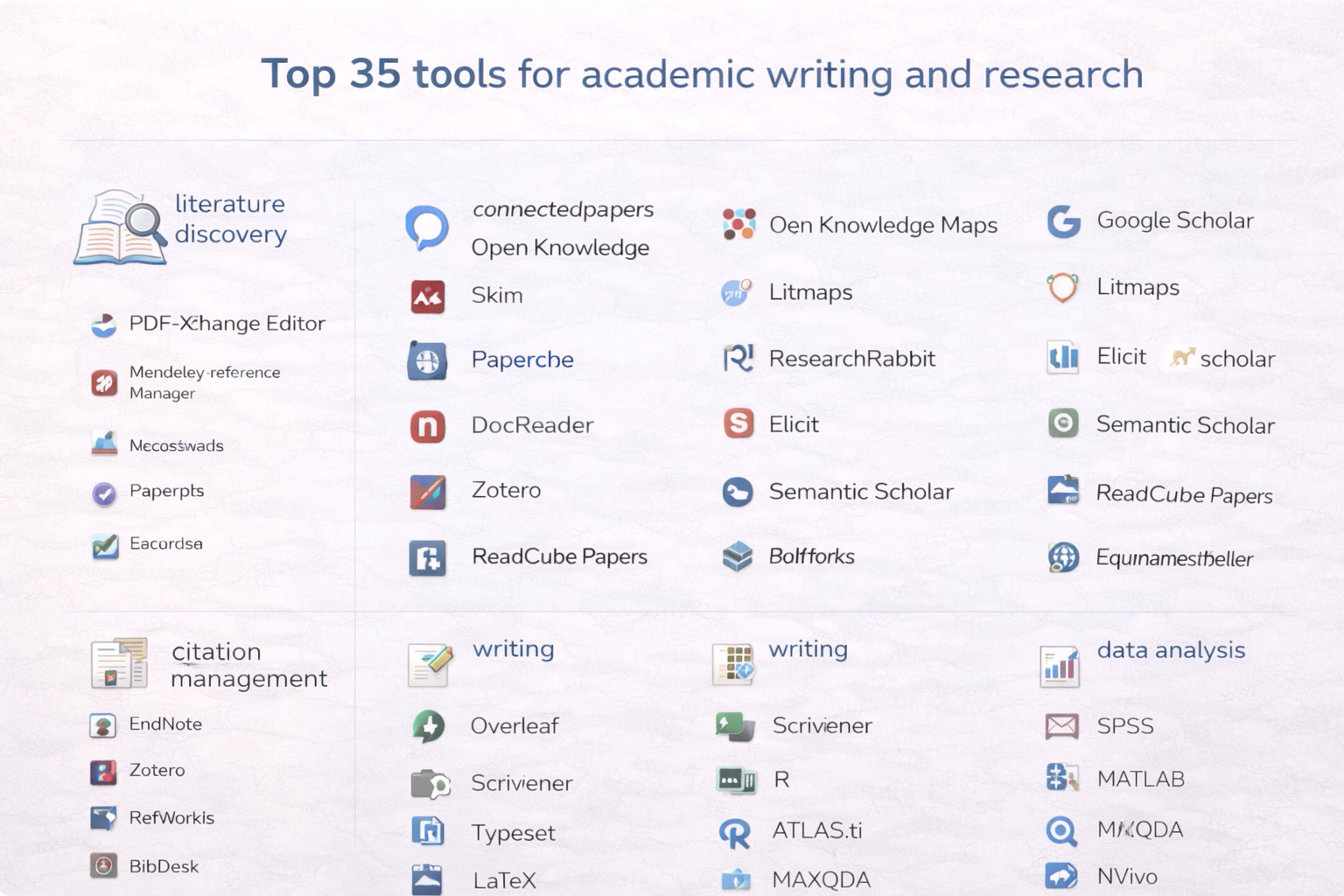
Academic writing and research are increasingly shaped by digital tools—from citation managers and PDF readers to literature mapping platforms and AI-assisted search. Yet many students still lose marks for reasons that have nothing to do with tool access: weak research questions, poor evidence integration, unclear methodology, inconsistent citations, and last-minute formatting errors. Tools do not “fix” academic quality; they support academic decisions. The difference between a high-scoring dissertation and a rushed submission is often a workflow that protects rigor, transparency, and coherence.
This guide curates and explains 35+ useful tools for academic writing and research by grouping them into the tasks students actually face: discovering sources, reading and annotating PDFs, managing citations, drafting and revising, and analysing qualitative or quantitative data. It also explains how to use these tools responsibly so your work remains academically credible and aligned with university expectations. If you want a structural overview of how research papers are assessed, start with Research Paper Structure and Format and use it as your “quality checklist” while choosing tools.

How to choose tools like an examiner: purpose, transparency, and academic ownership
Examiners reward work that demonstrates academic ownership: clear research aims, defensible methods, careful interpretation, and consistent referencing. Tools should therefore be selected based on the academic function they serve, not on hype. A citation manager supports consistency and reduces technical error; it does not replace critical reading. An AI search engine may accelerate discovery; it does not replace reproducible search strategies or careful screening decisions.
The most common student mistake is tool-driven writing: using whatever platform is available and then forcing the project to fit the tool. Academic work should be question-driven. When your workflow starts from the research question and assessment criteria, tool choice becomes straightforward. For a disciplined end-to-end quality audit before submission, use Essay Writing Checklist for Academic Success as your final review framework.
A tool is academically useful only when it strengthens evidence quality, transparency, or coherence—never when it replaces scholarly judgment.
Stage 1: Literature discovery and topic mapping
Literature discovery tools help you move beyond random Google searches and into structured scholarly exploration. Their academic value is twofold: they reduce the probability that you miss core studies, and they help you understand how debates cluster around concepts, methods, and findings. This is crucial for literature reviews, research proposals, and dissertation introductions, where examiners expect you to justify a gap and position your study in current scholarship.
However, discovery tools can also create false confidence. A visually impressive “paper map” does not guarantee that your review is comprehensive or unbiased. Treat these tools as starting points for disciplined reading and screening. If you are planning a longer project, the workflow guidance on Proposals and Coursework is useful because it emphasises structured planning before drafting.
- Connected Papers for visual paper graphs and “prior/derivative” exploration.
- Elicit for evidence-focused search, summarisation, and data extraction workflows.
- Google Scholar for baseline academic searching and citation chaining.
- Semantic Scholar for AI-supported paper discovery and metadata-rich searching.
- Litmaps for citation mapping and literature tracking over time.
In academic terms, the goal is not “more sources.” The goal is a defendable evidence base that justifies your research question and supports your argument structure. If your project is a dissertation or research paper with high methodological expectations, Dissertations and Research Papers provides a relevant reference point for what robust research workflows look like.
Stage 2: Reading, annotating, and extracting from PDFs
Students often underestimate how much time is lost to poor PDF handling. When you cannot retrieve key quotes, methods, or limitations quickly, your writing becomes vague and your referencing becomes inconsistent. Strong academic work is built on accurate extraction: you should be able to locate key definitions, measures, theoretical claims, and findings without rereading entire papers under deadline pressure.
PDF-focused tools support three academic needs: annotation, searchability, and evidence extraction. The risk is overreliance on AI summarisation, which can miss nuance or misrepresent claims. The best practice is to use AI as a navigation aid, then verify critical claims by reading the original text—especially in methodology and results sections, where small details change interpretation.
- Adobe Acrobat Reader for stable annotation and form handling.
- Zotero (built-in PDF reader) for reading, highlighting, and linking notes to citations.
- Mendeley for PDF library management, annotation, and syncing.
- ChatPDF for conversational navigation of a single PDF (verify key claims against the source).
- Anara for research discovery and reading workflows (verify against originals).
If your writing is losing marks because evidence is present but not interpreted, the problem is rarely “lack of PDFs.” It is usually weak integration: citations appear as decoration rather than as argument support. Use Essay Writing Checklist for Academic Success to diagnose whether your evidence is being used analytically rather than descriptively.
Stage 3: Citation management and reference consistency
Citation management tools are among the highest-return tools for students because they remove technical friction and reduce avoidable mistakes. Examiners often penalise inconsistent referencing, missing page numbers where required, and incorrect bibliographies—not because referencing is the “main point,” but because inconsistent citation signals weak academic discipline. Citation managers also allow you to store PDFs, tag sources, attach notes, and generate bibliographies in specific styles.
The academic risk is using citation tools mechanically without source verification. A reference manager can import incorrect metadata, broken DOIs, or incomplete author fields. Your workflow should include an explicit “metadata cleaning” step before final submission, especially for dissertations and journal-style projects.
| Tool | Best use case for students | Typical academic risk if misused |
|---|---|---|
| Zotero | Strong all-round reference management with flexible organisation, Word/Google Docs integration, and style support | Imported metadata errors if not checked, leading to incorrect bibliographies |
| Mendeley | PDF library + citation workflow, collaboration features, and Word add-in support | Library inconsistency if duplicates and metadata are not cleaned |
| Paperpile | Google Docs–centred workflows and fast reference insertion for collaborative writing | Overreliance on auto-imports without verifying source accuracy |
Table 1 should be read as an academic point: citation managers reduce errors, but they do not remove your responsibility to verify bibliographic accuracy. If your final submission needs language refinement and formatting consistency, Essay Editing Services is relevant at the polishing stage, after your argument and evidence are stable.
Stage 4: Writing and revision tools that support academic clarity
Writing tools are most academically useful when they strengthen clarity, coherence, and structure—not when they generate content without evidence. Examiners value writing that communicates a defensible argument: claims must be precise, paragraphs must be developed, and conclusions must be proportional to evidence. Grammar support can be helpful, but structure and reasoning quality matter more than stylistic polish.
A strong workflow separates drafting from editing. Drafting is where you build argument and evidence integration; editing is where you improve clarity, cohesion, and academic tone. Students often reverse this order: they obsess over wording while the logic remains unstable. If you need a reliable structure model that applies across essays and research papers, use Essay Structure Explained for University Students before you invest heavy time in language polishing.
- Grammarly for clarity and grammar support (use carefully for discipline-specific terminology).
- LanguageTool for multilingual grammar support and style consistency.
- Overleaf for LaTeX-based academic writing (common in STEM and math-heavy fields).
- Microsoft Word for track changes, styles, and submission-ready formatting.
- Google Docs for collaborative writing and version history control.
For high-stakes dissertations, clarity problems often arise from structure drift rather than grammar. If your chapters feel repetitive or unfocused, revisit your paper architecture using Research Paper Structure and Format and restructure before line-editing.
Stage 5: Data analysis tools for quantitative and qualitative research
Data analysis tools matter because they shape what claims your study can responsibly make. In quantitative research, software supports statistical testing, modelling, and reproducibility. In qualitative research, software supports systematic coding, audit trails, and rigorous theme development. Examiners penalise analysis that is either inappropriate for the data type or insufficiently explained, especially when students present results without showing how they were produced.
The key academic standard is transparency. Your methodology should allow a knowledgeable reader to understand your analytical steps, assumptions, and limitations. If you are working on a long research project with significant analysis components, Dissertations and Research Papers is relevant as a reference for how research methods and analysis are normally structured in advanced academic writing.
- SPSS for statistical analysis commonly used in social sciences.
- R for open, reproducible statistical analysis and visualisation.
- Python for data cleaning, analysis, and reproducible workflows.
- Stata for econometrics and applied statistical modelling.
- MAXQDA for qualitative coding and mixed methods workflows.
- NVivo for qualitative analysis, coding frameworks, and audit trails.
In most university contexts, your grade depends less on the software and more on methodological justification. Students sometimes choose advanced tools but fail to explain assumptions or interpretation limits, which undermines credibility. Use analysis tools to support clarity, not to replace reasoning.
Stage 6: Research integrity, reproducibility, and submission readiness
As academic expectations rise, integrity and reproducibility standards matter more. Even in undergraduate projects, examiners expect accurate citations, transparent methods, ethical awareness, and honest limitations. Tools can support these standards by helping you manage versions, document decisions, and run structured final checks. The most important principle is that integrity tools should reduce risk, not create false confidence.
For example, plagiarism checkers can help you detect accidental similarity, but they do not replace correct citation practice. Formatting tools can make references consistent, but they do not correct weak evidence use. This is why a final structured review matters. Use Essay Writing Checklist for Academic Success as your submission readiness checklist, then polish language and formatting.
| Submission failure | Tool category that helps | What a strong academic practice looks like |
|---|---|---|
| Inconsistent citations and bibliography errors | Citation manager | Use Zotero/Mendeley/Paperpile plus a final metadata audit before submission |
| Evidence present but not analysed | PDF annotation and note linking | Link notes to claims and ensure each citation has a clear argumentative function |
| Weak structure and unclear flow | Outline + checklist workflow | Rebuild structure using a research paper format guide, then revise for coherence |
| Last-minute formatting and language issues | Word processing + editing support | Apply styles consistently, run clarity edits, and consider professional editing when appropriate |
Table 2 reflects a key academic point: most “last-minute disasters” are preventable when tools are paired with a disciplined workflow. If you need careful polishing and formatting alignment after your argument is complete, Essay Editing Services is relevant for improving clarity and consistency.
A practical “35 tools” toolkit organised by academic task
Below is a curated toolkit that matches the categories shown in the image (literature discovery, PDF work, data analysis, writing support, citations, and AI search). The purpose is not to force you to use all tools, but to ensure you can select a reliable option for each task in your workflow.
- Literature discovery & mapping: Connected Papers, Litmaps, Elicit, Google Scholar, Semantic Scholar, Web of Science, Scopus
- PDF reading & annotation: Adobe Reader, Zotero, Mendeley, ChatPDF, Anara
- Citation management: Zotero, Mendeley, Paperpile, Crossref
- Writing and drafting: Word, Google Docs, Overleaf, Grammarly, LanguageTool
- Quantitative analysis: SPSS, R, Python, Stata, Excel
- Qualitative and mixed methods analysis: NVivo, MAXQDA, ATLAS.ti
- Project management & version control: Notion, Trello, GitHub, Dropbox, Google Drive
The academic aim is simple: choose a small set of tools that covers each stage of your workflow and reduces avoidable error. Tool overload often produces the opposite outcome: fragmented notes, inconsistent citations, and delayed drafting.
Responsible use of AI tools in academic work
AI tools can be helpful for navigation, brainstorming, and summarisation, but they must be used responsibly. Examiners may penalise uncritical AI use if it leads to inaccurate summaries, fabricated citations, or vague generic writing. The safest approach is to treat AI as a support layer: it can help you locate sections, generate alternative phrasings, or organise notes, but it must not replace reading, verification, and scholarly reasoning.
If your institution requires disclosure of AI tool use, comply explicitly. If it prohibits AI-generated text, use tools only for permitted support functions (such as grammar checking or reference organisation). When in doubt, prioritise transparency and academic ownership.
Top tools only matter when your workflow is academically strong
The highest-performing students are not those who use the most tools; they are those who protect the foundations: a clear research question, a defensible method, a coherent structure, and disciplined evidence integration. Tools help when they reduce friction and increase transparency. They harm when they create false confidence or replace scholarly judgment.
Build your workflow around academic standards first, then select tools that support each stage. If you want structured end-to-end support for larger projects, Dissertations and Research Papers and Proposals and Coursework provide relevant pathways for planning, execution, and revision. For final clarity and formatting alignment, Essay Editing Services supports submission readiness after your argument is complete.

Comments