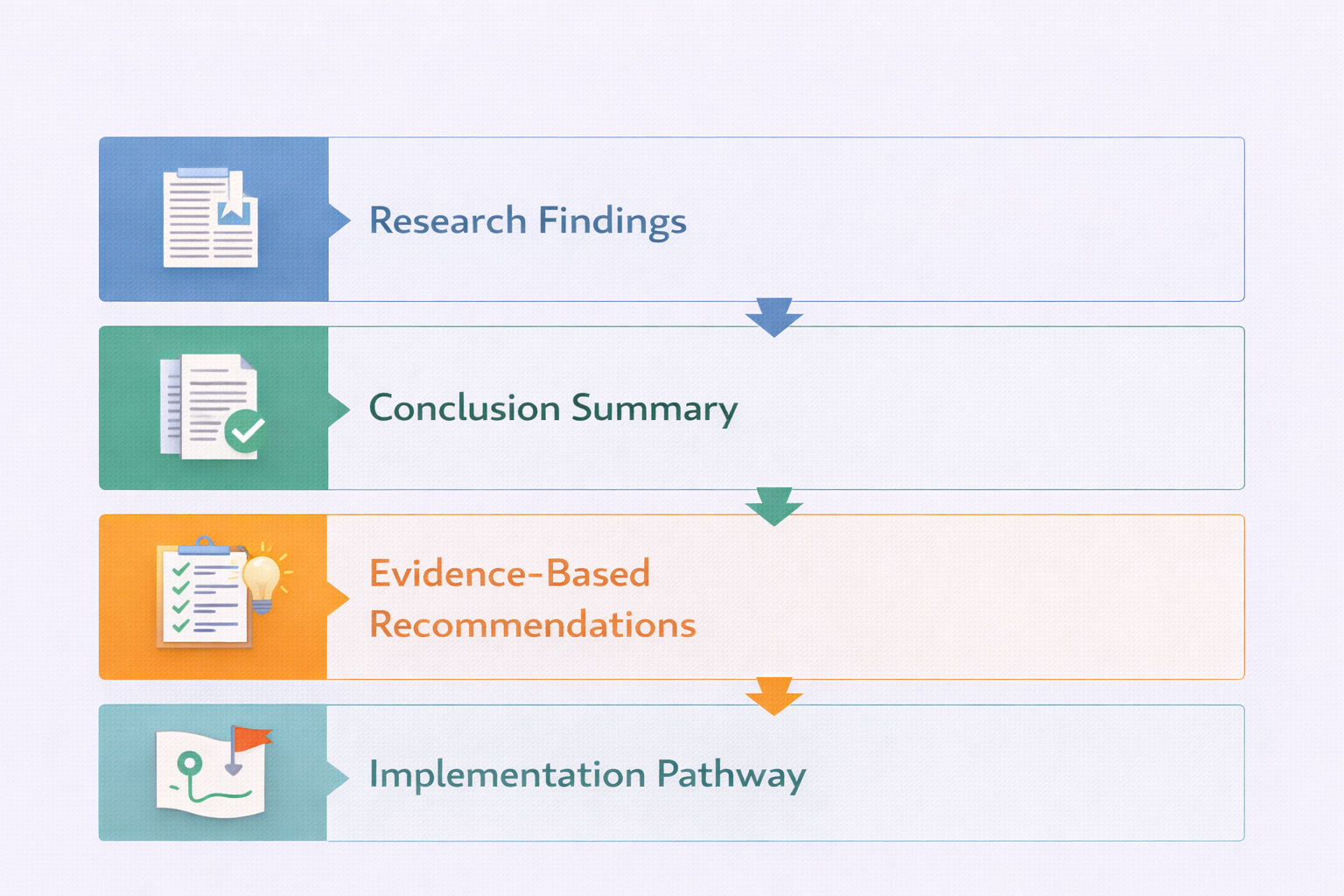
Understanding how to write conclusion and recommendations is essential for producing a strong academic report or research paper. These final sections determine how your work is remembered. A weak ending can undermine strong analysis, while a well-structured conclusion and clear recommendations demonstrate intellectual maturity, coherence, and practical insight.
Many students confuse the conclusion with the recommendations section, or repeat earlier content without adding value. Others introduce new arguments that were never discussed. This guide explains how to write conclusion and recommendations properly, ensuring logical flow, academic precision, and strong alignment with your research objectives.
The Difference Between Conclusion and Recommendations
Although closely related, the conclusion and recommendations sections serve distinct purposes. The conclusion summarises and synthesises findings. The recommendations propose actions or next steps based on those findings.
| Section | Primary Purpose | Focus |
|---|---|---|
| Conclusion | Summarise and interpret findings | What was discovered |
| Recommendations | Propose actions | What should be done |
Keeping this distinction clear prevents repetition and strengthens the final impact of your report.
How to Write a Strong Conclusion
The conclusion should not simply repeat earlier sections. Instead, it synthesises key findings and demonstrates how they answer the research question or objectives. It provides closure without introducing new evidence.
The conclusion summarises the core insights of the study without adding new data or arguments.
A strong conclusion typically includes:
- Restatement of the research aim.
- Summary of key findings.
- Overall interpretation.
- Brief statement of significance.
For example:
This study examined the impact of remote learning on student engagement. The findings revealed that structured interaction significantly improves participation, while passive lecture formats reduce engagement. Overall, the research highlights the importance of interactive design in digital education.
This example demonstrates clarity, synthesis, and academic closure.
Common Mistakes in Writing Conclusions
Students often make predictable errors when writing conclusions:
- Repeating the introduction verbatim.
- Introducing new evidence or statistics.
- Adding entirely new arguments.
- Writing overly brief summaries.
- Ending abruptly without synthesis.
A well-developed conclusion reflects analytical maturity rather than mechanical repetition.
How to Write Effective Recommendations
After the conclusion, the recommendations section translates findings into practical or academic action. Recommendations must be evidence-based and logically derived from the report’s analysis.
Every recommendation must be directly supported by findings discussed earlier.
Recommendations should be:
- Specific and actionable.
- Realistic and feasible.
- Clearly linked to findings.
- Professionally phrased.
For example, instead of writing “Improve communication,” a stronger recommendation would state, “Implement weekly cross-functional meetings to enhance internal communication and reduce project delays.”
Structuring the Recommendations Section
A structured approach improves clarity and readability. You may present recommendations in paragraph form or as a numbered list, depending on report guidelines.
- State the recommendation clearly.
- Briefly justify it based on findings.
- Indicate expected impact if relevant.
This approach ensures that recommendations remain grounded in analysis rather than speculation.
Prioritising Recommendations
In longer reports, prioritisation enhances practicality. Recommendations may be categorised into short-term and long-term actions.
| Priority | Time Frame | Action |
|---|---|---|
| High | Immediate | Revise digital learning guidelines |
| Medium | 6–12 months | Introduce interactive training workshops |
| Low | Long-term | Develop advanced online engagement tools |
Prioritisation demonstrates strategic thinking and practical awareness.
Balancing Academic and Practical Recommendations
In research-based dissertations, recommendations often include suggestions for future research. These may involve methodological improvements, expanded samples, or alternative theoretical approaches.
In professional or consultancy reports, recommendations focus more on policy changes, organisational improvements, or operational strategies. Tailoring the recommendations to the purpose of the assignment ensures relevance.
Writing Style and Tone
The tone of both the conclusion and recommendations must remain formal, objective, and concise. Avoid emotional language or exaggeration. Maintain academic authority by using clear, direct phrasing.
Examples of effective wording include:
- It is recommended that the organisation implement...
- The findings suggest prioritising...
- Future research should examine...
Professional tone reinforces credibility and scholarly maturity.
Ensuring Logical Flow Between Conclusion and Recommendations
The transition between conclusion and recommendations should feel natural. The conclusion summarises what has been learned, and the recommendations build directly upon those insights. This sequential flow strengthens coherence.
For example, if the conclusion identifies weaknesses in employee training, the recommendations should logically address training improvement rather than introducing unrelated issues.
Mastering How to Write Conclusion and Recommendations
Learning how to write conclusion and recommendations effectively requires clarity, logical structure, and analytical discipline. The conclusion synthesises findings and provides closure. The recommendations translate evidence into actionable steps.
When written thoughtfully, these final sections reinforce the strength of the entire report. They demonstrate not only understanding of the research topic but also the ability to apply knowledge strategically. Mastery of conclusion and recommendation writing enhances academic performance and prepares students for professional reporting environments.
Comments